

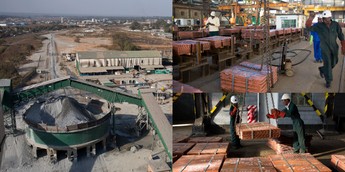

- Foreign Miners Dominate Zambia’s 271,742-Tonne Duty-Free Copper Export Window
Middle Eastern and Chinese-backed mining companies have secured the largest share of Zambia’s temporary duty-free copper concentrate export quota, underlining the continued influence of foreign capital in one of Africa’s most important mineral economies.
Zambia, Africa’s second-largest copper producer, has extended the suspension of a 10 percent export duty on copper concentrates until September 30, allowing selected miners to export a combined 271,742 metric tonnes of copper concentrates without paying the levy.
The move is designed to ease pressure on mining companies facing processing bottlenecks caused by prolonged maintenance and repair works at key smelters. Without the temporary waiver, authorities risked a build-up of unprocessed copper concentrates that could have disrupted mine operations and output.
The largest allocation went to Mopani Copper Mines, which received a 100,000-tonne duty-free export quota. Mopani is partly owned by Abu Dhabi-based International Resources Holding and Zambia’s state mining investment firm, ZCCM-IH, highlighting the growing role of Gulf capital in Zambia’s copper industry.
Barrick Mining’s Lumwana Mining Company secured the second-largest allocation at 56,986 metric tonnes, while Chinese-owned Nkana Mining and Minerals Processing received about 43,000 tonnes. Canada’s First Quantum Minerals also received a similar allocation of about 43,000 tonnes.
Other beneficiaries include Lubambe Copper Mine, which is 70 percent owned by China’s JCHX Mining and secured a 15,000-tonne quota, and Konkola Copper Mines, controlled by Vedanta Resources, which received 12,541 tonnes.
Zambia introduced the export duty on copper concentrates to encourage local processing and retain more value from its mineral resources. But technical constraints and smelter disruptions have forced the government to temporarily relax the policy in order to keep mines operating and protect production.
The latest allocations show the tension facing many resource-rich African economies: the desire to deepen domestic value addition while remaining dependent on foreign-owned mining companies and external capital for production, financing and operational continuity.
For Zambia, the stakes are high. The country exported 890,346 metric tonnes of copper in 2025 and is targeting annual production of 3 million tonnes by 2031, as global demand for copper rises on the back of power grid expansion, electric vehicles and renewable energy infrastructure.
The duty suspension gives miners short-term relief, but it also exposes the fragility of Zambia’s mineral beneficiation strategy. If local smelting capacity cannot keep pace with production, the government may be forced into repeated exemptions that weaken the original objective of capturing more value domestically.
The development also points to a broader geopolitical shift in Africa’s critical minerals sector. Gulf investors, Chinese state-linked companies, Canadian miners and Indian-backed firms are all competing for exposure to copper assets at a time when the metal has become central to the global energy transition.
For now, Zambia’s priority is to avoid production disruption and preserve export earnings. But the longer-term test will be whether the country can convert its copper wealth into deeper local processing capacity, stronger state revenues and more domestic industrial value.
Without that, the latest duty-free export window may solve an immediate smelter problem while reinforcing the same structural weakness Zambia is trying to escape: exporting minerals faster than it can process them at home.

