

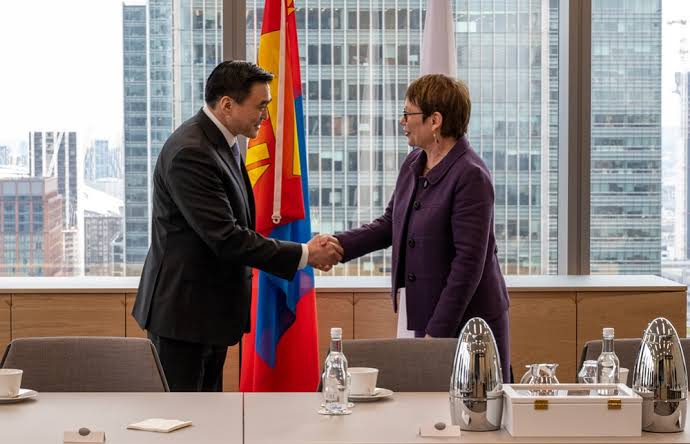

- From Beneficiary to Donor: Mongolia Joins World Bank’s IDA Coalition
Mongolia’s decision to become a donor to the World Bank Group’s International Development Association is more significant than the size of its contribution might suggest. The MNT4.8 billion, equivalent to approximately US$1.3 million, approved by its parliament represents a reversal of roles: a country that once relied on concessional development finance is now helping to provide it to others.
The transition offers a compelling measure of development progress. Mongolia joined the World Bank Group in 1991 and has since received more than US$1.62 billion in development financing. That support extended across transport, rural development, healthcare and education, sectors that helped the country build the physical and human foundations required for economic advancement.
In July 2020, Mongolia graduated from IDA eligibility and became a client of the International Bank for Reconstruction and Development alone. Four years later, it attained upper-middle-income status after tripling per-capita gross domestic product and making substantial progress in reducing poverty over three decades.
“Mongolia’s contribution to IDA21 marks an important milestone in our longstanding partnership with the World Bank and reflects our commitment to international solidarity,” Finance Minister Mendsaikhan Zagdjav said.
“Having benefited firsthand from IDA’s support, we recognise the vital role of concessional financing in helping countries reduce poverty, build resilience and expand opportunities,” the minister said. “As we continue to advance Mongolia’s own development priorities, we are proud to support other countries in pursuing theirs.”
The announcement presents development finance not simply as a transfer from permanently wealthy nations to permanently poor ones, but as a revolving expression of solidarity. Countries can receive support during periods of limited fiscal capacity, use that assistance to develop institutions and productive assets, and eventually contribute to the same mechanism that supported their progress.
That is the deeper importance of Mongolia’s US$1.3 million pledge. Measured against the financial requirements of 78 IDA-eligible countries, the amount is modest. Measured against the country’s position in 1991 and the symbolism of moving from beneficiary to donor, it carries considerable weight.
IDA provides grants and highly concessional financing to low-income countries that often have restricted access to affordable international capital. Its resources support governments facing extreme poverty, weak infrastructure, climate shocks, conflict, debt distress and fragile public institutions.
Unlike conventional commercial borrowing, IDA financing is designed to accommodate the limited repayment capacity of poorer economies. This allows governments to invest in schools, hospitals, roads, agriculture, electricity and institutional reform without immediately assuming the financing costs associated with commercial debt.
The fund is replenished every three years. IDA21, concluded in December 2024, is currently financing operations across 78 countries. Each new donor broadens the political and financial coalition supporting that work, particularly at a time when development needs are rising while aid budgets in several traditional donor economies face pressure.
Lisa Finneran, World Bank Vice President for Partnerships, Innovation and Mobilisation, described Mongolia’s entry into the donor community as evidence of what sustained development progress can achieve.
“Mongolia’s rise shows what development progress can make possible,” she said. “We are delighted to welcome Mongolia to the IDA donor community and grateful for its commitment to helping other countries build a more prosperous future.”
Mongolia’s experience nevertheless should not be reduced to a simple success narrative. Tripling income per person and reaching upper-middle-income status do not eliminate domestic inequality, exposure to external shocks or unfinished development needs. Graduation from concessional finance can itself create pressure as countries gain access to larger pools of capital but on less generous terms.
The government’s decision to contribute while continuing to pursue its own development priorities is therefore a statement about responsibility rather than abundance. Donor status does not mean Mongolia has solved every economic or social challenge. It means the country believes its progress has created sufficient capacity to help others confronting more severe constraints.
There is also a lesson for governments that receive concessional finance. Development assistance produces its strongest legacy when it builds systems that ultimately reduce dependence on assistance. Roads must connect producers to markets; education spending must expand productive skills; health investment must strengthen the workforce; and institutional reforms must improve how public resources are managed.
The US$1.62 billion Mongolia received since 1991 should consequently be judged not only by the projects it financed, but by whether those investments contributed to the country’s ability to graduate and participate as a donor. The latest decision suggests that at least part of that long-term objective has been achieved.
For the World Bank, Mongolia’s accession to the donor group strengthens the argument that IDA can support durable transitions. It supplies a tangible example for existing beneficiaries: concessional finance need not define a country’s permanent relationship with the international development system.
The development path, however, is rarely linear. Commodity-price movements, climate events, fiscal pressures or governance weaknesses can reverse hard-won gains. Mongolia’s donor contribution should therefore coexist with policies that protect its domestic progress, diversify its economy and ensure growth continues to reach citizens beyond headline income classifications.
The parliamentary approval is especially important because it gives the contribution democratic and fiscal legitimacy. International commitments ultimately involve public resources. Legislative backing indicates that Mongolia’s support for IDA is not only an executive decision but a recognised element of the country’s international role.
It also expands the meaning of international solidarity. Emerging and recently graduated economies bring more than money to development institutions. They contribute experience gained from managing transitions, implementing projects and balancing domestic priorities with the conditions attached to external financing.
The ultimate value of Mongolia’s decision will not be captured by comparing US$1.3 million with the billions required across IDA countries. Its importance lies in the direction of travel. After receiving more than US$1.62 billion since 1991, Mongolia is returning part of the opportunity it received to the international system.
That is both a development milestone and a test. Mongolia must preserve its progress while demonstrating that graduation can produce solidarity rather than disengagement. For IDA, the contribution is proof that successful development partnerships can eventually create new partners.

