

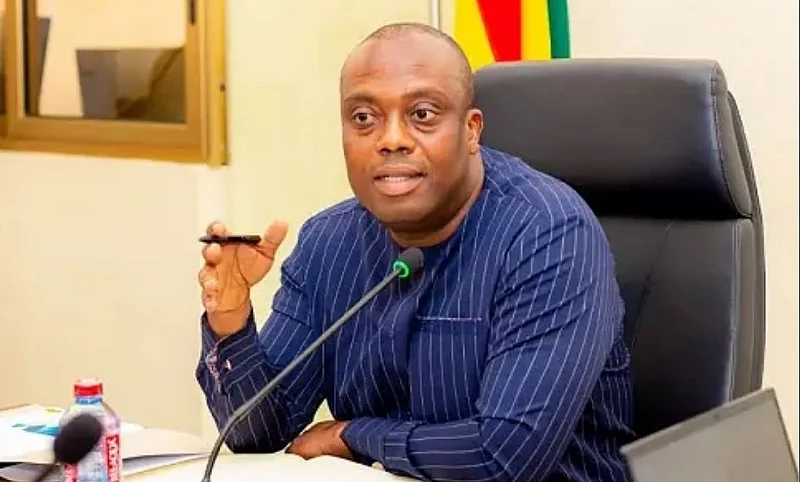

- From Recovery to Resilience: Ghana Urged to Strengthen Buffers, Exports and Private-Sector Capacity — Ampem
Ghana’s economic recovery should not be judged solely by the speed at which inflation falls, the cedi stabilises or fiscal balances improve, but by whether the country can withstand the next major shock without sliding back into debt distress and macroeconomic instability, Deputy Finance Minister Thomas Nyarko Ampem has warned.
His intervention goes to the heart of Ghana’s recurring economic dilemma. Periods of relative stability have repeatedly been interrupted by commodity-price shocks, global financial tightening, currency pressures and domestic fiscal imbalances that expose structural weaknesses beneath otherwise improving headline indicators.
Ampem is therefore calling for a shift from repeatedly repairing the economy after crises to deliberately building one capable of absorbing disruption. “Ghana must build an economy that can withstand future shocks,” he said.
That distinction between recovery and resilience is important for investors and policymakers alike. Recovery can restore indicators damaged during a crisis, but resilience requires institutions, public finances and productive sectors strong enough to absorb future disruptions without forcing government into emergency borrowing, abrupt expenditure cuts or another stabilisation programme.
Ghana’s latest crisis demonstrated how quickly fiscal deterioration can spread across the economy. Pressure on public finances fed into debt distress, foreign-exchange shortages, currency depreciation, inflation and weakening investor confidence, showing that vulnerabilities in one part of the system can quickly become economy-wide problems.
The objective of the current recovery must therefore be more ambitious than simply returning Ghana to the conditions that existed before the crisis. If those conditions themselves contained structural weaknesses, restoring them would merely recreate the foundations for another period of instability.
One of those vulnerabilities is Ghana’s dependence on a relatively narrow group of export commodities, particularly gold, cocoa and oil. Strong commodity prices can improve export receipts, government revenues and the balance of payments, but the concentration leaves the economy exposed when global prices or production conditions move in the opposite direction.
Diversification is therefore not simply an industrial-policy ambition. It is part of macroeconomic risk management.
A more resilient Ghanaian economy would need to generate foreign exchange from a broader base of competitive industries while reducing dependence on imports that place pressure on the cedi whenever external financing conditions tighten. Manufacturing, agro-processing, services and higher-value exports would have to play a larger role alongside the country’s traditional commodities.
That does not require Ghana to retreat from its natural-resource advantage. The more important question is how much domestic value the economy captures before those resources leave the country.
Gold, cocoa and oil can provide stronger foundations for resilience if revenues are used to finance infrastructure, skills, technology and productive capacity rather than being absorbed primarily by recurrent expenditure. Greater domestic processing can also create employment and industrial linkages that continue generating value even when commodity prices weaken.
Fiscal discipline remains the first line of defence. When government enters a crisis with high deficits, heavy refinancing needs and limited reserves, even a temporary external shock can quickly become a systemic problem.
Ampem’s argument should therefore be understood partly as a call to build buffers during good economic periods. Fiscal space created during recovery needs to be preserved so government can respond to the next downturn without immediately destabilising debt dynamics.
That means stronger revenue administration, disciplined expenditure and better selection of capital projects. It also means resisting the temptation to treat improved revenues or favourable commodity prices as permanent fiscal space for new recurrent commitments.
The same principle applies to external buffers. Stronger reserves and a more diversified export base can give the Bank of Ghana greater room to absorb temporary foreign-exchange shocks without relying excessively on emergency intervention or allowing disorderly currency adjustments.
The private sector must also become a larger shock absorber. Competitive domestic businesses can generate exports, taxes and employment while reducing the state’s burden during periods of stress.
That places renewed emphasis on the business environment. Reliable electricity, efficient ports, affordable long-term finance, predictable taxation, digital infrastructure and transparent regulation are not simply conveniences for businesses; they determine whether Ghanaian firms can compete regionally and internationally.
If companies remain highly dependent on imported inputs and short-term expensive credit, currency depreciation will continue to transmit global shocks directly into production costs and consumer prices. Greater domestic productive capacity can weaken that transmission channel.
The deeper objective should therefore be to create an economy in which production and productivity expand faster than vulnerability.
Headline statistics remain important, but they do not provide a complete picture of resilience. Inflation, GDP growth, reserves and the exchange rate can improve even while structural weaknesses remain beneath the surface.
The more demanding questions are whether productivity is increasing, exports are becoming more diversified, manufacturing is expanding and businesses are investing. Policymakers must also ask whether fiscal space is being rebuilt, young people are entering productive employment and households are becoming less vulnerable to future inflationary shocks.
These indicators move more slowly than the headline numbers, but they are ultimately more important in determining whether the next shock produces temporary disruption or another national economic crisis.
Climate change adds another layer of risk. Agriculture, infrastructure and energy systems are increasingly exposed to extreme weather, while geopolitical tensions and global trade fragmentation can disrupt commodity markets and capital flows even when domestic policy remains sound.
Resilience therefore requires more than fiscal buffers. It also demands stronger energy security, food systems, climate adaptation, financial-sector safeguards and institutions capable of responding quickly when conditions change.
Policy consistency will be equally important. Long-term productive investment becomes more difficult when businesses expect major changes in taxation, regulation or industrial policy after every election.
Building resilience therefore requires economic strategies capable of surviving political cycles. Investors need confidence that the fundamental direction of policy will remain predictable even when governments change.
Ghana’s recovery should consequently be treated as a foundation rather than a destination. The real test will come when the next major external or domestic shock arrives.
Success will not be measured simply by whether inflation has fallen or the cedi has strengthened before that moment. It will be measured by whether Ghana can absorb the shock without returning to the familiar cycle of emergency borrowing, currency stress, debt distress and painful adjustment.

