


- From Scattered Projects to National Priorities: Mahama Resets Ghana’s Philanthropy Strategy
President John Dramani Mahama has reaffirmed the Millennium Development Authority as the government’s principal coordinating institution for philanthropic, grant-based and humanitarian partnerships, arguing that Ghana must move away from fragmented development interventions towards support aligned with clearly defined national priorities.
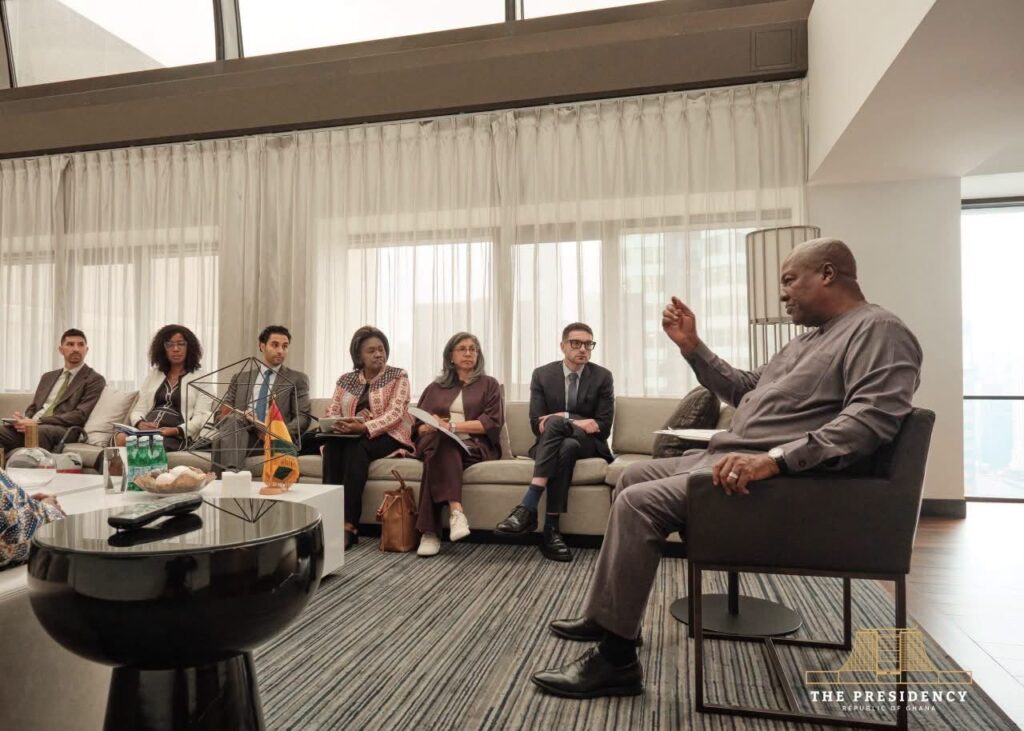
He made the comments during a courtesy call by Alex Soros, Chairman of the Open Society Foundations, in New York on the margins of the 81st United Nations General Assembly.
The meeting formed part of Ghana’s broader engagement with international foundations and development partners as the government seeks more coordinated and sustainable forms of external support.
“Let’s sit with our partners, agree what the priorities are for each country,” President Mahama said, setting out the philosophy behind the arrangement.
His argument is that philanthropic organisations may arrive with legitimate interests in health, women’s empowerment, environmental protection or other areas, but without stronger coordination those interventions can become dispersed across sectors and institutions.
The government therefore wants development partners to engage around a common national framework rather than pursue isolated projects that may not correspond with Ghana’s most pressing priorities.
The approach builds on a formal decision taken in September 2025, when President Mahama designated MiDA as the government’s primary focal institution for coordinating philanthropic and grant-based partnerships.
MiDA said at the time that the expanded role would include aligning such support with national development priorities, managing secured grants and working with the Ministry of Finance and relevant sector institutions to unlock financing opportunities.
The designation specifically contemplated engagement with organisations including the Open Society Foundations, the Gates Foundation and Mastercard Foundation.
Mahama said MiDA was selected because many philanthropic programmes cut across several ministries and agencies, making them vulnerable to institutional duplication and bureaucratic delay. “MiDA is supposed to crosscut and look at all that,” he said, referring to grants and other support being developed with international partners.
The authority’s experience managing complex multi-sector programmes was central to the decision to use it as a coordinating platform rather than create another institution.
MiDA was originally established by Parliament to implement Ghana’s programmes under the Millennium Challenge Account and has since evolved into a broader national development delivery institution.
Its current mandate includes overseeing and implementing programmes financed by the Government of Ghana and development partners, while its leadership says the institution is increasingly being positioned to mobilise public, private and philanthropic capital for national projects.
The authority also describes itself as a delivery partner for government initiatives including the 24-Hour Economy.
The shift reflects a deeper change in how the Mahama administration says Ghana should relate to development partners. Rather than viewing philanthropy simply as an additional source of money, the government wants grants and social investment to fit into national development plans and measurable delivery structures.
That approach also creates a clearer accountability question: whether resources attracted through global foundations ultimately produce outcomes consistent with the priorities for which they were mobilised.
The meeting with Mr Soros also connected the MiDA strategy to President Mahama’s broader Accra Reset agenda.
At a separate Open Society Foundation roundtable in New York, the President argued that the global development system is being disrupted by debt pressures and wider changes in the international order, but said that disruption also creates room for new ideas and partnerships.He stressed that countries such as Ghana must use those partnerships to create jobs, improve public services, build infrastructure and expand opportunity, particularly for young people.
That theme is also central to the Accra Reset’s push for greater African agency in development and health financing.
Mahama has argued that political independence has not always translated into control over the institutions and financing structures that shape development outcomes, and has called for a move away from excessive aid dependence towards stronger domestic capacity and more balanced international partnerships. The
Presidency has framed the initiative as one aimed at greater self-reliance without abandoning international cooperation.
The President also stressed that greater African self-reliance must be accompanied by stronger governance, transparency, accountability and prudent management of domestic resources.
That qualification is important because directing more development financing through national institutions places greater responsibility on governments to demonstrate that funds are properly allocated, monitored and evaluated.
MiDA’s value proposition will therefore depend not only on its ability to attract partners but on whether it can preserve the fiduciary discipline and delivery standards on which its expanded mandate is based.
Mr Soros, for his part, pointed to potential areas for further collaboration around financing reforms, regional security and engagement through the G20 platform.
Those discussions suggest the relationship could extend beyond conventional grant funding into wider questions about how Ghana and other African states gain greater influence over global financing and development architecture. No specific new funding package was announced from the meeting.
For Ghana, the strategic proposition is clear: international philanthropy should supplement national development plans rather than become a collection of disconnected projects driven principally by external institutional preferences.
Centralising coordination through MiDA could help government identify overlaps, reduce duplication and direct grants towards priority sectors, but it will also make the authority more consequential in deciding which partnerships proceed and how resources are channelled.
That increases the importance of transparent selection, reporting and performance measurement.
Mahama’s engagement with Mr Soros therefore goes beyond one meeting with a major global foundation. It represents an attempt to reorganise how Ghana receives and manages philanthropic capital, placing national priorities at the centre while retaining access to international expertise and finance.
The test will be whether MiDA can turn that coordinating mandate into fewer fragmented interventions, stronger accountability and development projects whose impact is visible beyond the size of the grants attracted.

