

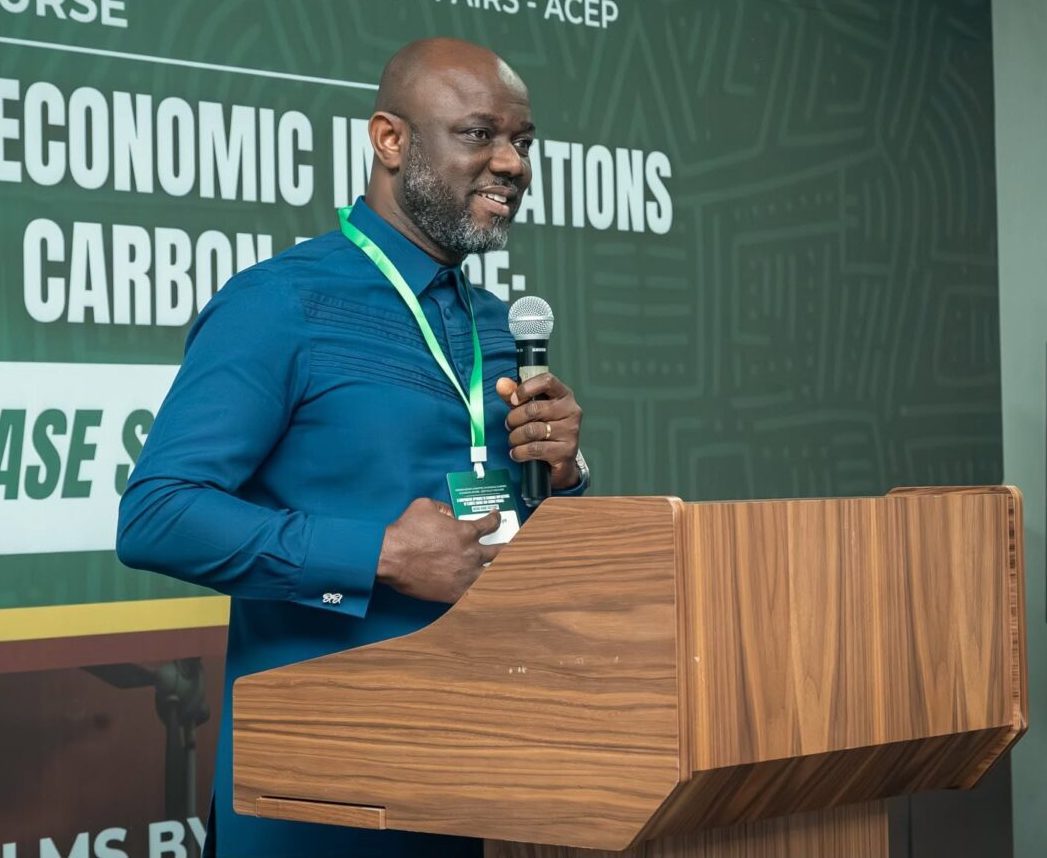

- Ghana Must Reopen IPP Contracts and Examine How Power Plants Were Priced — ACEP’s Ben Boakye
Ghana should use the bribery conviction connected to the AKSA Enerji power project as the starting point for a far-reaching examination of how the country procures electricity, values generation plants and enters long-term contracts with Independent Power Producers, according to Benjamin Boakye, Executive Director of the Africa Centre for Energy Policy.
Speaking to NorvanReports, Mr Boakye argued that the immediate significance of the Asante Kwaku Berko case should not be reduced to the criminal conduct established in the United States. For Ghana, he said, the more consequential question is whether agreements that emerged from a procurement environment now clouded by evidence of bribery were themselves economically sound, competitively priced and structured in the country’s long-term interest.
His starting point is uncompromising: where credible evidence raises serious questions about corruption around the procurement of a major power project, government cannot simply treat the criminal conviction as an isolated matter involving individuals while leaving the underlying commercial arrangements untouched.
“I think it is so evident that you have such a scale of bribery and corruption in our power system. Any sensible approach requires that you pause and investigate and look into it,” Mr Boakye said.
In his assessment, that review should go beyond AKSA itself. The Ministry of Energy, the Office of the Special Prosecutor and the Attorney-General should examine how affected agreements were negotiated, what assumptions informed the pricing, how the plants were procured and whether Ghana obtained value commensurate with the long-term financial obligations it accepted.
Mr Boakye’s argument is that the Berko conviction has created an opportunity to revisit questions ACEP has raised for years about Ghana’s Independent Power Producer agreements. Those questions concern not only corruption but the deeper economic architecture of the contracts: why particular capacity was contracted, how much Ghana needed, what assets cost, whether the pricing was justified and whether the wider power system had the ability to use the electricity being purchased.
“We have had no doubt in our minds since 2015, and when you track all the writings, all the publications we’ve done on some of these IPPs, we have always been worried about how these contracts were signed, and we knew something was wrong,” he said.
At the centre of Mr Boakye’s analysis is a distinction that has often been lost in Ghana’s debate over electricity contracts. He does not regard take-or-pay agreements, by themselves, as the fundamental problem confronting the power sector.
“Take-or-pay for me has never been a problem. It’s how we plan our systems to be able to use it,” he said.
That distinction materially changes the policy conversation. Under a take-or-pay arrangement, Ghana may be obliged to pay for agreed capacity whether or not all of that electricity is ultimately consumed. Such structures can be commercially understandable because power producers invest capital on the basis that sufficient revenue will exist to recover construction, financing and operating costs.
For Mr Boakye, the failure occurs when the country signs for generation capacity without ensuring that the electricity can actually move through the transmission and distribution networks, reach customers and generate sufficient revenue to pay the producer. In that situation, what may have been a commercially rational contractual structure becomes an expensive liability because the state has failed to plan the entire electricity value chain.
“So, when you have excess power or there’s a problem somewhere that we can’t use the power, and you still have to pay, that becomes a problem,” he said.
His argument therefore challenges the temptation to locate Ghana’s power-sector difficulties exclusively at the generation end of the system. The real weakness, he said, has been fragmented planning across generation, transmission, distribution and revenue collection.
“Our challenge as a country has been planning to make sure that the generation we actually sign up, we can actually use them,” Mr Boakye said.
That has profound implications for how Ghana should think about future power procurement. A government cannot evaluate a new power plant merely by asking whether the country may require additional megawatts. It must determine whether transmission infrastructure can evacuate the electricity, whether distribution networks can deliver it efficiently, whether customer demand is sufficient and whether the revenue system can convert that demand into cash available to pay generators.
Without that integrated approach, Ghana can technically have electricity and financially be unable to afford it at the same time. It can contract generation capacity in the name of solving shortages, only to discover that other weaknesses within the power chain prevent the electricity from being economically utilised.
Mr Boakye’s position is that this is precisely why the AKSA controversy should trigger a wider review rather than a narrow investigation focused only on bribery. If Ghana is already struggling financially to sustain existing IPP obligations, then any evidence suggesting that some contracts may not have been optimally negotiated becomes economically significant.
“We have recently been struggling to even engage these IPPs to give us significant haircut that keeps the sector afloat. So, this is, for me, a major opportunity to go back and look at how these contracts could have been optimised,” he said.
For Mr Boakye, the logic is straightforward. Ghana should not be asking private power producers to reduce obligations today without simultaneously examining how those obligations arose, whether the underlying assumptions were credible and whether opportunities existed at the time of contracting to secure better commercial terms.
The review he is proposing would therefore have to be forensic as well as financial. Authorities should establish where particular plants were sourced, the actual acquisition cost of the equipment, the financing assumptions underlying the projects and how those figures ultimately translated into the tariffs and capacity obligations imposed on Ghana.
This question of plant valuation is especially important to his argument. If a generating asset entered Ghana under an emergency arrangement, policymakers should be able to demonstrate how its value was determined and why the commercial structure represented a reasonable response to the electricity problem Ghana faced at the time.
Emergency conditions, in Mr Boakye’s analysis, should not become an exemption from economic scrutiny. The fact that a country urgently requires electricity does not eliminate the need to establish whether the technology, capital cost and contractual obligations attached to a project are proportionate to what is being delivered.
That point matters because the financial consequences of power procurement extend far beyond the government that signs the contract. Long-term generation agreements can survive several administrations, meaning errors made under emergency pressure can continue appearing years later in electricity-sector arrears, fiscal transfers, tariff pressures and negotiations with IPPs.
Mr Boakye’s concern is therefore fundamentally intergenerational in commercial terms. A minister may approve capacity to resolve an immediate crisis, but the payment commitments can remain on the public balance sheet long after the political urgency that produced the contract has disappeared.
This is why his critique of take-or-pay arrangements is more nuanced than simply calling for their abolition. If Ghana genuinely needs a plant and can utilise the electricity, a take-or-pay commitment can give an investor the revenue certainty necessary to mobilise financing and construct generation capacity.
The problem is contracting first and attempting to build the rest of the system around the agreement afterwards. If generation outruns demand, transmission investment, distribution efficiency or revenue mobilisation, the country ends up purchasing financial obligations rather than economically useful electricity.
That distinction also explains why Mr Boakye believes Ghana must examine the whole electricity value chain when deciding whether capacity is excessive. Installed generation on paper is not the same as power that can be reliably dispatched, transmitted, distributed, consumed and paid for.
A power plant can be available while bottlenecks elsewhere make part of its output commercially unusable. If the contract nevertheless requires payment, the system incurs a cost without receiving the full economic benefit that should accompany it.
For Mr Boakye, therefore, Ghana’s recurring power-sector financial problems are partly the consequence of treating generation procurement as separate from system planning. The country has repeatedly concentrated on securing megawatts while failing to ensure that the supporting infrastructure and commercial architecture can absorb them.
The Berko case now gives government an unusually strong reason to reopen that history. Mr Boakye is not arguing that evidence of bribery automatically proves every commercial provision in the AKSA agreement was defective, nor that every IPP contract is tainted. His case is that such serious evidence removes any justification for avoiding a rigorous examination of whether Ghana obtained fair and competitive terms.
That review, he argues, should answer basic but consequential questions. What was Ghana’s actual demand outlook when the contracts were approved? What capacity was already available? What additional capacity was genuinely needed? What did the plants cost? How were the tariffs determined? What risks were transferred to the investor and what risks remained with the state?
Those questions matter because a contract can be legally valid and still be economically inefficient. It can also deliver electricity while imposing a structure that makes the broader sector financially unsustainable.
Mr Boakye’s intervention therefore shifts the discussion away from the simplistic choice between honouring contracts and repudiating them. His argument is instead for evidence-based renegotiation where the facts justify it, particularly when government is already engaging IPPs over measures intended to reduce the financial pressure on the sector.
The objective, as he frames it, should be optimisation rather than arbitrary cancellation. Ghana must understand what it contracted, why it contracted it and whether the commercial assumptions remain defensible before determining how individual agreements should be treated.
That is also why he regards the present moment as an opportunity rather than simply another scandal. If authorities conduct a serious review, the Berko case could force Ghana to confront structural weaknesses in power procurement that have survived changes of government.
The alternative is to prosecute individuals while leaving untouched the institutional conditions that allowed questionable commercial arrangements to emerge. For Mr Boakye, that would address the symptom while preserving the vulnerability.
His wider argument to NorvanReports is that Ghana’s electricity problem cannot ultimately be solved by accumulating generation contracts. The country needs a power system in which every additional megawatt is connected to a credible plan for transmission, distribution, demand and revenue recovery.
That requires discipline before contracts are signed rather than negotiations to escape their consequences years afterwards.
The central lesson from the AKSA controversy, in Mr Boakye’s assessment, is therefore not that take-or-pay agreements are inherently wrong. It is that no contract structure can rescue poor planning.
If Ghana contracts electricity it cannot transmit, distribute, consume or pay for, the cost eventually returns to government and the wider economy. And if questions subsequently emerge about how those contracts were procured or priced, the country has an obligation to investigate not only who may have acted improperly, but whether the economic bargain itself was ever in Ghana’s interest.

