

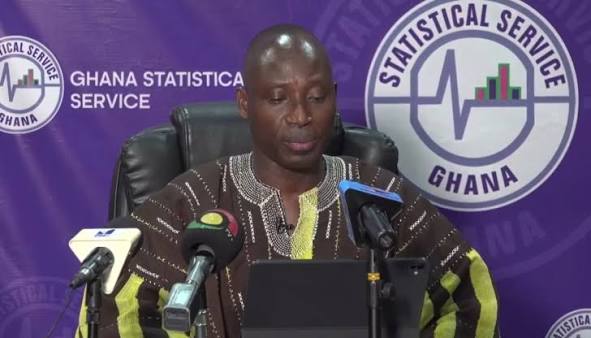

- Services Keep Ghana’s Recovery on Track as May Economic Activity Grows 5.10%
Ghana’s economy expanded by 5.10% year-on-year in May 2026, extending the country’s recovery as services remained the principal engine of economic activity while agriculture lost momentum.
The latest Monthly Indicator of Economic Growth from the Ghana Statistical Service shows that the economy maintained positive growth after expanding 4.70% in April, suggesting activity strengthened modestly in May even as performance remained uneven across sectors.
The monthly figures provide an early indication of the direction of quarterly gross domestic product and are particularly useful in identifying changes in economic momentum before the full national accounts are released. GSS describes the MIEG as a high-frequency indicator designed to track economic performance on a monthly basis.
The May performance continues a relatively strong start to 2026. Ghana’s economy expanded 6.40% in the first quarter, slightly above the 6.20% recorded during the corresponding period of 2025. Services grew 7.10% during the quarter and accounted for 48.30% of overall GDP growth, making it the largest contributor to the expansion.
Information and communication was one of the strongest-performing areas, expanding 25.20% during the first quarter, while transport and storage grew 13.00% and trade advanced 9.00%. Industry also recorded strong growth of 6.90%, supported particularly by mining and quarrying, which increased 10.70%.
The continued strength of services in May therefore reinforces a pattern already visible in the quarterly data.
For Ghana, that is economically significant because services now account for a large share of output and employment, with activity across telecommunications, finance, commerce, transport and professional services increasingly determining the pace of overall economic expansion.
But the slowdown in agriculture introduces an important weakness.
Agriculture grew 4.00% in the first quarter, considerably below the pace recorded in several services and industrial activities. Crop production expanded 4.70%, but the fishing subsector contracted sharply by 18.50%, illustrating the uneven performance within the sector.
Slower agricultural momentum matters beyond its direct contribution to GDP. Agriculture remains central to rural incomes, employment, food supply and inflation. Weak production can therefore affect the economy through several channels at once, reducing household incomes in farming communities while increasing the risk of shortages and higher food prices.
That becomes particularly important even as Ghana’s broader inflation environment has improved significantly.
Headline inflation stood at 3.70% in May, compared with 3.40% in April, but remained substantially below the 18.40% recorded a year earlier. Food inflation rose to 3.30%, with the Ghana Statistical Service pointing to domestic supply conditions as an important influence on prices.
The combination of strong services growth and weaker agriculture therefore points to a broader question about the quality of Ghana’s economic recovery.
A growing services economy can support higher-value activity, digitalisation and formal-sector employment, particularly where expansion is concentrated in information technology, finance and transport.
But sustainable growth will also require stronger productivity in agriculture and manufacturing if the recovery is to generate broad employment, contain food inflation and reduce dependence on imported goods.
The monthly data should also be interpreted cautiously. The MIEG is an indicator of economic activity rather than a replacement for quarterly GDP. Monthly growth can fluctuate considerably as production, commodity exports and sector-specific conditions change.
That volatility has already been visible during 2026. Economic activity expanded 6.10% in January, accelerated to 7.70% in February, eased to 5.40% in March and moderated further to 4.70% in April before the reported improvement to 5.10% in May.
The sequence suggests an economy that is continuing to grow at a healthy pace but without the uniform acceleration that headline annual figures can sometimes imply.
For policymakers, the critical question will be whether the strength in services can increasingly spread into productive sectors capable of generating large numbers of jobs.
Ghana’s improving macroeconomic environment provides a potentially supportive foundation. Lower inflation and stronger economic activity can improve business planning and household purchasing power, while higher private-sector investment could reinforce the recovery.
But growth that becomes excessively dependent on a narrow group of service industries or commodity-related activity would leave structural vulnerabilities unresolved.
Agriculture is particularly important in that regard. Higher productivity, irrigation, storage, extension services, rural infrastructure and access to appropriate finance could help strengthen output while reducing the recurring supply shortages that contribute to sharp price movements in individual food commodities.
The May numbers therefore carry two messages. At 5.10%, Ghana’s economy continues to demonstrate considerable resilience and the services sector remains capable of sustaining expansion.
But the weakness in agriculture is a reminder that macroeconomic recovery and structural transformation are not the same thing. The next stage of Ghana’s economic recovery will be judged not only by whether monthly growth remains around 5.00%, but by whether that expansion becomes broad enough to raise agricultural productivity, strengthen industrial output and translate into durable employment and higher household incomes.

