

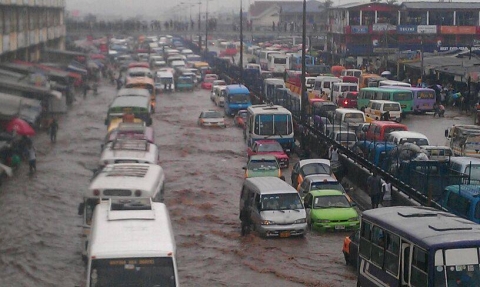

- Ghana, Nigeria and Côte d’Ivoire Face Rising Flood Threat as Climate Change Worsens Rainfall
Climate change, rapid urbanisation and weak drainage systems are intensifying flood risks across the Gulf of Guinea coast, exposing densely populated cities such as Accra, Abidjan, Lagos and Lomé to more frequent and damaging rainfall events, according to a new scientific assessment by World Weather Attribution.
The study, published on July 16, 2026, examined the extreme rainfall and flooding that affected coastal West Africa between June 20 and June 22, with Côte d’Ivoire, Ghana, Togo and Nigeria among the hardest-hit countries. It found that the rainfall event was not rare in today’s climate and that similar three-day rainfall episodes can now be expected roughly once every two to four years in the study region.
The findings are significant for Ghana, where heavy rains in June caused severe flooding in Accra and other vulnerable urban areas. The report notes that Ghana recorded one of its highest daily June rainfall amounts since 1995, while more than 140 millimetres of rain fell in Accra on June 29 alone. Abidjan recorded 172 millimetres on the same day, with authorities in Côte d’Ivoire reporting 59 deaths since the start of the rainy season.
Across Côte d’Ivoire, Ghana, Benin, Togo and Nigeria, more than 70 people were reported dead, while several locations suffered infrastructure damage, disruption and displacement. The report said the impact was worsened in some areas by poor waste management and blocked drainage systems, which intensified urban runoff and inundated buildings.
The core message of the study is that the Gulf of Guinea’s flood problem is no longer only a drainage or emergency-response issue. It is now a combined climate, urban planning, sanitation, infrastructure and governance challenge.
World Weather Attribution said the floods affected a densely populated region where rapid urbanisation, expansion of formal and informal settlements into floodplains, and conversion of natural vegetation to croplands have reduced natural drainage capacity and increased exposure to flooding. Population growth is expected to continue, further increasing vulnerability in the decades ahead.
The report also warned that flood impacts extend far beyond areas directly under water. Damage to infrastructure, agriculture and livelihoods can worsen food insecurity, while contaminated water and damaged sanitation systems raise the risk of water-borne diseases, particularly among children and people with pre-existing health conditions.
The attribution analysis found that observed three-day rainfall intensity has increased by about 23.00% over the study region since records began. It said an event of this nature is now about five times more likely to occur than it would have been in a climate 1.40°C cooler, although the scientists cautioned that uncertainty around the estimates remains high and depends on the datasets used.
A more detailed synthesis of the observational datasets estimated that a similar event is 5.37 times more likely in the current climate than in a 1.40°C cooler climate, with rainfall intensity estimated to have increased by 22.80%. But the study stressed that the confidence intervals are wide because of short observational records, natural rainfall variability and differences among datasets.
Climate models showed a smaller signal, indicating only a modest increase in the likelihood of such events and about a 3.50% increase in intensity. The report said most models point toward more extreme precipitation, but they underestimate the observed increase and were not specifically developed or calibrated for the African continent.
That caveat matters. The scientists are not saying climate change is the only reason for the floods. Rather, they are saying climate change is loading the dice toward heavier rainfall, while urban pressures are turning that rainfall into deeper and more destructive floods.
The study further warned that under a future warming scenario of 2.80°C above pre-industrial levels, even wetter three-day periods should be expected. Since such events are already not rare today, the report said they could become common occurrences, requiring the region to prepare for much heavier events than those observed in 2026.
Sea level rise is also compounding the danger. The report notes that sea level rise along the Gulf of Guinea coast has exceeded the global average, worsening the impact of increasingly intense rainfall and raising risks to densely populated cities and critical infrastructure.
For Ghana, the implications are direct. Flood control cannot be limited to periodic desilting, emergency relief and post-disaster appeals. The country will need stronger planning enforcement, improved drainage and sanitation, protection of waterways, investment in climate-resilient infrastructure and better early warning systems.
The WWA report recommends a broader adaptation approach beyond physical infrastructure. It calls for safer and affordable housing, improved drainage and sanitation systems, enforcement of safer construction policies, better early warning dissemination and greater participation of affected communities in planning.
This is especially relevant for Accra, where settlement expansion, poor solid waste management, blocked drains and construction in flood-prone areas repeatedly turn heavy rains into public emergencies.
The report’s findings also reinforce the need for Ghana’s climate finance strategy to prioritise urban resilience. If extreme rainfall events are becoming more likely and more intense, then drainage, sanitation, housing, spatial planning and flood early-warning systems must be treated as economic infrastructure, not just environmental interventions.
The cost of inaction is rising. Floods destroy homes, damage roads, disrupt businesses, threaten food systems, spread disease and weaken household resilience. They also impose fiscal costs on government through emergency response, infrastructure repair and health risks.
The warning from World Weather Attribution is therefore clear: the Gulf of Guinea coast is entering a more dangerous flood era. Climate change is increasing rainfall risk, but poor urban planning and weak infrastructure are determining how destructive that risk becomes.
For Ghana and its coastal neighbours, the policy test is no longer whether floods will recur. The test is whether governments, cities and communities will act fast enough before heavier rainfall becomes the new normal.

