

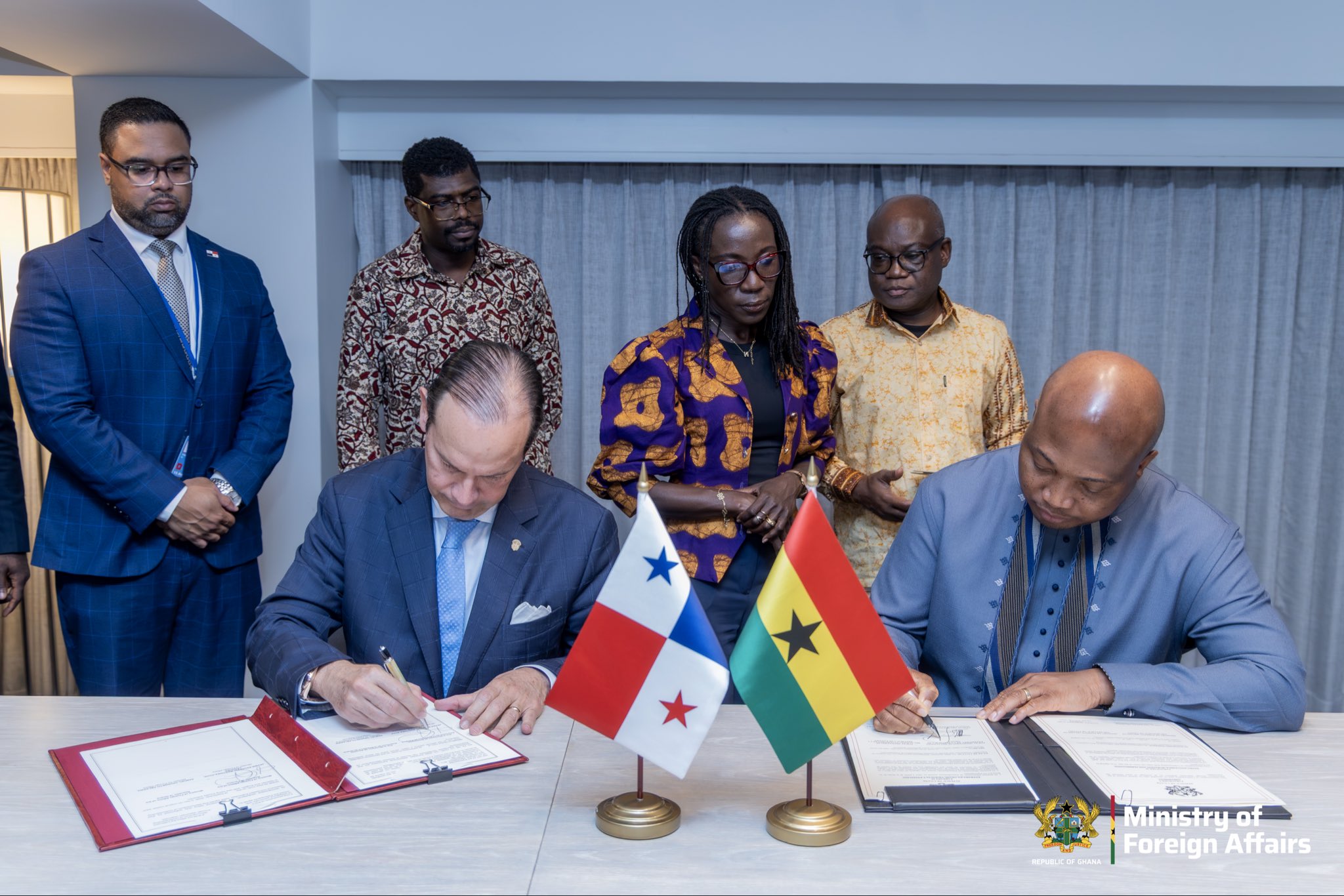

- Ghana-Panama Ties Gather Pace as Accra Looks to Turn Diplomacy into Export Growth
Ghana is seeking to deepen economic ties with Panama around trade, maritime affairs and logistics, opening a potentially useful bridge between West Africa and one of Latin America’s most important shipping centres.
The engagement comes as Accra looks to diversify export destinations while improving the competitiveness of its ports and extracting more value from commodities that have historically been shipped with limited processing.
For Ghana, the opportunity lies less in diplomatic symbolism than in whether stronger relations can translate into new shipping connections, market access and private-sector transactions.
The latest formal engagement came in June when Deputy Foreign Minister James Gyakye Quayson received the open letters of Panama’s Ambassador-Designate to Ghana, Isbeth Lisbeth Quiel Murcia.
Ghana’s Foreign Affairs Ministry said Mr Quayson identified maritime affairs, logistics, trade, tourism and education as areas with significant potential for cooperation, while the Panamanian envoy expressed her country’s readiness to deepen bilateral relations and explore new areas of partnership.
The discussions did not constitute a trade agreement, but they established a clearer economic agenda for a relationship that has historically remained modest in commercial terms.
The maritime component could prove particularly important because Panama occupies an outsized role in global shipping and logistics, while Ghana is attempting to strengthen its position as a regional gateway for West African commerce.
Accra’s wider strategy increasingly links port efficiency and transport infrastructure to the African Continental Free Trade Area, whose secretariat is based in Ghana.
A deeper relationship with Panama could therefore provide opportunities for knowledge-sharing, shipping services and access to logistics networks that extend beyond traditional European and Asian trading corridors.
Trade between the two countries remains relatively small, highlighting both the opportunity and the scale of the challenge. Secondary trade data cited in diplomatic reporting put Ghana’s exports to Panama at about US$155,000 in 2024, down from US$5.67mn in 2019, with cocoa paste and ceramics among the products shipped.
Panama’s exports to Ghana were reported at roughly US$707,000 in 2024, suggesting that any meaningful bilateral commercial relationship would have to be built from a relatively low base.
Cocoa could provide one route for that expansion, particularly if Ghana uses new diplomatic relationships to promote processed products rather than simply raw beans. The commercial prize lies in expanding exports of cocoa liquor, butter, powder, chocolate and other semi-finished or finished products into markets where Ghana currently has limited penetration.
Panama’s role as a distribution and logistics hub could potentially make it useful not only as an end market but also as an entry point into parts of Latin America and the Caribbean.
That distinction matters because Ghana’s long-term cocoa challenge is no longer only about how many tonnes it produces. Greater domestic value comes from processing, branding, manufacturing and distribution after beans leave the farm, activities that generate additional industrial employment and retain a larger share of export earnings within the economy.
New trade diplomacy will therefore be commercially meaningful only if it helps Ghanaian processors reach buyers, secure distribution agreements and compete in markets beyond the country’s established export destinations.
The maritime side of the relationship is similarly tied to Ghana’s domestic reform agenda. The Ghana Ports and Harbours Authority has been pressing for deeper cooperation among West and Central African ports as changing shipping patterns, security threats, technology and environmental requirements force ports to rethink infrastructure and operating models. Major-General Paul Seidu Tanye-Kulono, GPHA’s Director-General, said this month that future competitiveness would depend increasingly on innovation, digitalisation and infrastructure capable of responding to evolving global trade.
“Our ports are not only responsible for facilitating trade, but also protecting our waters, our environment, and the communities that we serve,” Major-General Tanye-Kulono said during a meeting of the Port Management Association of West and Central Africa in Tema.
He argued that AfCFTA would require ports to reduce inefficiencies, strengthen safety and security and become more sustainable and competitive.
Those objectives broadly align with the areas Ghana has identified for cooperation with Panama, although no specific Ghana-Panama port project has yet been announced.
Ghana has already begun trying to improve the operating environment at Tema and Takoradi through measures aimed at shorter turnaround times, deeper digitalisation and more efficient cargo handling.
A June initiative involving the Ghana Maritime Authority, GPHA, Meridian Port Services and the International Maritime Organization focused on Just-In-Time sailing, which is intended to reduce waiting periods and emissions while improving port efficiency. Such reforms matter because new international trading relationships cannot compensate for high logistics costs or inefficient clearance procedures at home.
For exporters, the economics will ultimately determine whether the Panama relationship produces measurable gains. Competitive freight rates, regular vessel connections, predictable customs procedures, access to trade finance and compliance with destination-market standards will matter more than diplomatic declarations alone.
Unless businesses can move goods reliably and at viable cost, expanded bilateral relations are unlikely by themselves to generate sustained export growth.
The commercial logic nevertheless extends beyond cocoa. Ghanaian manufacturers and agribusinesses could potentially use stronger Panamanian ties to test new markets, while logistics companies, freight forwarders and shipping operators could explore partnerships linking the Gulf of Guinea with Central America and the wider Caribbean.
For Panamanian businesses, Ghana could similarly offer a base from which to access West African markets and the broader opportunities created by AfCFTA.
Implementation will therefore be the decisive test. Government agencies would need to move from identifying broad sectors of cooperation towards specific commercial missions, product opportunities, shipping arrangements and business-to-business partnerships, while private companies would need to assess whether demand is large enough to justify new routes or distribution networks. The absence so far of announced financing commitments, shipping services or major export contracts means the relationship remains at an early stage.
The opportunity for Ghana is to use the engagement as part of a broader transition from commodity dependence towards a more diversified export model built around processing, services and logistics.
Panama’s global maritime relevance makes it an attractive partner, but the economic payoff will depend on whether Ghana can combine external market access with improvements in port efficiency and domestic productive capacity.
The real measure of the relationship will therefore be whether Ghanaian cocoa processors, manufacturers and logistics companies begin converting diplomatic access into contracts, shipments and higher domestic value.

