


- Ghana Shifts from Economic Stabilisation to Jobs Under ‘New Economy’ Agenda
Ghana’s government is preparing to shift the centre of economic policy from macroeconomic stabilisation to employment creation, with Finance Minister Dr Cassiel Ato Forson promising that the emerging “New Economy” programme will prioritise decent jobs, business growth and improved living standards.
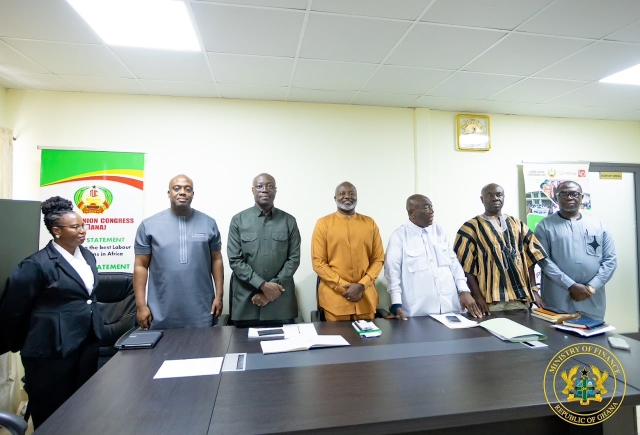
Speaking during a meeting with the leadership and members of the Trades Union Congress, Dr Forson said the government believed it had reached the point at which greater attention could be directed towards the microeconomy after concentrating initially on restoring stability.
“If you look at the NDC manifesto, you will notice that we said we will spend half of our time to stabilise the economy,” he said.
The next phase, he added, would move policy closer to businesses and workers “where jobs, decent jobs are created”.
The declaration marks an important change in emphasis. Ghana’s recent economic debate has been dominated by debt restructuring, inflation, fiscal consolidation, exchange-rate stability and the repair of public finances following the country’s most severe economic crisis in a generation.
But macroeconomic indicators, however improved, do not automatically translate into employment, higher wages or stronger household purchasing power. The government’s next challenge will be to demonstrate that stability can become productive investment and that economic growth can generate sufficiently large numbers of secure, adequately paid jobs.
The New Economy programme is expected to form a central part of the 2027 Budget, due to be presented to Parliament in November.
Earlier details indicated that the government intended to commit resources equivalent to about 1 per cent of gross domestic product to selected areas capable of attracting private investment and generating employment. The programme has also been associated with a wider ambition to mobilise as much as $10bn into strategic sectors.
Dr Forson has previously described the government’s economic strategy as a sequence moving from stability to resilience and then development.
“Stabilisation was never the destination. It was the price of entry,” he said during earlier consultations on the programme.
That distinction is economically significant. Fiscal consolidation can restore confidence and reduce inflation, but it can also restrain public demand and employment in the short term. If the gains are not followed by investment and business expansion, citizens may experience stabilisation largely as spending restraint rather than economic renewal.
The New Economy agenda is therefore an attempt to bridge the gap between improving headline indicators and the daily economic conditions confronting workers.
The government has acknowledged that the public sector cannot sustainably absorb the large number of young people entering Ghana’s labour market.
About 500,000 graduates and other jobseekers are estimated to enter the employment market annually. Creating positions for them through government payroll expansion would increase recurrent expenditure, weaken fiscal discipline and risk recreating the imbalances the stabilisation programme was intended to correct.
The strategy consequently depends on private businesses becoming the principal engines of job creation.
That will require more than government spending. Firms need reliable and competitively priced electricity, affordable credit, predictable taxes, efficient transport and logistics, access to land, skilled workers and confidence that policies will not change abruptly.
A jobs programme that does not confront these constraints could produce subsidies and short-term schemes without achieving the sustained expansion of productive enterprises.
The quality of employment also matters. “Decent jobs” must mean more than reducing the headline unemployment rate. They should offer reliable incomes, safe working conditions, social protection and opportunities for workers to improve their skills and productivity.
TUC General Secretary Joshua Ansah welcomed the initiative and expressed hope that it would create opportunities and improve wages for Ghanaian workers.
Organised labour’s support will be important, but the programme’s credibility will ultimately depend on measurable targets.
The 2027 Budget will need to identify the sectors receiving support, the amount of public money committed, the private capital expected to be mobilised and the number and quality of jobs projected.
It should also explain how the government will distinguish genuinely new employment from jobs that would have been created without public intervention.
Agriculture and agro-processing could offer employment at scale, while manufacturing may generate stronger productivity gains and export earnings. Digital services and technology could create higher-value opportunities, although they may not absorb labour as broadly without substantial investment in skills.
Infrastructure spending can support all these sectors, but inefficient project selection could add to public liabilities without producing lasting employment.
Ghana has previously recorded periods of strong economic growth without corresponding improvements in employment and household welfare. Capital-intensive sectors such as mining and oil can lift GDP and exports while creating relatively few direct jobs.
The government’s New Economy strategy must therefore be judged not only by how rapidly the economy expands, but by where that growth occurs, who participates in it and how much value remains within Ghana.
The transition from stabilisation to employment creation may prove harder than repairing the macroeconomic numbers. It requires coordination across finance, trade, agriculture, education, energy and infrastructure as well as confidence from businesses expected to invest.
For workers, the relevant measure will not be whether the economy has technically stabilised. It will be whether jobs are available, wages retain their value and families can experience the recovery in their living standards.
The government has defined the next stage as a move towards the microeconomy. The 2027 Budget must now show how that phrase will become factories, farms, enterprises and durable jobs.

