


- Ghana’s Bauxite Draws Global Capital as Government Targets Value Addition
Ghana’s bauxite industry is attracting a fresh wave of international investor interest, strengthening the country’s ambition to move beyond raw mineral exports and build an integrated aluminium industry capable of generating more jobs, foreign exchange and domestic manufacturing.
The latest signal comes from Coal India, the world’s largest coal producer, which is evaluating bauxite opportunities in Ghana as part of a broader strategy to diversify beyond coal and secure overseas mineral assets.
The Indian state-controlled group is also exploring lithium, iron ore, rare earths and other critical minerals, reflecting a wider global push by large industrial economies to secure strategic mineral supply chains.
Coal India’s interest in Ghana remains preliminary. No specific mine or deposit has been identified publicly and there is no indication yet that formal negotiations with government have reached an advanced stage.
But its interest matters because it joins a growing list of international investors looking at Ghana’s bauxite and aluminium value chain.
That is increasingly shifting the conversation away from whether Ghana possesses commercially attractive bauxite reserves and towards whether it can build the infrastructure, power systems and industrial capacity required to process those resources domestically.
Ghana is estimated to hold about 920 million tonnes of bauxite, concentrated principally around Awaso, Nyinahin and Kyebi.
Yet the country has historically captured only a fraction of the value embedded in those deposits.
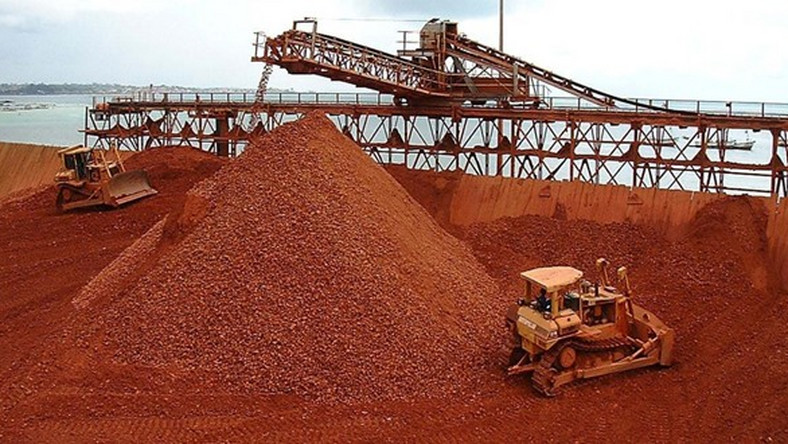
Raw bauxite is exported, while Ghana lacks an operational alumina refinery capable of transforming the ore into the intermediate material required for aluminium production.
That creates a longstanding industrial paradox.
Ghana possesses the mineral resource, yet imports alumina required by its aluminium smelting industry.
The government, through the Ghana Integrated Aluminium Development Corporation, is attempting to break that structure.
GIADEC’s strategy envisages increasing bauxite production from roughly 1 million tonnes annually at Awaso to about 5 million tonnes, alongside the development of an alumina refinery with capacity of approximately 1.6 million tonnes a year.
It is also pursuing a mine-and-refinery project at Nyinahin-Mpasaaso in partnership with Ghanaian mining company Rocksure International.
An integrated aluminium industry could allow Ghana to capture value at several stages of the chain extraction, refining, smelting, rolling and manufacturing rather than earning most of its revenue from the export of unprocessed ore.
That could deepen foreign-exchange earnings, create industrial jobs, broaden the tax base and generate more business for local suppliers.
It could also support downstream manufacturing in sectors including electrical cables, roofing materials, packaging, construction products and automotive components.
Recent investment activity suggests that parts of that ecosystem are beginning to take shape.
UAE-based Metalloïd Resources Investment has formalised a US$60 million facility agreement with GIADEC and Ghana Integrated Bauxite Development Limited Company to support expanded extraction at Nyinahin.
Italian engineering company Danieli & C. Officine Meccaniche has also signed a €300 million memorandum of understanding with GIADEC for an aluminium foil rolling plant at the Tema Integrated Industrial Park, with planned annual production of up to 45,000 tonnes.
These developments are important because they suggest the government is attempting to build an industrial chain rather than a standalone mining project.
But Ghana’s biggest constraint may not be investor interest. It may be whether the economics of the projects can work at scale.
Bauxite mining, refining and aluminium production require heavy infrastructure.
GIADEC is negotiating an estimated US$6 billion infrastructure programme covering rail and power, underscoring the size of the investment needed around the mines themselves.
Rail is particularly important.
Transporting millions of tonnes of bauxite from inland deposits to refineries or ports by road would increase costs, damage road infrastructure and weaken the competitiveness of the industry.
A functioning Western Rail Line linking producing areas to Takoradi Port could therefore become as strategically important as the mines.
Without efficient bulk transport, Ghana risks developing deposits that remain too expensive to integrate competitively into global aluminium supply chains.
Aluminium production is among the most electricity-intensive industrial activities.
That means Ghana cannot build a competitive aluminium value chain on unreliable or excessively expensive electricity.
GIADEC’s master plan envisages at least 500MW of dedicated power for the initial phase of the integrated industry and is examining independent power producer structures and large-scale renewable-energy options.
This places the bauxite strategy directly within Ghana’s broader energy-policy debate.
If power is too expensive, investors may favour other jurisdictions. If government heavily subsidises industrial electricity, the fiscal cost could dilute some of the economic benefits expected from the projects.
The challenge is therefore to provide predictable and competitive industrial power without transferring unsustainable costs to the public balance sheet.
That balance will be central to whether Ghana’s aluminium ambitions become commercially viable. Interest involving India, the UAE, China, Russia and Jamaica suggests Ghana’s bauxite resources are becoming part of a broader international contest for minerals, processing capacity and supply-chain security.
That diversity of potential partners could strengthen Ghana’s negotiating position.
But it also increases the need for transparent contracts, competitive procurement and clear rules around national participation. The debate around the future of the Volta Aluminium Company already demonstrates how politically sensitive the issue can become.
Concerns from labour groups over potential strategic investors and equity structures show that decisions about foreign participation will not be judged solely by how much capital is offered.
They will also be judged by how much control Ghana retains, how workers are treated and how much value remains in the domestic economy.
Companies such as Western Rod and Wire Limited have argued for stronger recognition and domestic supply arrangements as Ghana develops the aluminium value chain.
Will foreign investment simply create more efficient platforms for exporting Ghanaian resources and semi-processed products, or will local businesses become meaningful participants in the downstream economy?
The answer will determine whether the bauxite strategy becomes another extractive investment cycle or a genuine industrialisation programme.
Government has signalled a preference for the latter, including efforts to improve mineral exploration and moves towards restricting raw bauxite exports.

