

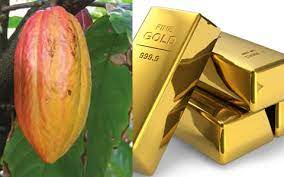

- Ghana’s Trade Surplus Climbs 31.54% to $8.80 Billion on Gold Windfall
Ghana’s trade surplus increased to $8.80 billion during the first eight months of 2026 as stronger earnings from gold, cocoa and crude oil lifted total exports faster than imports.
Total export receipts rose by 24.80% to $22.39 billion from $17.94 billion in the corresponding period of 2025, according to data reported by the Bank of Ghana.
The trade surplus consequently expanded by $2.11 billion, or 31.54%, from $6.69 billion a year earlier.
The improvement strengthens Ghana’s external position and provides additional foreign-exchange inflows that can support reserves, currency stability and the financing of imports.
However, the composition of the growth reveals an economy becoming increasingly dependent on a small number of primary commodities, particularly gold.
Earnings from other exports, including non-traditional exports, declined by 3% to $2.39 billion. The contraction contrasts sharply with the strong performance of gold, cocoa and crude oil and raises questions about the depth of Ghana’s export diversification.
Gold export earnings increased by 32.90% to $14.86 billion during the review period.
Gold alone accounted for 66.37% of Ghana’s total export receipts, making it by far the country’s most important foreign-exchange-earning commodity.
The increase was driven primarily by prices rather than production volumes. Ghana’s average realised gold price rose by 44% to $4,374.65 per fine ounce as geopolitical and financial-market uncertainty strengthened international demand for safe-haven assets.
Export volumes, by contrast, declined by 7.70% to 3.40 million fine ounces from 3.70 million fine ounces. The reduction was attributed largely to shipment disruptions associated with the onset of the Middle East conflict.
The price increase was sufficiently large to offset the decline in volume and produce an additional $3.68 billion in gold earnings.
Total exports increased by approximately $4.45 billion between the two periods. Gold therefore generated more than 82% of the overall increase.
This concentration provides immediate foreign-exchange benefits but exposes Ghana’s trade position to movements in the international gold price.
If safe-haven demand weakens or global financial conditions change, prices could decline even if domestic production remains stable. Because the latest growth was overwhelmingly price-driven, the trade surplus may be difficult to sustain at the same level if gold prices normalise.
The decline in export volumes also deserves attention. Strong prices can conceal production, logistics or shipment weaknesses that may become more visible when market conditions are less favourable.
Ghana must therefore distinguish between a structural improvement in export capacity and a commodity-price windfall.
Cocoa export receipts, including beans and processed products, increased by 9.90% to $2.71 billion from $2.47 billion.
The increase was supported by favourable realised prices and higher export volumes. Cocoa accounted for approximately 12.10% of total export earnings.
Unlike gold, where volumes declined, the combination of stronger prices and higher cocoa exports provides a broader foundation for revenue growth.
However, the performance must be placed within a difficult international cocoa market. The Bank of Ghana’s commodity-price index showed that cocoa prices had contracted on an annual basis, even though the cocoa sub-index recorded a modest year-to-date improvement.
The wider commodity index for cocoa, gold and crude oil increased by 5.60% from the beginning of the year to 261.86 in August 2026.
On an annual basis, the index was 15.40% higher, although this was below the 20.30% growth recorded in August 2025. The slower annual increase reflected falling cocoa prices, which moderated the gains in gold and crude oil.
Cocoa’s contribution to foreign exchange will depend on Ghana’s ability to sustain production, protect farms from disease and illegal mining, and increase the share processed domestically.
Higher bean exports may improve short-term receipts, but processing and manufacturing provide greater opportunities for employment and value retention.
Crude oil export earnings rose by 32.80% to $2.42 billion from $1.83 billion in the corresponding period of 2025.
The improvement was driven by both increased production and higher international prices.
Export volumes rose by 8% to 27.60 million barrels from 25.60 million barrels, supported by increased output from the Jubilee field.
The average realised price increased by 23.10% to $87.68 per barrel from $71.25. Crude oil accounted for approximately 10.81% of total export receipts.
The simultaneous improvement in volume and price distinguishes crude oil from gold. Ghana exported more barrels and received more for each barrel.
Yet oil also introduces external vulnerability. Higher prices strengthen export receipts but increase the cost of imported refined petroleum products. The net effect on the economy therefore depends on the relationship among crude exports, fuel imports, domestic refining and energy-sector obligations.
Sustaining higher production will also require investment in existing fields and the development of new reserves. A temporary rebound cannot substitute for a long-term strategy to arrest production decline and improve the reliability of the petroleum sector.
The $8.80 billion trade surplus implies that imports reached approximately $13.59 billion during the first eight months of 2026.
In the corresponding period of 2025, imports were approximately $11.25 billion, based on the difference between exports of $17.94 billion and the $6.69 billion trade surplus.
This indicates that imports increased by roughly $2.34 billion, or about 20.80%.
Export growth of 24.80% was strong enough to exceed the increase in imports, producing the larger surplus. But the rapid rise in imports shows that domestic demand for foreign goods, machinery, fuel and intermediate inputs remains substantial.
Some import growth may be positive if it reflects increased purchases of machinery and productive inputs. It becomes more concerning if it is driven predominantly by consumer goods that could be produced locally.
The durability of the trade surplus will therefore depend on both sides of the trade account: maintaining export earnings while improving the productive value of imports.
Earnings from other exports, including non-traditional products, fell by 3% to $2.39 billion from $2.46 billion.
The decline reportedly occurred across all non-traditional export subcategories.
This is the weakest part of Ghana’s trade performance because non-traditional exports are expected to reduce dependence on gold, cocoa and crude oil.
The category accounted for only 10.67% of total export earnings, compared with the combined 89.29% contribution from the three leading commodities.
The performance means Ghana’s trade surplus is large but not necessarily diversified.
Commodity exports can generate significant foreign exchange, particularly during periods of high international prices. They are also vulnerable to geopolitical developments, global demand, weather, production disruptions and price cycles over which Ghana has limited control.
Non-traditional exports can provide a wider base of products, firms and destination markets. They also offer stronger opportunities for agro-processing, manufacturing, job creation and participation by small and medium-sized businesses.
A 3% contraction may appear modest beside the strong headline export growth, but it represents a warning about the underlying structure of the external sector.
Ghana’s larger trade surplus should provide near-term support for reserves and the foreign-exchange market. Strong commodity receipts can improve confidence and reduce pressure on the cedi when the proceeds enter the domestic financial system transparently and consistently.
But a commodity-led surplus is not the same as a transformed export economy.
The latest figures show Ghana benefiting from exceptional gold prices, a recovery in crude production and improved cocoa receipts. They do not yet show a broad expansion in processed, manufactured and non-traditional exports.
Policy must therefore operate on two tracks.
The first is to manage the commodity windfall carefully by strengthening reserves, improving revenue collection and investing in productive infrastructure rather than expanding recurrent expenditure permanently.
The second is to address the weaknesses behind the decline in non-traditional exports. Exporters need competitive finance, reliable energy, efficient ports, predictable regulations, improved standards and access to larger regional markets.
The African Continental Free Trade Area provides Ghana with an opportunity to expand exports, but preferential market access will have limited value if domestic businesses cannot produce competitively or move goods efficiently.
The $8.80 billion trade surplus is a strong result. Its long-term value will depend on whether Ghana uses the additional foreign exchange to reduce vulnerability rather than deepen dependence on commodity prices.

