

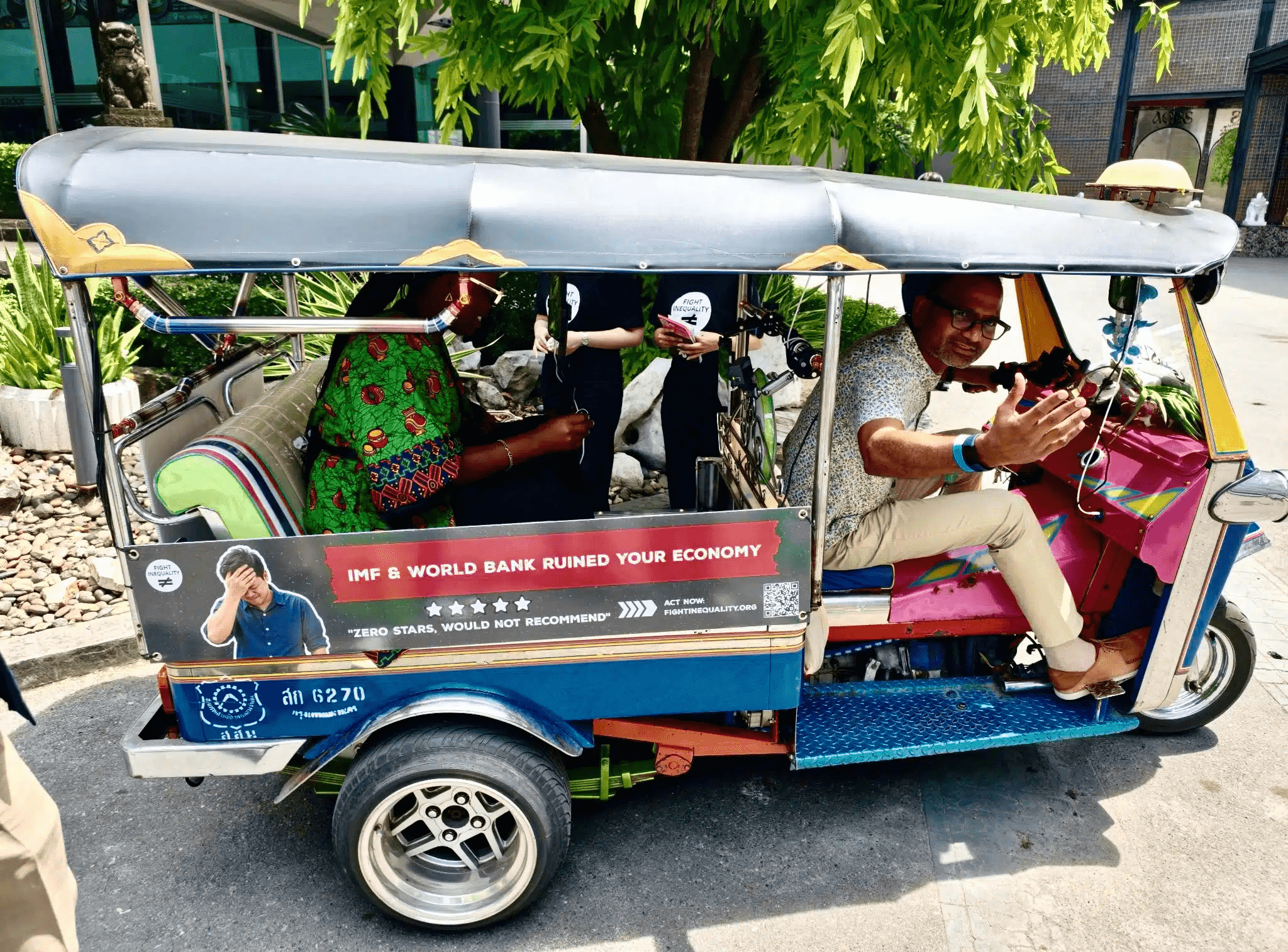

- Global Alliance Confronts IMF And World Bank with Demand to Cancel Developing-Country Debt
A global coalition of civil-society organisations has called for sweeping debt cancellation and an end to austerity policies, opening a direct challenge to the International Monetary Fund and World Bank as finance ministers gather in Bangkok for their 2026 Annual Meetings.
The Fight Inequality Alliance said current international lending arrangements force heavily indebted governments to prioritise creditors over hospitals, schools and food security, leaving ordinary citizens to bear the cost of financial crises they did not create.
Its intervention places sovereign debt, fiscal adjustment and representation at the centre of the October 12-18 meetings, where policymakers are confronting slower global growth, elevated borrowing costs and shrinking development finance.
The alliance cited analysis from Development Finance International showing that 16 developing countries spend an average 45 percent of their annual budgets servicing debt. That burden is almost twice their combined expenditure on health and education, it said.
Ghana is not included in the 16-country calculation. However, its recent debt restructuring and fiscal adjustment demonstrate why the debate matters across Africa. When interest payments and principal repayments consume large shares of revenue, governments have less room to invest in healthcare, education, infrastructure and employment programmes.
Jenny Ricks, general secretary of the Fight Inequality Alliance, accused the Bretton Woods institutions of preserving an economic system in which creditor repayment takes precedence over essential services.
“Cancel the debt, tax the super-rich, and stop making ordinary people pay,” she said, arguing that fiscal crises should not be resolved mainly through reductions in public expenditure or additional taxes on households.
The coalition’s demands extend beyond debt cancellation. It wants governments and international institutions to end spending cuts affecting hospitals and schools, support a global tax on billionaires, halt the privatisation of essential public services and reform voting power at the IMF and World Bank.
“Every country deserves a fair vote,” the alliance said, reflecting longstanding criticism that the governance structures of the institutions give advanced economies disproportionate influence over decisions affecting developing countries.
The campaign also urged the World Bank to finance free public healthcare and education instead of promoting private participation in services that it believes should remain publicly controlled.
These proposals will resonate with citizens facing rising living costs, but they also raise difficult questions. Cancelling debt can restore fiscal space and prevent prolonged social hardship, yet the process must determine which obligations qualify, how losses are shared among official and private creditors and how countries regain sustainable access to capital.
A blanket cancellation without reforms could provide temporary relief while leaving the causes of repeated indebtedness unresolved. Weak revenue systems, inefficient expenditure, poorly managed state enterprises, corruption and borrowing for projects that generate limited economic returns can quickly rebuild debt vulnerabilities.
The sharper policy question is therefore not simply whether debt should be repaid or cancelled. It is how legitimate creditor claims can be balanced against the state’s obligation to protect lives, expand opportunity and maintain basic services.
That balance has become harder as developing countries face high interest rates, currency depreciation and climate-related expenditure. Many borrowed heavily during periods of cheap money, then encountered pandemic costs, commodity shocks and tighter global financing conditions.
Debt service frequently rises just as governments need to spend more on food security, energy support and disaster recovery. Fiscal adjustment imposed in that environment can appear economically necessary to lenders but socially destructive to households already struggling with inflation and unemployment.
Brenda Osoro, the alliance’s Kenya national coordinator, said nearly 67 percent of Kenyan revenue was being absorbed by debt repayment while clinics lacked medicines and health workers faced difficult conditions. She linked new taxes and rising prices to efforts to satisfy IMF-supported fiscal targets.
For Ghana, the lesson is particularly relevant as the country works to consolidate gains from debt restructuring and macroeconomic stabilisation. Restored fiscal discipline remains necessary, but its durability will depend on whether citizens can see improvements in jobs, services and living standards.
Ghana’s experience also shows that debt relief alone cannot substitute for sound public financial management. The country must strengthen domestic revenue collection, limit waste, improve procurement and ensure new borrowing supports investments capable of expanding productive capacity.
At the same time, creditors must accept responsibility for lending decisions. Sovereign debt crises are rarely created by borrowers alone. International banks, asset managers, bilateral lenders and multilateral institutions assess risks, price loans and sometimes continue financing after vulnerabilities become apparent.
The alliance is therefore demanding that every category of lender, including commercial banks, hedge funds, the IMF and World Bank, share the cost of cancellation. Its position challenges debt treatments in which some creditors provide relief while others receive full repayment.
Co-ordinating such burden-sharing remains one of the greatest obstacles to faster restructurings. Disputes over comparability of treatment, disclosure and repayment terms can keep countries in negotiations for years, prolonging uncertainty and suppressing investment.
The Fight Inequality Alliance’s language is confrontational, but its central warning is difficult to dismiss: debt sustainability cannot be judged only by whether creditors are paid. It must also be measured by whether countries can educate children, treat patients, protect vulnerable households and invest in future growth.
For the IMF and World Bank, the challenge is to show that fiscal responsibility and social justice are not competing objectives. For governments, the responsibility is to use any relief transparently and productively. Without both, the global debt system will continue producing adjustment programmes that balance accounts while leaving societies dangerously unbalanced.

