


- GNCCI Says 24-Hour Economy, Big Push Must Move Faster to Unlock Private Investment
Ghana’s improving macroeconomic conditions will only translate into durable private-sector expansion if government accelerates implementation of its flagship economic programmes, the Ghana National Chamber of Commerce and Industry has warned, arguing that policy credibility now depends increasingly on execution rather than announcements.
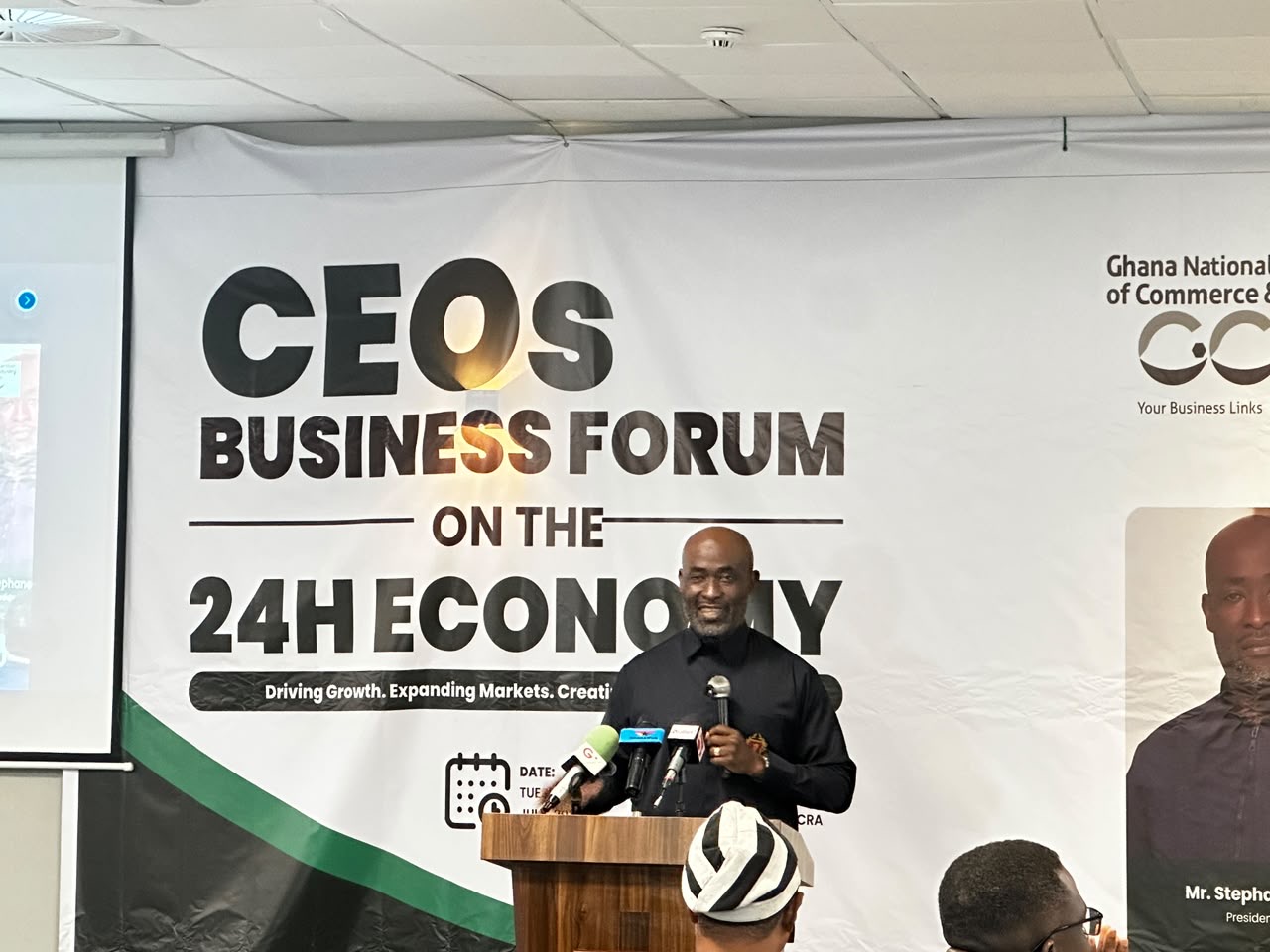
Speaking at the Chamber’s Mid-Year Budget Review Seminar in Accra, GNCCI President Stephane Miezan said fiscal consolidation and a more stable macroeconomic environment had helped rebuild confidence, but businesses now want to see faster delivery of the 24-Hour Economy, the Big Push infrastructure programme and the Accelerated Export Development Programme.
While businesses previously focused heavily on inflation, exchange-rate volatility, fiscal deficits and macroeconomic instability, the debate is increasingly moving towards whether the government can convert the current recovery into higher productivity, stronger industrial capacity and sustained employment.
Miezan said the 2026 Mid-Year Budget Review offered a more encouraging economic outlook and signalled a gradual return to a more predictable operating environment for investors.
He praised government’s commitment to fiscal discipline and its efforts to move away from excessive borrowing and expenditure towards more prudent public financial management.
But he cautioned that stabilisation by itself would not be enough.
“The success of these interventions will largely depend on timely execution, policy consistency, sufficient financing and stronger partnerships between the public and private sectors,” Miezan said.
That warning goes to one of the central risks facing Ghana’s current economic strategy: implementation capacity.
Successive governments have unveiled ambitious programmes intended to accelerate growth and structural transformation, but many have struggled with funding delays, bureaucratic bottlenecks, weak coordination and uneven execution across ministries and agencies.
Investment decisions are influenced not only by the quality of announced policies but also by whether government can deliver supporting infrastructure, maintain regulatory consistency and implement programmes within predictable timelines.
The 24-Hour Economy is one of the most closely watched initiatives.
The programme is designed to encourage round-the-clock activity in selected sectors through incentives, improved logistics, infrastructure support and reforms intended to increase productive utilisation.
If implemented effectively, the policy could allow factories, logistics companies, ports, service providers and other businesses to extend operating hours and make better use of existing assets.
That could improve productivity and create additional employment, particularly where businesses currently operate below capacity.
But success will depend on practical considerations including electricity reliability, transport, security, labour arrangements and demand.
A 24-hour operating model cannot be sustained simply through policy designation if firms do not have the infrastructure or commercial incentives required to operate additional shifts profitably.
The programme is intended to accelerate infrastructure investment and address bottlenecks that continue to raise the cost of doing business.
Transport links, roads, logistics infrastructure and public utilities all have direct consequences for productivity.
Poor infrastructure increases delivery times, raises vehicle and fuel costs and reduces the competitiveness of domestic firms relative to businesses operating in more efficient markets.
For the GNCCI, faster delivery of those projects could therefore have a multiplier effect extending well beyond construction itself.
Improved infrastructure can reduce private-sector costs, attract new investment and make industrial expansion more commercially viable.
The Accelerated Export Development Programme presents a similar opportunity.
Ghana remains heavily dependent on a relatively narrow group of primary commodity exports, leaving the economy vulnerable to commodity price fluctuations and limiting the amount of domestic value added.
An effective export development strategy could strengthen non-traditional exports, expand foreign-exchange earnings and support manufacturing and agro-processing.
That would also have macroeconomic implications.
A broader export base could improve foreign-exchange supply and reduce some of the pressures that periodically affect the cedi.
The GNCCI’s argument is therefore that flagship programmes should not be treated as separate policy initiatives.
Together, the 24-Hour Economy, Big Push and export development agenda could form part of a broader strategy to increase productive capacity.
But the private sector will need to play a central role.
Much of the capital required to expand factories, warehouses, logistics networks and export businesses will ultimately have to come from private investors.
Government can establish the policy environment and provide critical infrastructure, but businesses will make the final decision on whether to commit capital.
Investors need certainty that regulations will remain predictable, projects will be completed, government commitments will be honoured and policy direction will not change abruptly.
This is why Miezan placed emphasis on stronger public-private partnerships and improved coordination across government.
Without such coordination, projects can become trapped between agencies or slowed by conflicting procedures.
Geopolitical tensions, commodity price volatility, changing trade patterns and tighter international financing conditions mean domestic policy execution has become even more important.
Ghana cannot control external shocks, but it can improve the resilience of its economy by lowering domestic business costs and expanding productive capacity.
The GNCCI’s message therefore reflects a broader transition in Ghana’s recovery story.
The first stage focused on restoring macroeconomic stability.
The next stage is about translating that stability into investment, production and jobs.
Fiscal consolidation can improve headline indicators relatively quickly. Structural transformation requires sustained implementation over several years.
For government, the measure of success will increasingly be whether flagship programmes move from policy documents into completed infrastructure, operating factories and stronger exports.
For businesses, the key question is whether the current improvement in macroeconomic conditions becomes durable enough to justify long-term investment.
The GNCCI’s warning is therefore straightforward: Ghana’s recovery has created an opportunity, but that opportunity could be weakened if implementation lags.
The next phase of economic policy will be judged less by what government announces and more by what it delivers.

