

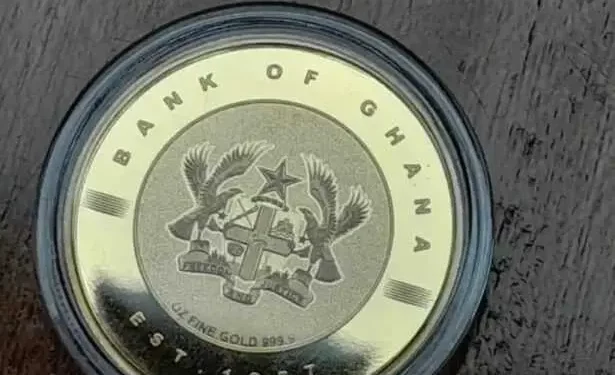

- Gold Coin Crosses GH¢50,000 As Bullion and Cedi Pricing Converge
The Bank of Ghana has priced the one-ounce Ghana Gold Coin at GH¢50,012.73 for Thursday, July 23, 2026, reinforcing the growing role of gold-linked assets in Ghana’s domestic savings market at a time when investors remain sensitive to inflation, exchange-rate risk and the search for value preservation.
According to the Bank of Ghana’s public pricing notice for the Ghana Gold Coin, the 1.00-ounce coin was quoted at GH¢50,012.73, while the 0.50-ounce and 0.25-ounce coins were priced at GH¢25,363.52 and GH¢13,062.49 respectively. The central bank said the pricing was based on the previous day’s LBMA PM gold price of US$4,155.10 and the Bloomberg REGN USD/GHS rate of 11.6150.
The latest quote places Ghana’s gold coin programme at the centre of a wider policy and investment conversation: whether domestic access to gold can offer households and institutions a credible hedge against currency uncertainty, or whether it risks becoming another investment window accessible mainly to wealthier savers.
The one-ounce price of GH¢50,012.73 is significant not only because of the nominal amount, but because of what it says about the intersection between the global gold market and Ghana’s local currency environment. Gold is priced internationally in US dollars, but the coin is sold locally in cedis. That means the final domestic price reflects both bullion in cedis. That means the final domestic price reflects both bullion prices and the exchange rate.
Using the Bank of Ghana’s stated LBMA PM price and exchange rate, the cedi equivalent of one ounce of gold works out at roughly GH¢48,261.49 before other pricing factors. The official 1.00-ounce gold coin price of GH¢50,012.73 therefore implies a margin of about 3.63% over the simple spot-equivalent calculation. For the 0.50-ounce coin, the implied margin is about 5.11%, while the 0.25-ounce coin carries an implied margin of about 8.26%.
That pattern is not unusual in physical bullion products. Smaller denominations often carry higher per-ounce equivalents because of minting, packaging, distribution, handling and liquidity costs. But for local investors, the practical implication is clear: the smaller the coin, the more expensive the exposure on a per-ounce basis.
This matters because the Ghana Gold Coin is being positioned in a market where savers are still scarred by recent macroeconomic volatility. Inflation has eased sharply from previous highs, but households and institutions remain conscious of how quickly purchasing power can be eroded. The cedi has also gone through periods of sharp movement in recent years, making gold attractive to investors seeking a store of value that is not fully dependent on local-currency confidence.
The Bank of Ghana’s gold coin pricing therefore does more than publish a daily rate. It gives the market a reference point for converting international bullion value into a domestic investment product. In effect, it creates a local price signal for gold ownership outside the traditional jewellery, mining or informal bullion channels.
That is important for financial deepening. A properly structured gold coin market can give investors an alternative savings instrument, support formalisation of gold-related investment demand and reduce reliance on unregulated channels. It may also help households diversify their savings beyond bank deposits, Treasury bills, property and foreign currency.
But the policy challenge is equally real. At GH¢50,012.73 for the 1.00-ounce coin, the product is beyond the reach of many ordinary wage earners. Even the 0.25-ounce coin, priced at GH¢13,062.49, requires substantial liquidity. That means the gold coin may be a domestic savings instrument, but it is not yet a mass-market financial inclusion product.
The Bank of Ghana may therefore face a delicate balance. If the gold coin is framed mainly as a store-of-value product for high-net-worth individuals and institutions, it can still serve a useful market function. But if policymakers expect it to become a broad alternative to dollarisation or informal gold buying, accessibility will matter.
There is also the question of liquidity. For any gold coin programme to gain credibility, investors must be confident not only that they can buy the coin, but that they can sell it transparently and at a fair price when needed. The label “buy/sell price” in the Bank of Ghana notice suggests the central bank is providing a two-way market reference, but the actual depth, spread and ease of rederactive the product becomes over time.
Gold’s current importance to Ghana also gives the coin added symbolism. The country’s external sector has increasingly leaned on gold exports for foreign exchange earnings, fiscal confidence and reserve support. A domestic gold coin product therefore links the household savings conversation to the broader national macroeconomic story.
But that link must be handled carefully. Gold can preserve value, but it is not risk-free. International prices move. Exchange rates move. Local pricing formulas may shift. Investors who buy at high gold prices may face losses if global bullion prices decline or if the cedi strengthens materially.
That makes public education essential. The Ghana Gold Coin should not be marketed or understood as a guaranteed-return product. It is an exposure to gold, priced through the cedi. Its value can rise or fall depending on global bullion markets and exchange-rate movements.
For Ghanaian investors, the coin’s appeal lies in its tangibility and its association with gold, one of the world’s oldest stores of value. For the Bank of Ghana, the broader opportunity is to formalise part of domestic demand for gold-backed savings and create a regulated alternative to less transparent bullion channels.
Still, the programme’s credibility will depend on consistency, pricing transparency, availability, resale arrangements and investor protection. If buyers understand the pricing basis, transaction costs and liquidity conditions, the product can develop into a useful part of Ghana’s financial market architecture. If not, it could become a niche product surrounded by speculation and misunderstanding.
The July 23 pricing notice is therefore small in size but large in implication. It shows how closely Ghana’s domestic savings conversation is now tied to global commodity markets and the cedi’s exchange-rate path.
At GH¢50,012.73 for a one-ounce coin, the Ghana Gold Coin is not merely a collectible. It is a mirror of investor anxiety, gold’s growing macroeconomic relevance and the search for instruments that can preserve value in an economy still rebuilding confidence.
The bigger question is whether Ghana can turn this gold-linked product into a transparent, liquid and well-understood savings instrument or whether it remains another reminder that in uncertain times, citizens often trust gold more than paper promises.

