

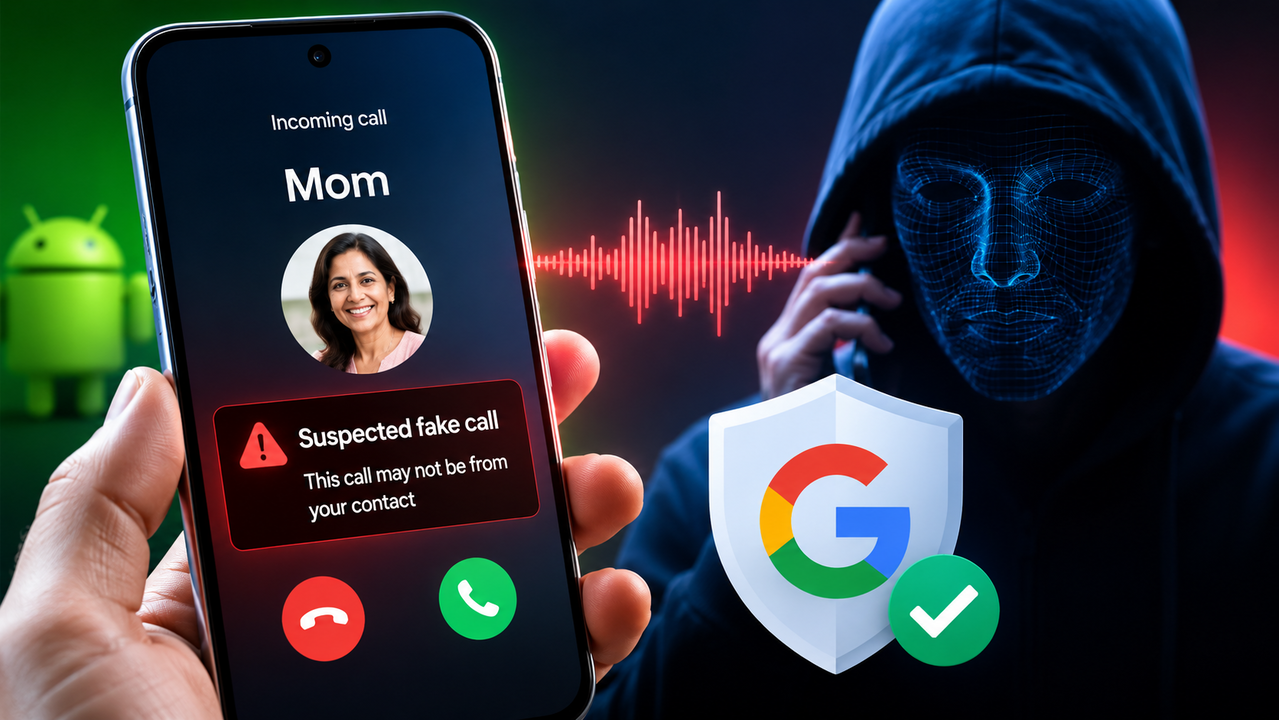

- Google rolls out fake call detector on Android as AI voice-cloning scams surge
Google has begun rolling out a fake call detection feature for Android devices, as technology companies race to contain the growing threat of AI-powered voice cloning and caller ID spoofing scams.
The feature, which is being deployed globally this month through the Phone by Google app, will initially be available on Pixel devices running Android 12 and newer before expanding more widely across supported Android phones. Google says the tool is designed to warn users in real time when a caller may be impersonating one of their saved contacts.
The system uses encrypted device verification to confirm whether a call is genuinely coming from the contact’s phone. Google describes the process as a silent authentication signal exchanged during the call setup. Where that signal is missing, the receiving phone checks with the real contact’s device to confirm whether it is actually making a call.
If the real device confirms that no call is being placed, Android displays an on-screen warning advising the recipient to hang up immediately. Google says the process is built on Rich Communication Services, an open standard, and requires both the caller and recipient to be using Phone by Google, with Google Messages and RCS capability installed.
The launch comes as impersonation fraud becomes more sophisticated, with fraudsters combining caller ID spoofing, social engineering and AI-generated voices to mimic relatives, employers, bank officials, executives and government representatives.
INTERPOL’s March 2026 Global Financial Fraud Threat Assessment said financial fraud losses were estimated at US$442 billion in 2025, placing fraud among the world’s most serious transnational crime threats. The agency also warned that the scale of offending is expected to escalate significantly over the next three to five years, mainly because of the wider availability of AI tools and low barriers to entry.
In the United States, the Federal Trade Commission said consumers reported losing more than US$12.5 billion to fraud in 2024, a 25 percent increase over the previous year. Imposter scams accounted for US$2.95 billion of reported losses, second only to investment scams.
Google said the new fake call detection tool is part of a wider push to protect users across Android, Gmail and messaging services. The company already uses AI-powered scam detection in Google Messages and offers scam call detection features for some Pixel and Samsung users.
“Security shouldn’t be limited to just one type of phone or app. We want to raise the bar across the industry to help protect as many people as possible,” Google said in its announcement.
The move reflects a broader shift in cybersecurity from post-incident fraud reporting to real-time identity verification. As generative AI tools become cheaper and more accessible, voice impersonation scams are increasingly difficult for victims to detect by listening alone.
For Android users, the protection will work automatically where the required apps and RCS settings are in place. Users whose devices do not use Phone by Google as the default dialer can install it from the Play Store and set it as their default phone app. Google says the feature can also be disabled through app settings.
The effectiveness of the tool will depend partly on adoption. Because the verification process requires both parties to be using Phone by Google and RCS-supported services, the protection will be strongest where Android users operate within Google’s supported communication ecosystem.
Still, the rollout marks a significant step in the fight against AI-enabled fraud. It signals that the next phase of mobile security will not only be about blocking unknown numbers, but also verifying whether a familiar number is truly who it claims to be.

