

Government Allocates $250m for AI Infrastructure, $20m for Strategy Implementation
President John Dramani Mahama has announced a $250 million government investment to establish a world-class artificial intelligence (AI) computing centre, as part of efforts to position Ghana as a leader in emerging technologies.
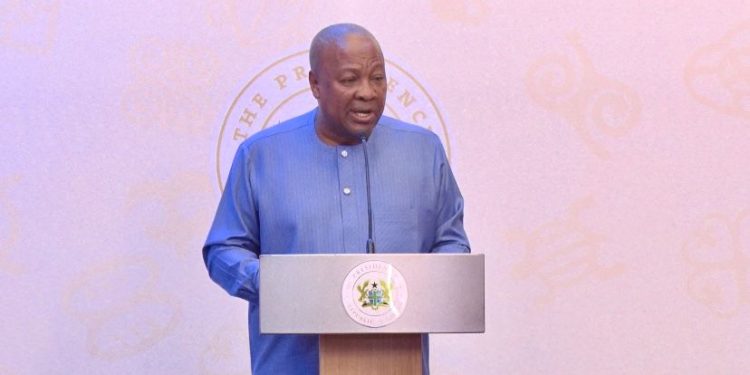
The announcement was made at the launch of the National Artificial Intelligence Strategy on Friday, April 24, where the President described the initiative as a cornerstone of Ghana’s digital transformation agenda.
“I am therefore pleased to announce major financial commitments towards our AI agenda. Ghana will invest $250 million to establish a world-class AI computing centre,” he stated.

According to President Mahama, the proposed facility will serve as a hub for research, innovation and enterprise, enabling local talent to develop solutions for both the domestic market and the wider African continent.
“The proposed AI computing centre will serve as a nerve centre for research, innovation and enterprise, enabling Ghanaian talent to build solutions not only for our country but also for the wider African continent,” he added.
In addition to the computing centre, government has committed a further $20 million to support the short- to medium-term implementation of the National AI Strategy, with the President describing the combined investment as critical to Ghana’s long-term development.
“These investments are bold but necessary,” he emphasised.
President Mahama noted that achieving the objectives of the AI strategy will require strong collaboration across multiple stakeholders, stressing that government cannot drive the agenda alone.
“Success will require strong partnerships among the state, academia, civil society, industry, and our development partners,” he said.
He acknowledged the role of key partners in developing the strategy, including the Ministry of Communications, Digital Technology and Innovation, led by Samuel Nartey George, as well as the UK High Commission, GIZ, the United Nations, and the Responsible AI Lab at KNUST.
The President outlined key pillars underpinning the National AI Strategy, including ethical AI development, education and skills training, industrial innovation, data governance, research, and enhanced public sector service delivery.
He stressed that capacity building remains central to the success of the strategy.
“At the heart of all these pillars is one imperative: capacity. Without skilled people, strong institutions, secure infrastructure, and sound governance, no AI strategy can succeed,” he said.
Highlighting the importance of digital infrastructure, President Mahama likened it to traditional development assets such as roads and energy systems.
“Data, computing power, connectivity, and energy are now as strategic to the digital age as roads, ports, railways, and power plants were in earlier eras of development,” he noted.
He added that government is deliberately strengthening the country’s digital backbone to support the growing demands of artificial intelligence systems.
“We are building deliberately because infrastructure is the foundation upon which innovation rests,” he stated.

