

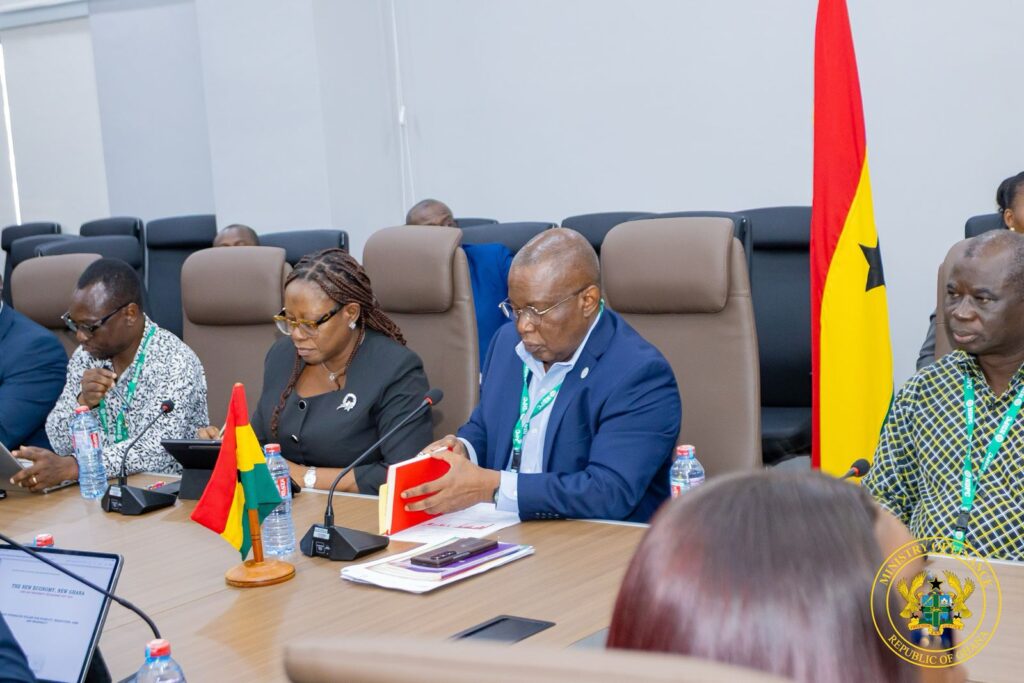

- Government Turns to NDPC to Measure Delivery of US$10.00bn Economic Transformation Plan
Ghana’s National Development Planning Commission will monitor and assess implementation of the government’s proposed New Economy Programme, placing the state planning body at the centre of an ambitious attempt to move the economy from stabilisation towards higher production, job creation and wealth generation. The programme is expected to involve about US$10.00 billion in investment across key sectors, with its full architecture due to be unveiled in the 2027 Budget in November.
Finance Minister Dr Cassiel Ato Forson outlined the NDPC’s role during an engagement on Monday, September 7, with the Commission’s leadership, chaired by Dr Nii Moi Thompson. He described the NDPC as a critical stakeholder in ensuring that the programme is implemented and its progress systematically assessed rather than allowed to remain primarily a collection of policy commitments.
The decision places greater emphasis on implementation at a time when government is seeking to translate improving macroeconomic conditions into economic outcomes felt more directly by households and businesses. Ghana’s recent policy debate has increasingly shifted from stabilising public finances and restoring macroeconomic confidence towards the more difficult question of how those gains can generate production, sustainable employment and higher incomes.
Dr Forson signalled that transition during the 2026 Mid-Year Fiscal Policy Review, arguing that stabilisation should be regarded as the foundation rather than the endpoint of economic management. “Stabilisation was never the destination. It was the price of entry. Ghana has paid that price. What comes next is the work that changes lives at scale, the work of transformation,” he said.
The New Economy Programme is intended to become the vehicle for that transformation. President John Dramani Mahama has said approximately US$10.00 billion will be invested in key sectors, although the detailed financing structure, sectoral allocations, implementation timelines and performance targets are expected to be provided when government presents the 2027 Budget.
The scale of the proposed programme makes the NDPC’s monitoring role particularly important. A US$10.00 billion investment ambition is substantial, but the economic impact will ultimately depend on how much financing is actually mobilised, where it is deployed, whether projects are completed and whether expenditure translates into productive assets rather than simply higher headline investment numbers.
That means monitoring will need to go beyond measuring money committed or projects announced. For a programme explicitly designed around production, jobs and wealth creation, the stronger indicators will include additional productive capacity, private investment mobilised, sustainable employment created, export earnings generated and improvements in the competitiveness of Ghanaian businesses.
Dr Forson has already indicated the direction government wants the programme to take. “Through the New Economy agenda that we will unveil, we will build an economy that does not merely withstand shocks but creates jobs, generates wealth and grows on the strength of what Ghana produces,” he said during the Mid-Year Fiscal Policy Review.
That production emphasis could prove critical because macroeconomic stabilisation and structural economic transformation are not the same thing. Lower inflation, greater currency stability and improved fiscal balances can create a more predictable environment for investment, but they do not automatically expand factories, increase agricultural productivity or create enough jobs for a growing workforce.
The challenge for the New Economy Programme will therefore be to connect macroeconomic stability with the productive sectors of the economy. Government will need to demonstrate how its interventions address constraints such as the cost and availability of long-term finance, infrastructure deficiencies, energy reliability, skills gaps, technology adoption and the ability of domestic businesses to compete in regional and international markets.
The NDPC’s involvement could provide a mechanism for imposing greater discipline on that process, particularly if implementation is linked to measurable targets and regular public reporting. Monitoring becomes economically useful when it identifies projects falling behind schedule, programmes that are failing to deliver expected outcomes and interventions that need to be redesigned before large amounts of public or private capital are consumed.
The Commission’s role could also help address a recurring weakness in Ghana’s development policy: the gap between medium- and long-term national planning and annual government budgeting. If the New Economy Programme is anchored within a broader development framework and tracked consistently, it could provide greater continuity between policy objectives, budget allocations and measurable economic outcomes.
Financing will nevertheless remain one of the most important questions when the programme is formally unveiled. Government will need to clarify how much of the US$10.00 billion is expected from the national budget, private investors, development finance institutions, public-private partnerships or other sources, because the fiscal consequences differ substantially depending on how that capital is structured.
The distinction between announced investment and additional investment will also matter. If existing projects or previously committed spending are incorporated into the US$10.00 billion headline figure, government will need to distinguish those amounts from genuinely new capital mobilised through the programme to allow an accurate assessment of its economic additionality.
The 2027 Budget will therefore be the first major test of the New Economy agenda. Beyond announcing sectors and projects, the budget will need to establish clear baselines, timelines, financing arrangements and performance indicators against which the NDPC can independently assess whether implementation is advancing.
For Ghana, the transition from stabilisation to transformation is arguably the harder phase of economic recovery. Restoring macroeconomic discipline can create the conditions for growth, but converting those conditions into factories, farms, exports, businesses and productive jobs requires sustained execution across government and the private sector.
The decision to involve the NDPC suggests government recognises that the credibility of the New Economy Programme will ultimately depend on measurable delivery. The US$10.00 billion ambition may define the scale of the policy, but its success will be determined by a different set of numbers: how much production increases, how many sustainable jobs are created, how much private capital is mobilised and how much additional wealth Ghana’s economy ultimately generates.

