


- Governor Asiama Explains GoldBod’s Role in Forex Supply and Reserve Accumulation
Bank of Ghana Governor Dr Johnson Pandit Asiama has rejected claims that the central bank has transferred its foreign-exchange responsibilities to the Ghana Gold Board, insisting that the Bank retains its legal mandate and remains prepared to intervene whenever market conditions threaten exchange-rate stability.
Dr Asiama said GoldBod’s increasing role in supplying foreign exchange to commercial banks should be understood as support for the central bank’s market operations rather than a replacement for them.
“We want to focus on reserve build-up while GoldBod supports with FX intermediation as well as some level of intervention for the market,” the Governor said.
He explained that the Bank of Ghana would enter the market when necessary, particularly where excessive volatility threatened orderly trading or broader macroeconomic stability.
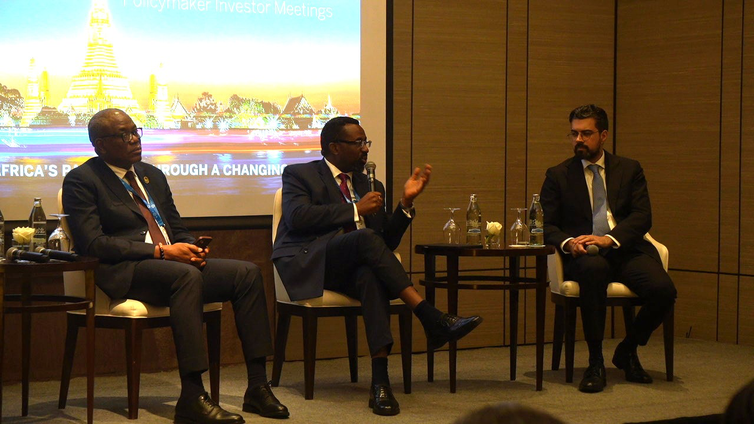
Dr Asiama was responding to questions from institutional investors, brokers and fund managers at a meeting organised by Standard Bank at the Conrad Hotel in Bangkok, Thailand, on the sidelines of the IMF–World Bank Annual Meetings.
The clarification follows growing debate about the division of responsibilities between the central bank and GoldBod under Ghana’s revised foreign-exchange arrangements.
Some market observers have questioned whether GoldBod’s direct sale of foreign currency to banks is consistent with the Bank of Ghana Act, the country’s foreign-exchange framework and constitutional provisions governing monetary authority.
The issue also surfaced during a recent hearing of Parliament’s Public Accounts Committee, where GoldBod’s Chief Executive appeared to answer questions about the institution’s operations.
Dr Asiama maintained that GoldBod was complementing the central bank. He said foreign-exchange inflows being channelled through the gold-trading institution would ordinarily have entered the domestic market through other channels.
Under the revised system, GoldBod directs a portion of those inflows towards commercial banks, improving market supply, while transferring another portion to the Bank of Ghana to support reserve accumulation.
“I have been wondering why we had not set up GoldBod long ago,” Dr Asiama said, arguing that its contribution under prevailing conditions had justified its establishment.
Since the beginning of October 2026, GoldBod has sold about US$452 million to commercial banks through its GoFX platform. The electronic system conducts foreign-exchange sales twice each week.
The platform supports electronic bid submissions, allocation processing, time-stamping, transaction histories and audit trails intended to improve transparency and accountability.
GoldBod operates the programme under the Bank of Ghana’s regulatory oversight. The central bank is expected to have real-time access to the platform, while GoldBod must submit transaction reports following each sale.
Under its revised foreign-exchange programme, GoldBod plans to generate approximately US$1.5 billion during October. About US$1 billion is expected to be sold to commercial banks, with the remaining US$500 million transferred to the central bank for reserve accumulation.
The scale of the planned flows makes the governance of the arrangement important. Clear rules covering allocation, eligible participants, pricing and disclosure will be necessary to maintain confidence and ensure that foreign currency reaches the formal market efficiently.
Central banks intervene in foreign-exchange markets to manage disorderly conditions, build or preserve reserves and support the transmission of monetary policy. Delegating operational tasks does not remove that responsibility, particularly when the central bank continues to regulate the platform and determine when direct intervention is required.
The cedi has faced renewed pressure during recent months, although market conditions have improved marginally over the past two weeks. Its year-to-date depreciation was reported at 10.33 percent.
Dr Asiama described the recent weakness as a marginal blip and said he expected conditions to normalise. He linked part of the pressure to profit-taking and foreign-currency demand from multinational companies and other businesses.
The Governor reiterated that the central bank would intervene if necessary to prevent temporary demand pressures from developing into excessive exchange-rate volatility.
Ghana’s gross international reserves stood at approximately US$12.04 billion as of September 22, 2026. Dr Asiama acknowledged that energy-sector payments had placed pressure on the reserves but said the Bank remained on course to achieve its year-end programme targets.
He expects Ghana to reach six months of import cover by December under the Policy Coordination Instrument.
Building reserves while supplying the market presents a delicate policy balance. Large interventions can ease immediate pressure on the cedi but reduce the buffers available to protect the economy against future external shocks.
Allowing GoldBod-generated foreign exchange to support commercial banks could reduce the amount the central bank must release directly from reserves. Transferring part of GoldBod’s inflows to the Bank could simultaneously strengthen those reserves.
Dr Asiama said stronger reserves were necessary to protect the economy against less favourable external conditions, including a significant decline in global gold prices.
His central message to investors was that GoldBod is an additional channel within Ghana’s foreign-exchange framework, not a substitute for the Bank of Ghana. The central bank retains regulatory control, continues building reserves and remains prepared to act when market stability requires intervention.

