



- Governor Dr Asiama defends gold reserve rebalancing amid rising political scrutiny
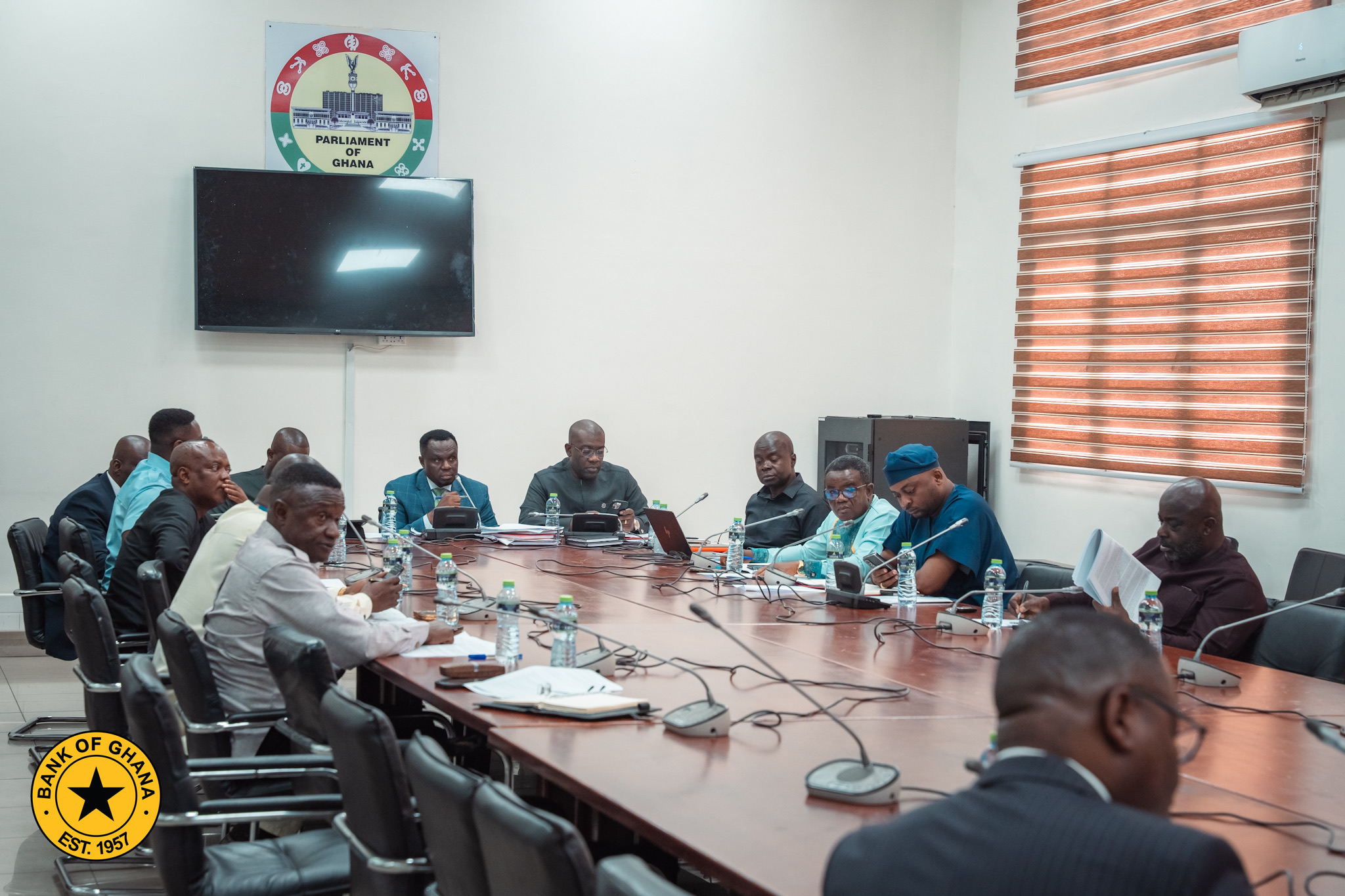
At Parliament House on Monday, March 9, the Governor of the Bank of Ghana, Dr Johnson Pandit Asiama, arrived with a message that was both technical and political: Ghana’s macroeconomic improvement did not happen by accident, and the central bank’s controversial choices over the past year must be understood as deliberate acts of stabilisation, not signs of institutional weakness.
In his briefing to the Parliamentary Committee on Economy and Development, the Governor outlined the logic behind the Bank’s 2025 policy stance, defended the rebalancing of Ghana’s gold reserves, and sought to reassure lawmakers that the gains recorded in inflation, reserve accumulation and banking sector stability are not cosmetic but the result of hard policy trade-offs.
The appearance came at a time when monetary policy in Ghana is no longer discussed only in dealing rooms, research notes and central bank communiqués. It is increasingly contested in public debate, filtered through politics and social media, and often framed by suspicion around reserves, exchange rate management and the Bank’s balance sheet. Monday’s engagement suggested the central bank is now being forced to fight not only inflation, but also narrative risk.
Pull quote:
“The hearing was as much about defending the Bank’s policy choices as it was about explaining them.”
Dr Asiama’s case rested heavily on where Ghana stood at the start of 2025. According to his presentation, inflation ended 2024 at 23.8 per cent, the cedi had depreciated by 24.8 per cent during the year, lending conditions remained tight, and the after-effects of the Domestic Debt Exchange Programme continued to weigh on financial intermediation and confidence.
That backdrop shaped the Bank’s response. Rather than pivot quickly to accommodation, the central bank maintained a tight monetary policy stance, intensified open market operations to absorb excess liquidity, strengthened coordination with fiscal authorities, and introduced a revised foreign exchange operations framework in November 2025 aimed at improving market transparency and predictability.
The message to Parliament was straightforward: Ghana’s stabilisation required discipline before relief. The Bank’s argument is that without credibility, neither disinflation nor currency stability would have been sustainable.
Dr Asiama used the hearing to confront mounting public concerns over the Bank’s handling of the country’s gold reserves. His central claim was that the Bank had not recklessly depleted national assets, but had instead undertaken a reserve diversification exercise intended to reduce concentration risk and improve the quality and usability of Ghana’s external buffers.
The figures he cited help explain the concern. Ghana’s gold holdings, he said, rose from about 8.7 tonnes before the Domestic Gold Purchase Programme in 2021 to more than 40 tonnes by October 2025. Over the same January-to-October 2025 period, the global gold price surged by about 62 per cent, raising gold’s share in Ghana’s gross international reserves to roughly 42 per cent.
For a central bank, that level of exposure presents a problem. Gold is valuable, but not always sufficiently liquid for the day-to-day demands of reserve management in a small open economy vulnerable to external shocks. Dr Asiama’s defence was that reserve adequacy is not simply about asset accumulation; it is about asset composition. In that framework, converting part of the gold stock into foreign exchange assets was designed to strengthen flexibility, not reduce security.
Pull quote:
“Reserve management is not a speculative exercise. The question is not whether gold is valuable, but whether reserves are sufficiently liquid, safe and diversified.”
The governor further argued that international reserve management practice supports a more balanced allocation. Ghana, he implied, had drifted too far into gold concentration, and the Bank’s task was to restore equilibrium rather than cling to a politically attractive but operationally limiting asset mix.
Headline inflation, he noted, fell from 23.8 per cent in December 2024 to 5.4 per cent by December 2025 and further to 3.3 per cent in February 2026. Gross international reserves rose to US$13.8 billion by end-2025, equivalent to 5.7 months of import cover, while the policy rate was reduced by 900 basis points over the course of 2025 to end the year at 18 per cent.
These were presented not as isolated wins, but as linked outcomes: tighter liquidity management, improved reserve conditions, more orderly foreign exchange operations and easing inflation together created the space for policy loosening and a more stable financial environment.
The banking sector numbers were used to reinforce that narrative. The Governor said capital adequacy improved to 17.5 per cent, above the 13 per cent regulatory threshold. The non-performing loan ratio declined to 18.9 per cent from 21.8 per cent. Total banking sector assets rose from GH¢368 billion to GH¢447 billion, deposits increased from GH¢276 billion to GH¢325 billion, and gross loans expanded from GH¢95 billion to GH¢111 billion.
Taken together, these indicators formed the core of the Bank’s case: that the economy is not merely experiencing temporary statistical relief, but showing signs of broader repair in financial conditions and institutional confidence.
He acknowledged that the Bank of Ghana itself has absorbed heavy financial strain in the adjustment process, including the impact of the domestic debt restructuring, substantial liquidity sterilisation costs and valuation effects linked to exchange rate movements and asset repricing. In effect, the central bank has had to restore macroeconomic order while carrying part of the fiscal and financial legacy of the crisis on its own balance sheet.
That admission matters. It underscores a broader truth often lost in public debate: post-crisis stabilisation is not costless, and central bank balance sheets are not immune from the burdens of sovereign adjustment. The real question is whether those costs are temporary and manageable in the service of a more durable recovery.

Pull quote:
“The Bank is asking to be judged not by the pain of adjustment alone, but by whether that pain has restored policy credibility.”
Meanwhile, the Chairman of the Committee on Economy and Development, Hon. Dr Eric Afful, MP for Amenfi West, expressed satisfaction with what he described as the Governor’s open and frank engagement. He also urged the Bank of Ghana to deepen its engagement with Parliament in order to curb misinformation and disinformation around economic policy issues.
That appeal is significant. It reflects an emerging reality in Ghana’s political economy: communication is no longer peripheral to monetary policy. In an environment where reserve decisions are politicised and macroeconomic narratives are rapidly contested, the Bank’s credibility depends not only on what it does, but on how clearly and consistently it explains why it does it.
For Dr Asiama, Monday’s hearing was therefore more than a statutory briefing. It was an attempt to reclaim the narrative around the Bank’s actions at a moment when institutional trust is still fragile.
The data presented to Parliament point to clear progress: inflation has fallen sharply, reserves are stronger, the banking sector is in better shape, and monetary conditions have become more supportive. But the Governor also referenced external sector risks, including geopolitical tensions and broader vulnerabilities in the global environment, reminding lawmakers that Ghana’s recovery remains exposed to shocks beyond domestic control.
That is the real test ahead. It is one thing to engineer a period of calm after crisis; it is another to convert that calm into durable macroeconomic credibility.
For now, the Bank of Ghana is asking Parliament, and the wider public, to accept that some of its most contentious decisions were not signs of retreat, but instruments of repair. Monday’s hearing showed that the institution understands it must now make that case in public, not just in policy documents.
If the numbers hold, the Governor’s defence may yet prove persuasive. If they do not, the political scrutiny around the Bank’s gold strategy, reserve posture and policy credibility will only deepen.

