

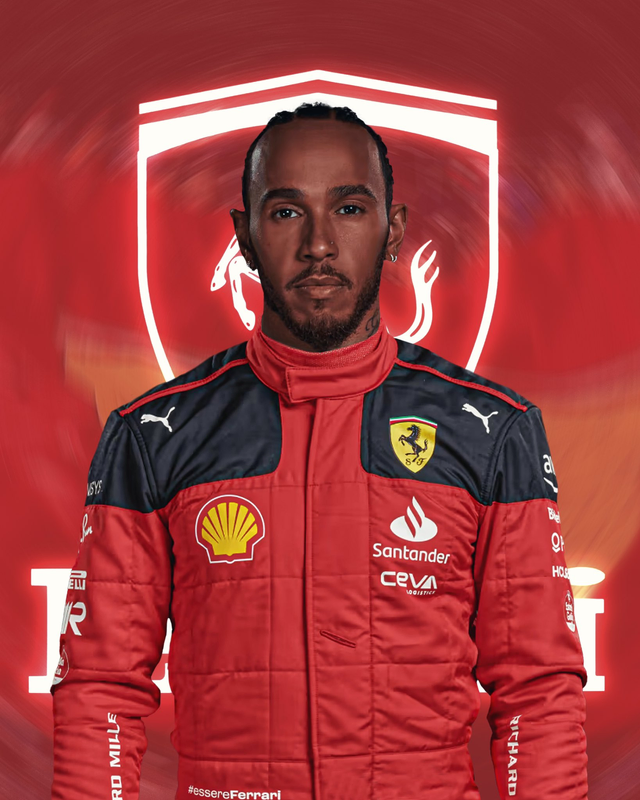

- Hamilton’s Singapore Gamble Exposes Ferrari’s Growing Crisis of Trust
Lewis Hamilton’s apology after the Singapore Grand Prix may have settled the immediate question of responsibility, but it has not resolved the more important issue confronting Ferrari: whether the seven-time world champion retains sufficient confidence in the team’s pit wall to follow its instructions without hesitation.
Hamilton was positioned to deliver a podium at Marina Bay when a Virtual Safety Car offered Ferrari a relatively cheap opportunity to change tyres. The team called both Hamilton and Charles Leclerc into the pits, but Hamilton missed the entry and subsequently decided to remain on the circuit.
It proved costly. Running on increasingly worn tyres, Hamilton lost third place and was overtaken by Mercedes driver Kimi Antonelli and McLaren pair Lando Norris and Oscar Piastri. He eventually finished sixth, surrendering valuable points on a weekend when Ferrari possessed the pace to place both cars on the podium.
Hamilton immediately accepted responsibility.
“Sorry boys. I let you down today with that strategy. My call, and I lost us valuable points,” he told Ferrari over the radio after the race.
The apology was direct and unusually unqualified. There was no attempt to blame unclear communication, equipment failure or the unpredictable behaviour of the tyres. Hamilton later described the outcome as a “painful lesson” and acknowledged that his decision to protect track position had failed.
Yet the incident cannot be understood simply as an isolated error by a driver. It occurred against a background of strategic friction between Hamilton and Ferrari during his first season with the Italian team. That history makes the Singapore decision more revealing than the final classification alone suggests.
Hamilton had started the race on medium tyres while Leclerc began on the softer compound. Ferrari divided its strategy because rain during Saturday’s Sprint had left teams with limited information about dry-weather tyre performance.
The split was initially logical. It gave Ferrari two ways to attack Max Verstappen and reduced the risk of both drivers being compromised by the same tyre choice. In practice, the soft tyre proved significantly stronger.
Hamilton struggled during the opening phase and stopped on lap 19. When he returned to competitive pace on soft tyres, he found himself behind Leclerc, whose slower medium-tyre stint restricted Hamilton’s ability to exploit his fresher rubber.
That detail matters. By the time the Virtual Safety Car appeared on lap 39, Hamilton had already experienced a race in which Ferrari’s sequencing appeared to have favoured Leclerc’s track position over his own strategic momentum.
Ferrari wanted both cars to stop. Team principal Fred Vasseur said the instruction was “crystal clear” and argued that compliance would probably have secured second and third places for the team.
Hamilton missed the pit entrance, but the decisive error came afterwards. Instead of stopping on the following lap and accepting the loss of some track position, he attempted to reach the chequered flag on ageing tyres.
On a circuit where overtaking is difficult, the attraction was understandable. If Hamilton could maintain track position, he might still protect a podium. But the gamble underestimated the severity of tyre degradation and the pace advantage available to cars behind him.
The result was not merely one lost position, but three.
Sky Sports analyst Naomi Schiff argued that Hamilton’s decision was partly explained by weakening trust between the driver and Ferrari’s strategists.
“I think that they’ve sort of lost trust with each other on making the right decisions in certain circumstances,” Schiff said. She suggested Hamilton had begun challenging Ferrari because previous calls had not always produced the right outcome.
That interpretation is plausible, especially after Hamilton’s frustration with Ferrari’s strategy at the preceding Bahrain Grand Prix in Malaysia. Drivers do not suddenly begin second-guessing pit walls. Such behaviour normally develops when earlier decisions have created doubt.
Trust in Formula One is not abstract. A driver travelling at more than 250 kilometres per hour cannot independently process the gaps, tyre projections, rivals’ likely stops, Safety Car timing and weather data available to engineers.
The pit wall sees the whole race. The driver feels the car.
A successful partnership depends on both sources of information being combined quickly. When the driver starts believing that his instincts are more reliable than the team’s broader dataset, strategic execution becomes vulnerable.
Hamilton’s history makes this especially significant. At Mercedes, his partnership with race engineer Peter Bonnington was built over many years. Their communication became efficient because each understood when to challenge and when to insist. Ferrari and Hamilton have not yet developed that institutional shorthand.
However, former world champion Jenson Button rejected the trust explanation. He argued that Hamilton merely wanted control of his race and believed staying out offered a chance to escape Leclerc’s strategic shadow.
“He didn’t want to be sat behind his team-mate for the rest of the race,” Button said. “He wanted to give it a go, and he knew his pace was there when he was on the soft tyre.”
Both assessments may contain some truth. Hamilton wanted track position, but his willingness to reject the safer call may also have been strengthened by doubts created during previous races.
Hamilton made the final decision and correctly accepted responsibility. Nevertheless, Ferrari must ask why its driver felt empowered or compelled to overrule a call that the team later described as obvious.
If the instruction was genuinely unambiguous, Ferrari should examine whether it was delivered forcefully enough. In critical moments, a pit wall must sometimes do more than present an option. It must issue a command supported by the relevant consequence: box now or lose the podium.
Ferrari also needs to consider the events preceding the missed stop. Hamilton’s frustration at following Leclerc was not irrelevant background noise. It shaped his perception of the race and his willingness to gamble.
The danger for Ferrari is that every strategic disagreement becomes part of a cumulative trust deficit. One questionable call can be dismissed as normal racing uncertainty. Repeated confusion can persuade a driver that intervention is necessary.
Once that happens, Ferrari effectively operates with two strategists: the team on the pit wall and Hamilton inside the cockpit. Formula One decisions occur too quickly for such divided authority to work consistently.
The consequences reach beyond one podium. Hamilton left Singapore 111 points behind championship leader Antonelli, while his advantage over race winner Verstappen was reduced to eight points.
Ferrari also lost a potentially valuable double-podium finish despite demonstrating competitive pace throughout the weekend. Hamilton and Leclerc had finished second and third in Saturday’s Sprint, while Leclerc went on to finish second in the Grand Prix.
That should have made Singapore a statement of Ferrari’s progress. Instead, it became another examination of the team’s decision-making.
Hamilton deserves credit for apologising immediately. Publicly accepting responsibility reduces the risk of an internal blame contest and gives Ferrari an opportunity to address the problem constructively.
But an apology is not a repair mechanism.
Before the United States Grand Prix in Austin, Ferrari must establish clearer rules governing strategic authority. Hamilton should retain the freedom to report what he feels in the car, but when the pit wall has superior information and a narrow decision window, the final instruction must carry certainty.
Singapore did not conclusively prove that trust between Hamilton and Ferrari has broken down. It did, however, show that enough doubt exists for the question to be credible.
For a team seeking championships, that alone is a warning. Ferrari’s next challenge is therefore not simply to improve its strategy. It is to build a relationship in which Hamilton believes the team’s call before the opportunity and the podium has disappeared.

