

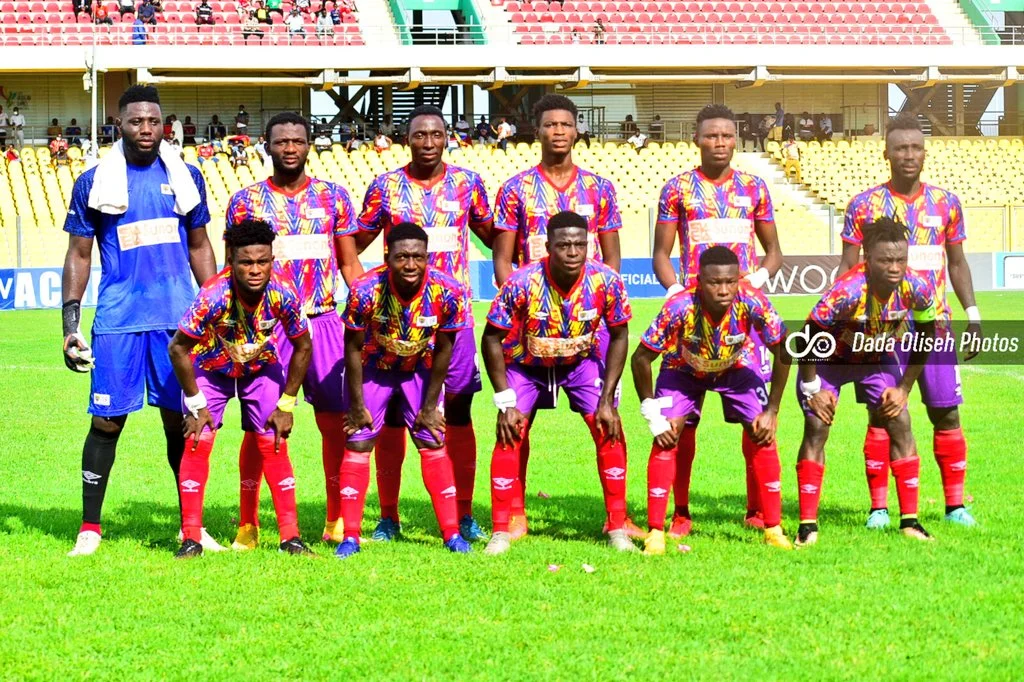

- Hearts Withdraw from GHALCA Top-4 After Rescheduling Talks Fail
Accra Hearts of Oak have withdrawn from the 2026 GHALCA Top-4 Tournament after concluding that the competition would interfere with their pre-arranged preparations for the new Ghana Premier League season. The club announced the decision on Tuesday, August 11, after talks with the Ghana League Clubs Association failed to produce a change in the tournament schedule.
Hearts said the competition was scheduled too close to the start of the 2026/27 league campaign and would disrupt their training programme, player recovery plans and other pre-season commitments. The decision effectively places the club’s competitive preparation for the league ahead of participation in one of Ghanaian football’s traditional pre-season tournaments.
The Phobians had engaged GHALCA over the possibility of adjusting the tournament dates before deciding to withdraw. Those discussions did not result in a rescheduling, leaving the club to proceed with its original pre-season plan under head coach Nebojsa Kapor.
The decision underlines the increasingly delicate balance clubs face between commercial and competitive pre-season events and the sports-science demands of preparing players for a full league campaign. Pre-season tournaments can provide valuable match fitness and competitive intensity, but they can also disrupt carefully structured conditioning programmes if fixtures are compressed too close to the start of the domestic season.
For Hearts, the calculation appears to be that a controlled training programme offers greater value than participating in a tournament whose timing could affect recovery and tactical preparation. That approach is particularly significant for a club entering a new campaign under a recently appointed technical team that may require uninterrupted time to establish playing patterns and assess the squad.
Kapor, who was appointed Hearts head coach on a two-year deal in July, will now continue with the club’s localised pre-season programme. The withdrawal gives him greater control over training loads, friendly matches and player conditioning ahead of the league season.
There is also a broader organisational issue for GHALCA. The Top-4 Tournament is designed to give leading Ghana Premier League clubs competitive preparation while generating interest ahead of the domestic season, but its value depends partly on whether participating teams regard the timing as compatible with their technical programmes.
Losing Hearts of Oak, one of the country’s biggest-supported clubs, inevitably reduces some of the tournament’s commercial and spectator appeal. The Phobians remain one of Ghana football’s strongest brands, and their absence could affect attendance, broadcast interest and the overall profile of the competition.
That does not necessarily mean GHALCA’s scheduling was unreasonable. Tournament organisers must balance venue availability, participating clubs’ calendars and the start date of the league, and finding a window that satisfies every team can be difficult.
The episode nevertheless points to the need for closer calendar coordination between GHALCA, clubs and domestic football authorities. Pre-season competitions are most effective when their dates are agreed sufficiently early for clubs to incorporate them into training schedules rather than forcing teams to choose between participation and their own technical preparation.
Hearts sought to avoid turning the disagreement into a wider dispute. The club expressed appreciation to GHALCA for organising the competition, wished the remaining participating clubs well and stressed that it intended to maintain a cordial working relationship with the association.
That tone suggests the withdrawal is primarily a technical decision rather than a breakdown in relations. Hearts’ position is that the current dates do not fit its preparation model, not that the club is rejecting the Top-4 competition itself.
The timing question is particularly important because the transition from pre-season into competitive football can influence the opening weeks of a campaign. Training loads are typically calibrated to build fitness progressively, and additional competitive fixtures can affect recovery schedules or expose players to injury risks if not properly integrated.
At the same time, competitive matches can give coaches useful information that training-ground sessions cannot fully provide. The trade-off is therefore not between preparation and no preparation, but between a tournament controlled by an external schedule and a programme designed specifically around the needs of the squad.
Hearts have chosen the latter.
The remaining teams will now proceed without one of the country’s most prominent clubs, while GHALCA faces the immediate task of ensuring that Hearts’ withdrawal does not significantly diminish the quality or attractiveness of the tournament.
For the Phobians, the decision will ultimately be judged by what follows when the Ghana Premier League begins. If Kapor’s uninterrupted pre-season produces a fitter, more tactically organised team, withdrawing from the Top-4 will look like a disciplined football decision.
If Hearts start the campaign slowly, however, questions will inevitably return over whether competitive matches in the tournament might have offered more useful preparation. For now, the club has made its priority clear: the league campaign comes first.

