

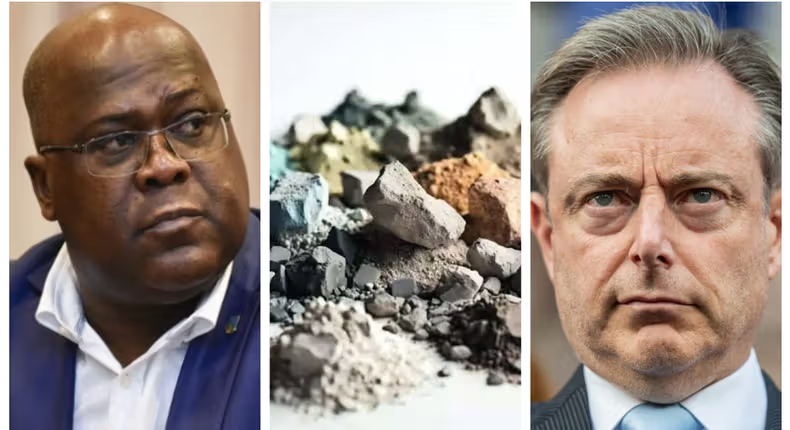

- Colonial-Era Mineral Records Become New Battleground Between DR Congo and Belgium
The Democratic Republic of Congo has intensified efforts to recover millions of colonial-era geological maps and records held in Belgium, as Kinshasa seeks greater control over data that could reveal the location of copper, cobalt, lithium and other critical minerals central to the global energy transition.
The records, currently held at the Royal Museum for Central Africa near Brussels, include maps, field reports, aerial photographs, rock samples and other documents gathered during decades of Belgian colonial rule between 1885 and 1960.
Congolese Mines Minister Louis Watum Kabamba has held discussions with Belgian and European Union officials on the digitisation and transfer of the archives, which Kinshasa considers historically important and commercially strategic.
The push is part of a broader attempt by DR Congo to strengthen what officials describe as “geoscientific sovereignty” over its natural resource base, at a time when demand for minerals used in electric vehicles, renewable-energy systems and advanced technologies is rising sharply.
The country is already the world’s dominant supplier of cobalt and one of Africa’s most important copper producers. However, large parts of its territory remain underexplored, making historical geological records potentially valuable for future exploration and investment.
A spokesperson for the Congolese mining ministry said there was a need to move into implementation because the country must accelerate the discovery of new mineral deposits.
“A very large part of DR Congo has not yet been explored,” the spokesperson said.
Following the talks, officials agreed to draw up a joint roadmap for the digitisation and restitution of the records and to establish a task force to oversee the process.
For Kinshasa, the issue goes beyond access to historical archives.
The maps and records could improve the country’s ability to identify new mineral deposits, negotiate with investors from a stronger position and reduce dependence on foreign companies for geological intelligence.
In the mining industry, geological data is a strategic asset. It helps determine where exploration capital is deployed, how concessions are valued and which investors gain early advantages in identifying commercially viable deposits.
That makes DR Congo’s push for the archives both a sovereignty issue and an economic development strategy.
The dispute also reflects a wider post-colonial debate over assets, artefacts, documents and scientific material retained by former colonial powers after independence.
Belgium governed Congo for decades and accumulated extensive geological knowledge during a period when mineral extraction became central to the colonial economy.
Today, those records have new commercial relevance as global competition intensifies for critical minerals needed for batteries, power systems, defence technologies and industrial supply chains.
DR Congo’s push for the archives comes as the country is also tightening control over its cobalt exports.
Kinshasa suspended cobalt exports in February 2025 after oversupply depressed prices and weakened state revenues.
The export ban was later replaced with a quota system in October 2025, capping exports at 96,600 tonnes annually in 2026 and 2027.
The measures were intended to reduce market oversupply, support prices and increase DR Congo’s influence over a mineral for which it supplies about three-quarters of global output.
The restrictions helped lift cobalt prices, but also tightened supplies for refiners, particularly in China, and accelerated interest in cobalt-free battery technologies.
The latest push for geological records therefore fits into a wider policy shift: Kinshasa wants greater control not only over mineral production and exports, but also over the data that determines where the next generation of deposits may be found.
The issue has also drawn in KoBold Metals, a US exploration company backed by investors including Bill Gates.
KoBold signed an agreement with DR Congo in 2025 to help digitise the geological records. However, the company has yet to gain access to the Belgian-held collection.
Belgian officials have resisted granting exclusive access to millions of documents on DR Congo’s geology to a foreign private company.
Instead, Belgian authorities say the museum will manage the digitisation process and gradually provide digital copies directly to Congolese authorities.
A Belgian government spokesperson said the project was already under way with European Union funding, adding that digital copies were being sent gradually to the relevant Congolese institutions.
The dispute highlights the sensitive balance between public ownership of national geological data and the role of private exploration companies in using such information for commercial gain.
For DR Congo, allowing foreign companies to help digitise and interpret old records could accelerate exploration. But without strong state control, such arrangements could also risk transferring valuable geological intelligence to private actors before national institutions fully benefit.
Across Africa, governments are increasingly recognising that geological data is not simply a technical resource, but a foundation for mineral strategy, investment promotion and bargaining power.
Countries with stronger geological databases are better placed to attract credible investors, design competitive licensing rounds, reduce speculative concession holding and negotiate better terms.
DR Congo’s demand for access to its colonial-era records therefore forms part of a wider continental push to modernise geological data systems and strengthen national control over mineral information.
South Africa’s Council for Geoscience has partnered with mining group BHP to unlock legacy datasets and improve exploration capacity.
The European Union-backed PanAfGeo+ programme is also supporting African geological agencies to improve mapping, data management and technical expertise.
DR Congo joined the PanAfGeo+ INVEST initiative in March 2026, strengthening cooperation on geological data and critical-mineral exploration.
Technology is adding further momentum to this shift.
French miner Eramet has partnered with Lithosquare and France’s national geological service, BRGM, to use artificial intelligence to accelerate the discovery of critical metals, with an initial focus on Africa.
Such developments show how historical geological archives, modern mapping, artificial intelligence and critical-mineral demand are converging to reshape exploration across the continent.
For DR Congo, the recovery and digitisation of colonial-era records could improve the quality of investment into its mining sector and support the discovery of new deposits beyond established mining belts.
However, the process is likely to remain politically sensitive because it touches on colonial history, commercial interests and the question of who controls knowledge about Africa’s natural wealth.
Analysts say the outcome could set an important precedent for other African countries seeking access to geological, agricultural, cultural or scientific records retained abroad.
If successful, DR Congo’s campaign could strengthen its bargaining position in the global critical-minerals race and help redefine how resource-rich African states manage historical data linked to their economic future.
For now, Kinshasa’s message is clear: control over minerals must begin with control over the maps that show where those minerals are.

