

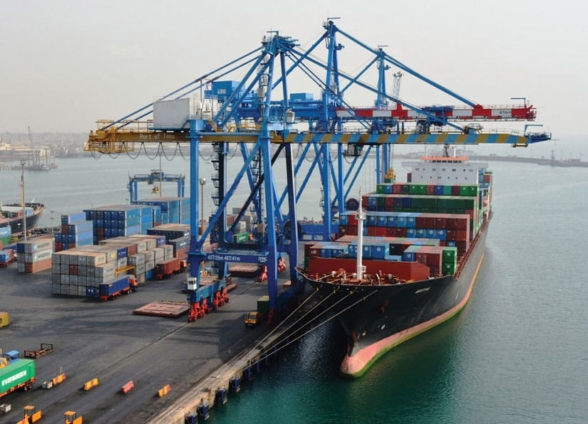

- ICC Ghana Urges Smarter Inspections as Port Delays Become an Invisible Tax on Trade
Ghana’s ambition to become a competitive regional trading and logistics hub is facing an increasingly familiar obstacle: the time it takes for goods to move through its ports.
The International Chamber of Commerce Ghana has warned that delays associated with inspection procedures are increasing both the cost and time of doing business, placing additional pressure on importers, freight forwarders and companies that depend on predictable supply chains.
The warning, delivered at a media forum organised by the Ghana Ports and Harbours Authority, goes beyond the inconvenience of delayed containers. It exposes a structural weakness in Ghana’s trade architecture: substantial investment in ports and digital systems can still be undermined when multiple agencies operate without sufficient coordination.
Emmanuel Doni-Kwame, Secretary-General of ICC Ghana, said the problem required stronger coordination among agencies involved in inspecting goods. His intervention is particularly significant because Ghana has already ratified the World Trade Organisation’s Trade Facilitation Agreement, which is intended to simplify, modernise and harmonise international trade procedures.
For businesses, the economic consequence is straightforward: time at the port has a price.
A container that cannot be cleared promptly can generate storage, handling and demurrage costs, while importers may be forced to keep working capital tied up for longer. Manufacturers waiting for raw materials or machinery can face disruptions to production schedules, and retailers can miss sales cycles.
Those costs may eventually reach consumers through higher prices.
This makes port efficiency more than a customs or maritime issue. It is a national competitiveness issue.
Port delays effectively operate as an invisible tax on trade. Unlike conventional taxes, however, the burden is fragmented across storage charges, financing costs, delayed deliveries, inventory adjustments and lost commercial opportunities.
That fragmentation can make the economic impact less visible in public accounts, but it is no less significant for companies operating on narrow margins.
For a manufacturer importing machinery, a delay can postpone installation and production. For a retailer, it may mean receiving stock after a peak sales period. For an exporter, a delay in obtaining imported inputs can affect delivery commitments to customers abroad.
The cumulative effect is a less predictable business environment.
Predictability matters because companies deciding where to locate distribution centres, factories or regional operations assess much more than wages, taxes and electricity costs. They also examine how reliably goods can enter and leave the country.
If clearance procedures are unpredictable, businesses build extra buffers into their operations. Those buffers require more inventory, more financing and more time.
ICC Ghana’s warning therefore raises a fundamental policy question: how can Ghana maintain effective border controls without imposing unnecessary friction on legitimate trade?
One potential answer is the Authorised Economic Operator programme.
The AEO framework is built around a simple principle: businesses with proven compliance records should be treated as lower risk and rewarded with more efficient customs procedures.
Mr Doni-Kwame said the programme could help reduce unnecessary inspections by building greater trust between Customs and businesses that consistently demonstrate compliance. Lower-risk firms, he argued, should be supported to qualify for faster clearance arrangements.
ICC Ghana intends to engage the Customs Division and identify companies that can be helped to develop the systems and capacity required to become Authorised Economic Operators.
The potential benefits are significant for both sides.
For government, stronger risk-based clearance means inspection resources can be concentrated on consignments and businesses presenting higher risks. For compliant companies, it reduces uncertainty and the commercial cost associated with unnecessary checks.
Trade facilitation, in other words, does not have to mean weaker enforcement.
It can mean smarter enforcement.
But a more effective AEO system will not by itself solve the coordination problem if several inspection agencies continue working independently.
Ghana’s ports involve multiple institutions with legitimate regulatory mandates. The economic inefficiency emerges when businesses must wait for one agency to finish before another begins, even where inspections could be coordinated.
Mr Doni-Kwame called for stronger coordination around joint inspections and proposed that the agency responsible for the longest delay could take the lead in organising inspection schedules.
That could allow relevant agencies to inspect consignments simultaneously rather than sequentially.
The logic is compelling.
If three agencies must inspect the same container, the objective does not necessarily have to be reducing the number of inspections. It should be ensuring that the inspections take place in the most efficient sequence possible.
Coordinated inspections could reduce congestion and turnaround times without weakening regulatory oversight.
That would effectively turn inter-agency coordination into an economic productivity tool.
The stakes are particularly high because Ghana wants its ports to serve not only the domestic economy but the wider West African market.
The country’s Atlantic location and existing infrastructure provide a strong foundation for regional trade, but geographical advantage alone does not create a logistics hub.
Speed, cost and predictability do.
A trader deciding whether to route cargo through Ghana compares the total cost of the journey, including port charges, customs procedures, inland transport, delays and financing costs.
If Ghana becomes materially more expensive or less predictable than competing routes, cargo can migrate elsewhere.
That is why ICC Ghana’s intervention should be understood as a competitiveness warning rather than an operational complaint.
Ghana’s broader industrialisation and AfCFTA ambitions also depend on logistics performance. Businesses cannot efficiently serve regional markets if inputs are delayed at the port or finished products cannot move through the system predictably.
There is also a macroeconomic dimension.
Ghana remains dependent on imports for machinery, fuel, intermediate goods, pharmaceuticals and other critical inputs. Any inefficiency at the border therefore has the potential to affect a wide section of the economy.
Reducing unnecessary port delays could lower businesses’ working-capital needs, improve inventory management and reduce some of the costs embedded in imported goods.
That makes trade facilitation part of the broader ease-of-doing-business agenda.
The ideal system is one in which low-risk trade moves quickly, high-risk trade receives appropriate scrutiny and regulatory agencies operate from a common timetable.
Technology can help achieve that, but technology alone will not solve the problem.
The harder reform is institutional. Agencies must share information, coordinate inspection schedules and accept that the ultimate customer of the port system is the wider economy.
The ICC Ghana proposal offers a practical starting point.
Greater use of the AEO programme can create trusted lanes for compliant companies. Joint inspections can reduce unnecessary waiting. Better risk profiling can allow regulators to focus attention where it matters most.
For Ghana, the payoff goes beyond shorter queues.
A more predictable port system can reduce business costs, support manufacturers, improve trade flows and strengthen the country’s attractiveness as a gateway into West Africa.
The central lesson is therefore straightforward.
Ghana does not necessarily need fewer inspections. It needs fewer unnecessary delays.
In a global trading system where competitiveness is increasingly measured in hours and days, the time a container spends waiting can matter as much as the distance it travels.
For Ghanaian businesses, that waiting time is not merely an inconvenience.
It is money.

