

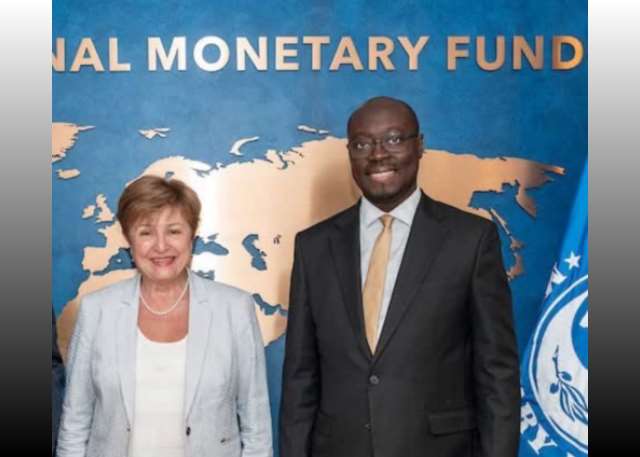

- IMF Programme Enters Final Stage as Ghana Seeks 36-Month Policy Anchor
Ghana is approaching the end of its three-year International Monetary Fund rescue programme, setting the stage for a transition from emergency financial support to a non-financing policy arrangement intended to preserve the country’s hard-won economic stability.
The IMF’s Executive Board is expected to consider Ghana’s sixth and final review under the Extended Credit Facility, alongside the 2026 Article IV consultation and a request for a 36-month Policy Coordination Instrument.
Completion of the review would make available the final tranche under the US$3.00 billion programme approved in May 2023. The IMF’s programme documents place the outstanding disbursement at SDR265.90 million, equivalent to about US$360.00 million when the financing schedule was prepared.
The decision would close a programme introduced at the height of Ghana’s economic crisis, when the government had lost access to international capital markets, public debt had become unsustainable and inflation and currency depreciation were eroding household incomes and business confidence.
More significantly, approval of the proposed Policy Coordination Instrument would shift Ghana’s relationship with the Fund from one centred on bailout financing to continued surveillance and structural reform.
The PCI does not provide fresh IMF funding. Instead, it offers a formal framework through which the Fund regularly assesses a country’s economic policies and reform implementation.
For Ghana, the arrangement would provide an external policy anchor as the government seeks to consolidate recent improvements in inflation, the exchange rate, foreign reserves, public finances and debt sustainability.
IMF staff and the Ghanaian authorities reached a staff-level agreement in May following discussions in Accra between April 29 and May 15. The mission combined negotiations on the final ECF review with the Article IV consultation and the proposed PCI.
The Fund said Ghana’s programme had delivered “substantial stabilisation gains”, supported by reform implementation and progress in restructuring domestic and external debt.
Inflation had declined rapidly, international reserves had been rebuilt and confidence in the cedi had improved, the IMF said. Fiscal performance also strengthened in 2025, while economic growth exceeded expectations and the public debt ratio fell sharply.
Programme performance was assessed as broadly satisfactory, with most quantitative targets met. However, the Fund noted that the implementation of several structural reforms had been delayed.
The expected transition comes after three years of fiscal adjustment, monetary tightening and debt restructuring that imposed significant costs on households, businesses, banks and investors.
Ghana launched a domestic debt exchange that altered the maturity and payment terms of government securities before reaching restructuring agreements with official bilateral creditors and Eurobond holders.
The resulting improvement in the debt trajectory has created what the IMF described as carefully calibrated fiscal space for development expenditure, including spending on youth employment and social programmes.
That space would nevertheless depend on continued reforms in public financial management, state-owned enterprise governance and the control of quasi-fiscal activities.
Under the proposed PCI, the government and the Fund have agreed on six broad policy priorities: sustaining growth-friendly fiscal adjustment, safeguarding debt sustainability, strengthening fiscal transparency and governance, improving monetary and exchange-rate management, reinforcing financial-sector stability and supporting economic diversification and inclusive growth.
The framework would allow Ghana to lower its primary surplus target to 0.50% of gross domestic product from 2027 while remaining consistent with its objective of reducing public debt to 45.00% of GDP by 2034, according to the IMF’s staff-level agreement.
That adjustment would create additional room for development spending, but only if the authorities prevent the re-emergence of expenditure arrears, contingent liabilities and losses at public institutions.
Finance Minister Dr Cassiel Ato Forson has presented the PCI as a mechanism for maintaining policy credibility while shifting the government’s attention from crisis stabilisation towards growth and employment.
For investors, the arrangement could provide continued reassurance that economic policy will remain subject to regular external assessment after the ECF expires.
The absence of new IMF financing, however, means Ghana will increasingly need to fund its development needs through domestic revenue, private investment, concessional financing and a gradual return to capital markets.
The transition will therefore test whether the authorities can maintain fiscal and monetary discipline without the immediate incentive of programme disbursements.
The IMF has warned that the stabilisation gains remain vulnerable to policy reversals, global uncertainty and unresolved weaknesses in the energy, cocoa and financial sectors.
In the energy sector, the Fund has called for stronger action to reduce distribution and collection losses at the Electricity Company of Ghana, improve payment discipline, clear legacy arrears and reduce power-generation costs.
It has also called for deeper reforms to improve Cocobod’s financial sustainability, including tighter cost controls and more frequent adjustments to the producer price paid to cocoa farmers.
The financial sector presents another unfinished part of the reform programme. The Fund has urged Ghana to complete bank recapitalisation, restructure weaker state-owned institutions, reduce non-performing loans and strengthen the central bank’s crisis-management framework.
It has also raised concerns about losses associated with the Bank of Ghana’s Domestic Gold Purchase Programme, arguing that greater transparency and safeguards are required to prevent quasi-fiscal activities from weakening the central bank’s balance sheet.
Ghana’s previous IMF programmes have often delivered initial stabilisation before fiscal pressures, particularly around election cycles, reversed some of the gains.
The proposed PCI is intended partly to break that pattern by embedding the post-bailout reform agenda in a formal monitoring structure.
The final ECF review will therefore represent more than the release of Ghana’s remaining programme financing.
It will mark the beginning of a more difficult phase in which the country must demonstrate that lower inflation, exchange-rate stability and improving public finances can be maintained through domestic institutions and disciplined policymaking rather than repeated emergency support.
For markets, the central question is no longer whether the IMF can help stabilise Ghana’s economy. It is whether Ghana can preserve that stability after the bailout ends.

