

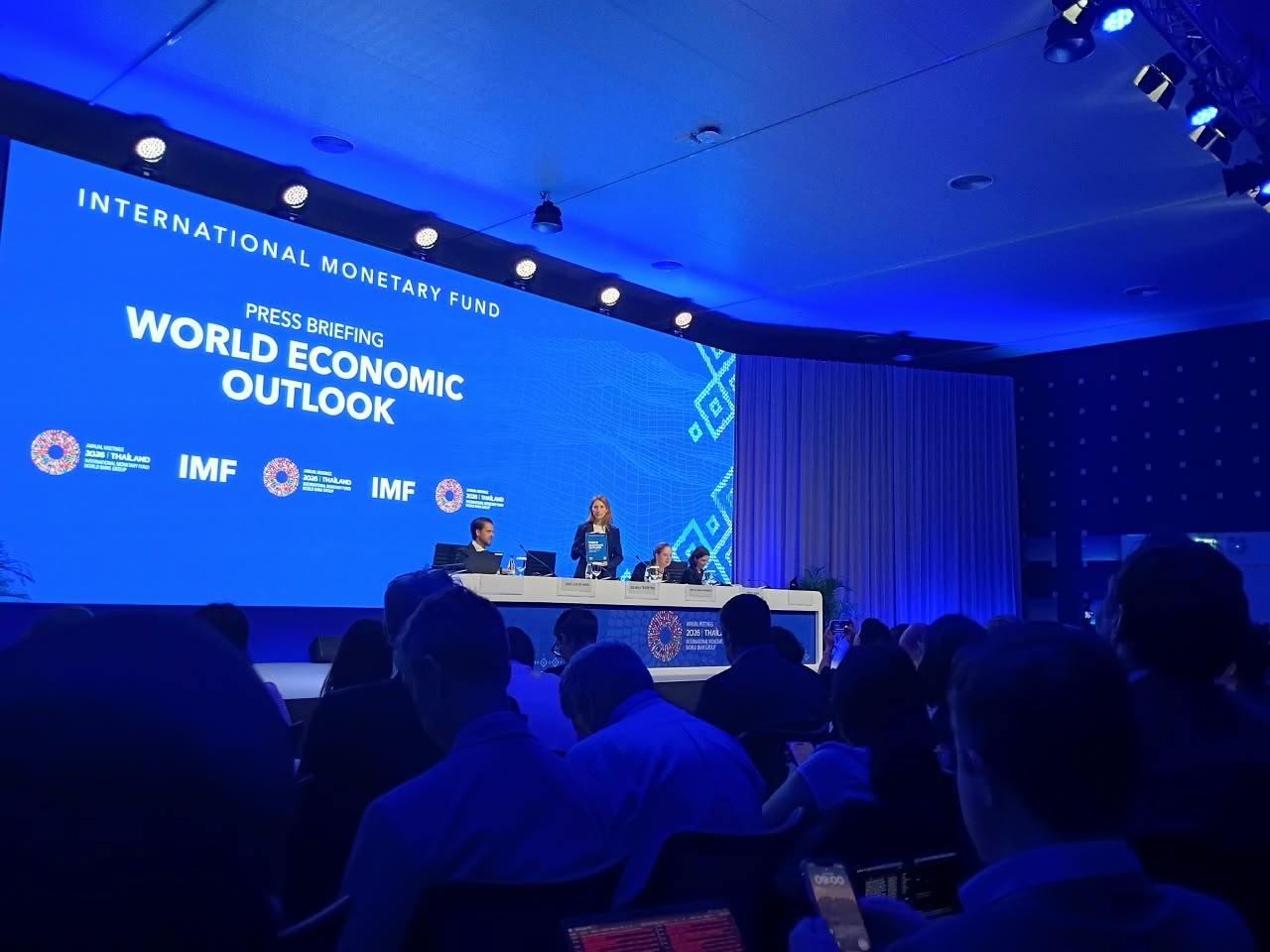

- IMF Warns Global Resilience Is Masking a Widening Economic Divide
The global economy has avoided the deep contraction many feared from war, trade fragmentation and renewed energy shocks. But the International Monetary Fund’s latest assessment suggests that resilience is becoming less a shared global condition than a privilege enjoyed by economies with the right exports, technology exposure and financial buffers.
In its October 2026 World Economic Outlook, the Fund describes the world economy as “resilient, but unevenly so”, warning that the room available for countries to absorb further shocks is narrowing rapidly. execsum.pdf
Global growth is projected at 3.1 per cent in 2026 and 3.4 per cent in 2027. The forecast for this year is unchanged from April, while the 2027 projection has been revised moderately upwards.
Those numbers appear reassuring. They indicate that the continuing Middle East conflict, tariff disputes and uncertainty surrounding global trade have not pushed the world into recession. Yet the stable headline disguises a redistribution of growth, inflation and financial pressure across countries.
Economies connected to artificial-intelligence investment or benefiting from higher energy prices are receiving new demand and export income. Countries that import fuel, lack meaningful participation in technology supply chains and possess limited fiscal space face a much more difficult combination: higher import bills, exchange-rate pressure, weaker household purchasing power and fewer sources of compensating growth.
That division matters for Ghana and much of Africa. Ghana exports gold, cocoa and oil, giving it commodity buffers that some low-income economies do not possess. But it remains dependent on imported petroleum products and has limited participation in the hardware, computing and advanced-services value chains driving the global AI investment cycle.
Its position is therefore mixed. Strong gold prices can support export receipts and foreign-exchange reserves, while expensive refined fuels increase dollar demand, transport costs and pressure on consumers. The country benefits from one side of the global commodity adjustment while remaining vulnerable to the other.
The IMF attributes the better-than-expected performance during the first half of 2026 to adaptation by governments and private businesses. Shipments were rerouted, inventories drawn down and fiscal support deployed. Economies have also become less energy-intensive than during earlier oil shocks.
However, these adjustments cannot be repeated indefinitely. Inventories eventually require replenishment, alternative shipping routes can be more expensive, and fiscal support consumes resources governments may already lack.
The resilience celebrated today may consequently be borrowing capacity from tomorrow. If conflict persists, governments could discover that the buffers used to soften the first shock are unavailable for the next one.
That warning is particularly relevant to highly indebted developing economies. Ghana has made progress in restoring fiscal stability after restructuring its debt, but it cannot respond to every increase in fuel or food prices through broad subsidies without weakening the public finances it is attempting to repair.
The IMF projects global headline inflation to rise to 4.7 per cent in 2026 before easing to 4.1 per cent in 2027. The cumulative forecast has been raised by 0.7 percentage points, mainly because of higher energy and food prices.
For Ghana, global inflation does not transmit mechanically into domestic prices, but fuel, freight, fertiliser and imported inputs provide powerful channels. A weaker cedi can magnify the domestic effect by increasing the local-currency price of goods even when their dollar price remains unchanged.
This creates a difficult policy trade-off. Protecting households through fuel subsidies or price controls may provide immediate relief, but poorly targeted measures can impose large fiscal costs and weaken the price signals needed to encourage conservation and alternative supply.
The IMF recommends temporary, targeted and nondistortionary income support rather than broad measures that undermine fiscal sustainability. The logic is compelling, although implementation depends on whether governments possess reliable social registries and payment systems capable of reaching vulnerable households quickly.
The present global cycle is being shaped by two powerful forces: geopolitics and technology. War is raising the value of energy security and commodity access, while AI investment is directing capital towards data centres, semiconductors, electricity systems and advanced digital services.
Countries participating in these value chains receive investment and demand that can offset other weaknesses. Those outside them face the costs of technological and geopolitical disruption without receiving an equivalent growth impulse.
This is where Africa risks falling further behind. The continent possesses energy resources and critical minerals, but much of the higher-value processing, technology development and intellectual property remains elsewhere. African economies may export raw inputs into the AI and energy transitions without capturing the productivity gains generated downstream.
Ghana’s response cannot be limited to promoting digital literacy or encouraging start-ups. AI readiness requires reliable electricity, affordable connectivity, data infrastructure, technical skills, research capacity and rules that encourage innovation while protecting citizens.
Without these foundations, the global technology cycle could widen rather than close Ghana’s productivity gap. Domestic businesses would pay for imported software and computing services while competing against foreign companies using technology more intensively.
The IMF also warns that the AI boom presents its own financial risk. If expected profitability and productivity gains are reassessed, investment could fall sharply, equity markets could correct and financing conditions could tighten.
World trade volume growth is expected to slow in 2026 and stabilise in 2027 as tariffs, production-chain adjustments and geopolitical fragmentation restrain commerce. Technology-related trade remains comparatively strong, but the broader system is becoming less efficient and predictable.
Regional trade cannot fully insulate Ghana from global shocks, but deeper African production networks could reduce dependence on distant suppliers, create markets for processed goods and allow countries to share capabilities across borders.
That opportunity will be missed if AfCFTA remains more effective as a diplomatic project than a commercial system. Businesses require efficient ports, harmonised standards, reliable payments, predictable border procedures and transport links that make regional trade cheaper than established overseas routes.
The Fund’s most consequential policy warning concerns public finances. Elevated debt, rising sovereign yields and growing spending demands leave governments increasingly exposed when the next disruption arrives.
It calls for credible fiscal-adjustment plans combining stronger revenue mobilisation with expenditure rationalisation and institutional reforms. This is not merely a demand for austerity. It is an argument that governments must create room to respond to emergencies without triggering a financing crisis.
For Ghana, rebuilding fiscal space means more than meeting annual deficit targets. It requires controlling arrears, managing state-owned enterprise liabilities, improving the quality of public investment and ensuring that revenue measures do not disproportionately punish compliant formal businesses while large parts of the economy remain outside the tax net.
The composition of adjustment matters. Cutting productive infrastructure or essential social services may improve a near-term balance while weakening future growth. Conversely, preserving inefficient expenditure under the label of social protection can entrench fiscal vulnerability.
The report rejects a uniform monetary response. Central banks must consider domestic inflation, expectations, demand conditions and the position of policy rates relative to neutral levels.
Energy importers facing weak demand may need caution rather than automatic tightening, particularly where inflation remains near target. Economies experiencing stronger technology-related demand and persistent underlying inflation may require higher rates.
For the Bank of Ghana, this reinforces the need to distinguish temporary imported inflation from broader price pressure. Tightening policy aggressively in response to a fuel shock could suppress domestic credit without producing more oil or reducing global prices.
Ignoring second-round effects would be equally dangerous. If higher fuel costs spread into transport fares, wages and inflation expectations, temporary pressure can become persistent. Exchange-rate movements add another complication because depreciation can amplify imported inflation and undermine confidence.
The appropriate response therefore depends on data, communication and coordination with fiscal policy. Monetary policy cannot preserve price stability if government spending continually recreates excess demand, while fiscal policy cannot deliver growth sustainably if inflation keeps borrowing costs elevated.
The IMF’s global message is not that disaster is inevitable. Upside possibilities remain: AI productivity gains could arrive faster, new trade agreements could reduce uncertainty and expensive fossil fuels could accelerate investment in energy security.
But resilience should not become an excuse for complacency. The world has endured successive shocks partly by using inventories, fiscal resources and financial buffers accumulated earlier. Those cushions are becoming thinner.
For Ghana, the central policy question is how to use today’s favourable gold earnings and improving macroeconomic credibility to prepare for less supportive conditions. That means building reserves, maintaining fiscal discipline, strengthening energy security and investing in the infrastructure and skills required to participate in the technology economy.
The most dangerous reading of the IMF forecast would be that global growth has survived and therefore existing policies are sufficient. The more useful interpretation is that survival has purchased limited time.
Countries that use that time to rebuild buffers and improve productive capacity may enter the next shock stronger. Those that consume their temporary advantages could discover that global resilience was real but never equally available.

