


- Industrial Policy Is Adapting to Crises, but Remains Hard to Implement Effectively
Industrial policy, the use of government interventions to support or develop specific firms and industries, has grown more popular in recent years—especially in response to crises.
The war in the Middle East is the latest example, with high energy prices and geopolitical upheaval prompting action. In addition to economy-wide support measures, such as fuel price caps and reduced excise duties, at least 305 industrial policy measures attributed to the conflict were announced in its first two months. They included energy and fertilizer export bans, subsidies for green energy products, and support for exporters.
These measures follow a broad uptick in industrial policy actions in recent years. The New Industrial Policy Observatory, which we developed with the Global Trade Alert, shows a sharp acceleration since 2020, when COVID-19 unleashed a wave of government action. Unlike previous crises, many of those measures remained in place after the emergency passed.
NIPO data, encompassing more than 52,000 interventions across 75 countries since 2009, shows that the total introduced last year was 2.5 times the pre-pandemic average.

Chart showing industrial policy activity has accelerated since the pandemic
This growth underscores the need to better understand how and why industrial policy is evolving—and when it’s successful.
Priorities shifting
Our analysis reveals a notable shift in why governments intervene. The recent embrace of industrial policy is increasingly motivated by resilience and security concerns, which are unlikely to abate given rising tensions in the Middle East.
After 2008, the dominant justifications for industrial support were to boost competitiveness and address climate change. But since 2020, they’re aimed more at supply chain resilience, national security, and geopolitical concerns, according to our study, which used large language models to classify policies by their rationale.

Chart showing industrial policy being more oriented toward national security and geopolitical issues
That shows how governments are no longer aiming just to build stronger, more competitive, industries. They increasingly want to depend less on geopolitical rivals and protect what they consider to be strategic sectors. This is a qualitatively different kind of industrial policy.
What’s working?
Our analysis shows that the results are mixed, with success determined by policy design, such as the choice of instrument used. But the picture becomes less encouraging with more detailed evidence—specifically our research on the economic impact of industrial policies, looking at trade patterns across countries and products, and how firms in targeted sectors respond.
Product-level analysis shows that industrial policy tends to improve competitiveness for targeted sectors, but with short-lived effects. More importantly, the boost is mostly seen in sectors that were already competitive. That’s an important consideration for governments hoping to use industrial policy to build new industries from scratch.
Firm-level subsidies are associated with sustained increases in capital investment, but their productivity and output effects fade quickly and can even reverse after a few years. Export incentives have little bearing on firm performance, though there are some signs that they can reallocate resources toward more productive firms after a period of adjustment.
There are bright spots. Many are linked to some of the newer industry policy objectives, such as climate and value chain resilience. When targeting sectors with high market distortions, such as generous mark-ups and external financial dependence, the effect can be as much as four times larger. Also, policies supporting the green transition show stronger and more durable improvements in competitiveness. And interventions that target components for final products, known as the upstream part of the supply chain, appear more effective than those directly aimed at end products.
Elusive success
Our takeaway is not that industrial policy is misguided. There are sound economic reasons for it in the presence of market failures. Rather, we conclude that it’s far harder to achieve the intended goals than the current political popularity of these actions might suggest. The evidence does not support the idea of self-reinforcing cycles of success, where government support fosters competition. Instead, we mainly see modest, temporary gains in sectors that were already strong.
This evidence raises a key question: should industrial policy even be the right first step?
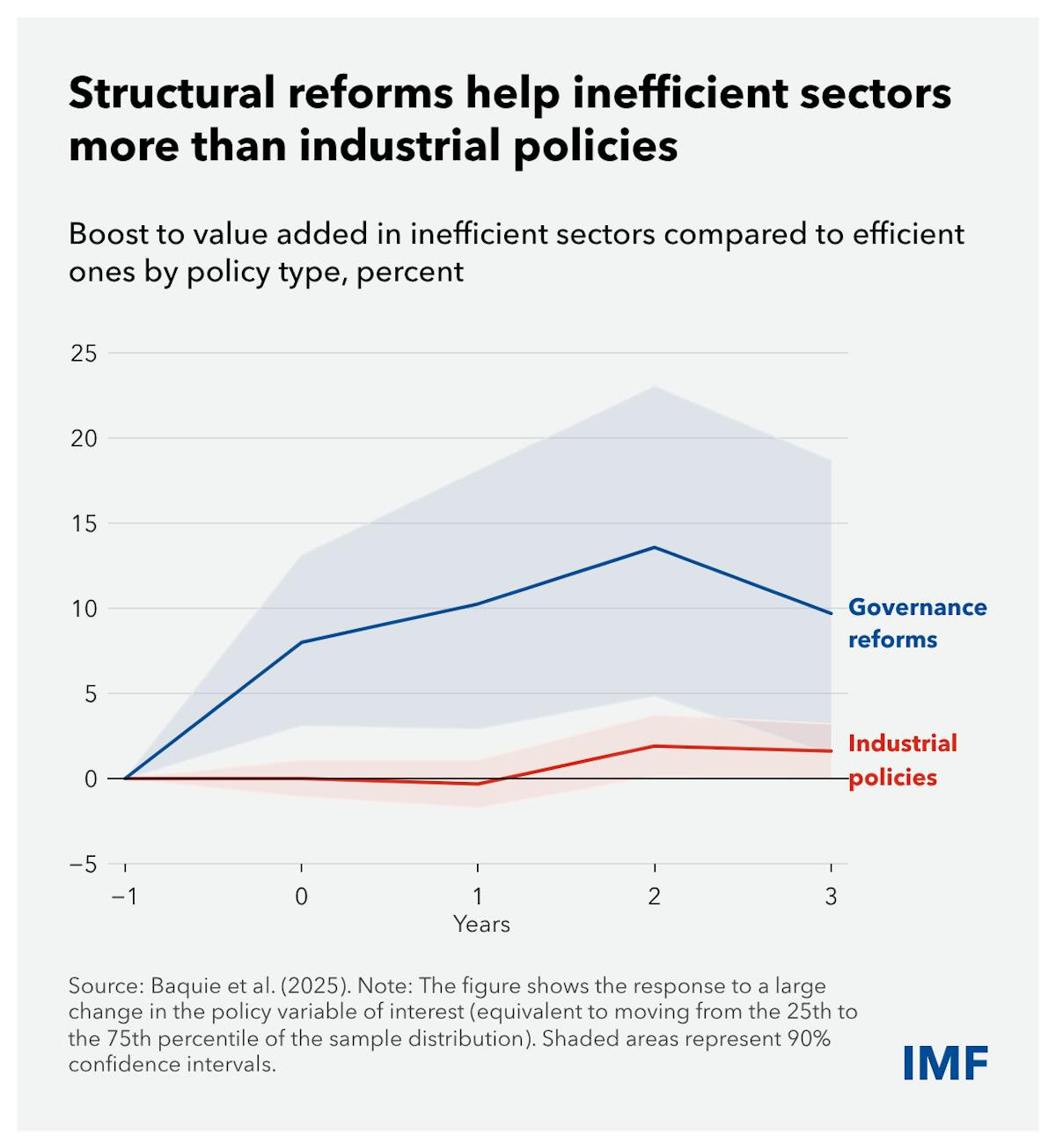
Broader, economy‑wide reforms often deliver bigger gains. Institutional and regulatory improvements can raise output in inefficient industries by as much as 10 percent in the medium term. This is five times as large as the medium-term output boost seen after the implementation of industrial policies. Financial reforms especially help credit‑constrained industries. More broadly, structural reforms benefit all sectors, avoid the risks of anointing winners, and improve the prospects of industrial policy succeeding if it is used.
Chart showing structural reforms help inefficient sectors more than industrial policies
Spillover effects
Governments often overlook broader country‑wide and global effects. Industrial policy typically reallocates resources to targeted entities, which may hurt the overall economy if it comes at the expense of more productive players. Further, when one country subsidizes a strategic sector, others frequently follow, as the NIPO data show.
The result can be an expensive, globally inefficient arms race of subsidies that leaves everyone worse off. Finally, industrial policy measures can matter for global imbalances when they impact aggregate productivity or are applied economy-wide to force savings and to redirect resources toward external surpluses. Managing these spillovers will require more international cooperation at a time when geopolitical tensions make such cooperation increasingly difficult.
While it is clear that industrial policy is back, it’s harder to say whether it can deliver sustained economic benefits or at what cost. Our analysis suggests it depends on how carefully policies are designed, how well governed the implementing institutions are, the strength of a country’s macroeconomic policy fundamentals, and whether the world can coordinate, not retaliate.
- By Adam Jakubik, Florence Jaumotte, Samuel Pienknagura, Michele Ruta

