

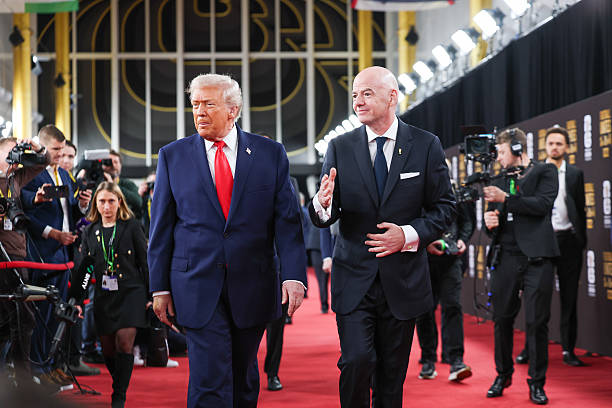

- Infantino Wins Trump’s Public Support as UEFA, Concacaf and AFC Challenge FIFA Leadership
US President Donald Trump has warned FIFA against removing Gianni Infantino from office, throwing his weight behind the football governing body’s president at a moment when Infantino is facing mounting criticism over a now-abandoned plan to bring private investors into FIFA’s commercial operations.
Trump’s intervention follows criticism from UEFA, Concacaf and the Asian Football Confederation over FIFA’s proposed Forward Enterprise structure, which would have created a new company to manage commercial and ticketing rights linked to FIFA competitions, including the World Cup. Under the proposal, a 21.00% stake would have been made available to private investors.
“Fifa would be making a terrible mistake if, for any reason, they even considered replacing president Gianni Infantino,” Trump wrote on social media. He added that Infantino had presided over what he described as the most successful World Cup ever staged and argued that FIFA would struggle to replicate its commercial performance without him.
The comments amount to Trump’s strongest public defence of Infantino since the commercial proposal emerged in late July. They also add a political dimension to what had initially been an internal football-governance dispute about transparency, commercial rights and how major strategic decisions are developed within FIFA.
The controversy centres on the Forward Enterprise proposal and the extent to which FIFA’s confederations were consulted before it was advanced. UEFA, Concacaf and the AFC subsequently issued an open letter accusing FIFA of breaking trust “through deception” over the process.
That criticism matters because the dispute is not simply about whether private investment should ever play a role in FIFA’s commercial structure. It is also about governance: who has the authority to reshape the economics of the World Cup, what level of consultation should precede such a decision and how much influence private capital should exercise over assets belonging to football’s global governing body.
The plan was eventually abandoned, but the political damage has persisted. FIFA later issued an apology and acknowledged that mistakes were made after details of the proposal became public, while its leadership reaffirmed support for Infantino.
The episode has consequently raised questions about whether the controversy can be contained as a failed commercial proposal or whether it has become a wider challenge to confidence in FIFA’s leadership. When three major confederations jointly raise concerns about trust and decision-making, the issue extends beyond the merits of one transaction.
Trump’s support gives Infantino a powerful external ally, particularly after a 2026 World Cup co-hosted by the United States, Canada and Mexico. But it also risks reinforcing perceptions that the FIFA president’s political relationships have become increasingly intertwined with the organisation’s wider governance debate.
The relationship between Trump and Infantino has been highly visible throughout preparations for the tournament and during the competition itself. Trump’s intervention therefore demonstrates how FIFA’s leadership controversies can extend beyond football administration into international politics.
The substance of the dispute, however, remains commercial governance. FIFA controls some of the most valuable sporting rights in the world, and any proposal involving private ownership of part of the structure managing those assets inevitably raises questions about valuation, control and the distribution of future revenues.
A 21.00% private stake would have represented more than a technical restructuring. It would have effectively introduced external investors into an enterprise built around commercial and ticketing rights associated with FIFA competitions, potentially creating long-term financial consequences for the governing body and its member associations.
The identity of the prospective investors has added another layer of scrutiny. Citi Sports reported that the proposed investor group was expected to be led by Thrive Eternal, a US venture capital firm founded by Joshua Kushner, brother of Trump’s son-in-law Jared Kushner.
That connection does not itself establish wrongdoing, but it makes transparency around the process particularly important. Where commercial arrangements involve politically connected individuals or companies, governance institutions generally face greater pressure to demonstrate that decisions were competitively structured and insulated from improper influence.
Trump had previously said he had not discussed the Forward Enterprise proposal with Infantino when he first commented publicly on the controversy at the end of July. His latest statement therefore focuses squarely on defending Infantino’s continued leadership rather than the commercial proposal itself.
That distinction may become important as FIFA determines how to respond to the criticism. Abandoning the proposal removed the immediate commercial issue, but it did not resolve the underlying concern about how the idea was developed and communicated.
The controversy also highlights a broader tension inside global football. FIFA has become one of the world’s most commercially powerful sporting organisations, but its legitimacy still depends on member associations and regional confederations accepting that major decisions are made transparently and with appropriate consultation.
Private capital can provide liquidity, expertise and growth opportunities, but selling an interest in rights connected to the World Cup is fundamentally different from conventional corporate fundraising. The asset being monetised is not owned by shareholders in the traditional sense; it sits inside an international sporting institution whose revenues ultimately support football development around the world.
That makes governance standards particularly important. Even a commercially attractive proposal can generate resistance if stakeholders believe they were excluded from the process or if the long-term implications for control and revenue distribution are unclear.
Trump’s argument is that Infantino’s commercial record should outweigh the controversy. His claim that FIFA would be less successful and profitable without the Swiss-Italian administrator effectively frames the leadership debate in terms of performance rather than process.
Infantino’s critics are approaching the issue from the opposite direction. For them, strong financial results do not eliminate the need for transparent governance, particularly when decisions concern assets as valuable and politically sensitive as World Cup commercial rights.
That leaves FIFA facing a more fundamental question than whether one proposal should be revived or permanently abandoned. The organisation must determine whether trust between its leadership and major confederations can be repaired without broader changes to how strategic commercial decisions are made.
Trump’s intervention may strengthen Infantino politically, but it is unlikely by itself to settle that governance dispute. If anything, the public support of a sitting US president could intensify scrutiny of the relationships surrounding FIFA’s leadership and commercial strategy.
The immediate threat to Infantino may therefore be less about a formal removal process than about the erosion of confidence among powerful football institutions. UEFA, Concacaf and the AFC collectively represent a substantial share of FIFA’s sporting and commercial ecosystem, meaning any prolonged breakdown in trust could complicate future decisions.
For FIFA, the lesson from the failed Forward Enterprise proposal is that commercial innovation cannot be separated from institutional legitimacy. The governing body can pursue new sources of capital and revenue, but only if member associations and confederations believe the rules of the process are credible.
Trump has now made clear where he stands. Whether FIFA’s own stakeholders agree will determine whether the controversy ends as a failed commercial experiment or develops into a much deeper test of Infantino’s authority.

