

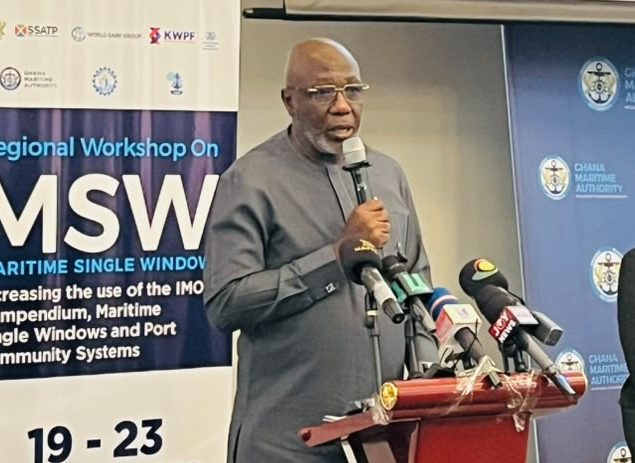

- Institutional Turf Disputes Threaten Ghana’s Maritime Single Window — GMA Boss
Ghana’s attempt to create a fully integrated Maritime Single Window could be derailed by institutional turf disputes unless state agencies place trade efficiency above control of individual systems, the Director-General of the Ghana Maritime Authority has warned.
Capt. Dr Kamal-Deen Ali said Ghana had already invested in several digital platforms supporting maritime activity, but those investments would not deliver their full economic value if port authorities, customs, immigration and maritime regulators continued operating as separate information territories.
The country’s problem is no longer simply whether agencies possess technology; it is whether institutions with different mandates, databases and interests are willing to function as one trade ecosystem.
“I am aware, of course, as a public servant, and some of us spent many years in public service, that one of the challenges we always have is the issue of ownership and turf and who should control what,” Capt. Ali said.
“But we have a simple obligation of making sure that trade facilitation works very well for all of us.”
He was speaking at the opening of a five-day Regional Workshop on Maritime Single Window at the Alisa Hotel in Tema on October 19, 2026.
The programme brings together the International Maritime Organization, World Bank, Korea-World Bank Partnership Facility, regional maritime institutions and private-sector representatives to examine implementation of maritime single windows and port community systems.
Maritime administrations have been under pressure to modernise vessel-clearance processes since the IMO’s mandatory Maritime Single Window requirements took effect on January 1, 2024.
A Maritime Single Window allows shipping operators to submit vessel-related information electronically through one entry point. Relevant public institutions can then obtain the information necessary to perform their respective regulatory duties without requiring the operator to repeat the same submission.
Ghana’s maritime economy includes the Ghana Ports and Harbours Authority, Customs Division of the Ghana Revenue Authority, Ghana Maritime Authority and Ghana Immigration Service, among other bodies.
The difficulty begins when separate mandates produce different data requirements, incompatible technology, duplicated approvals or competing claims over who should own and manage the central platform.
A shipping company may no longer carry documents from office to office, yet it can still be required to upload similar information to several platforms, wait for sequential approvals and resolve inconsistencies between agencies.
The trader encounters several digital doors instead of several physical counters, while the underlying administrative burden remains largely intact.
Capt. Ali therefore argued that Ghana should refine and connect the systems it already possesses rather than equating progress with the procurement of additional platforms.
“But I’m sure we are all looking at striving to see whatever systems we have in place, how we will build those systems, refine them, and let them work more effectively,” he said.
He pointed to existing maritime-information and vessel-traffic-monitoring infrastructure as a foundation upon which Ghana could develop a more integrated national system.
New technology requires capital expenditure, maintenance, licences, cybersecurity protection, staff training and periodic upgrades. Procuring another platform before resolving the institutional weaknesses affecting existing systems risks increasing public costs without reducing the cost of trade.
Integration requires agreement on common data standards, ownership, access permissions, cybersecurity and operational accountability. Agencies must know which institution collects particular information, who may use it, how errors are corrected and who bears responsibility when the platform fails.
These decisions cannot be left entirely to technology vendors. They concern public authority, statutory responsibility and the treatment of commercially sensitive information. Ghana therefore needs an institutional and legal architecture for the Single Window, not merely a technical design.
Shipping lines, freight forwarders, terminal operators, importers and exporters interact with clearance systems daily and can identify duplications or bottlenecks that may be invisible to policymakers.
If users are consulted only after procurement, Ghana could acquire a technically sophisticated platform that does not reflect the order in which trade transactions actually occur.
Delays in vessel and cargo clearance raise demurrage, storage and transport costs. Importers eventually pass some of those expenses to households and businesses, while exporters lose competitiveness when delivery schedules become unreliable.
Businesses compare not only harbour depth and terminal capacity but also the predictability, speed and transparency of regulatory processes.
An integrated maritime platform could strengthen Ghana’s attractiveness to shipping lines and companies seeking to serve markets under the African Continental Free Trade Area. It could improve cargo visibility, reduce repeated documentation and support more predictable movement from ports into inland transport corridors.
Digital processing alone, however, cannot compensate for unreliable physical infrastructure or inconsistent regulatory enforcement. Ghana must connect information reform with road, rail, terminal and border improvements if it wants to convert port efficiency into wider trade competitiveness.
Capt. Ali said the Tema workshop would allow participating countries to exchange implementation experiences and examine how existing systems could be expanded.
“So I believe that what we are going to do is over the next couple of days, explore how these systems work and how we can upscale them in a better way that make trade facilitation key,” he said.
More importantly, he said the process should produce an actionable national framework.
“We will also seek to build a roadmap that will enhance maritime trade facilitation in Ghana through a single window.”
That roadmap should do more than record aspirations. It needs deadlines, assigned institutional responsibilities, financing arrangements, legal milestones and measurable outcomes such as shorter vessel-clearance times, fewer duplicate submissions and reduced compliance costs.
Political leadership will be decisive. Technical committees can recommend interoperability, but only government can resolve conflicts between agencies, clarify authority and insist that institutional interests do not override the national objective.
The test of the workshop will therefore come after delegates leave Tema. Success will not be measured by the quality of presentations but by whether Ghana’s agencies connect their systems and change their procedures.
Capt. Ali’s message is ultimately simple: Ghana already possesses important digital foundations. What it now requires is the governance discipline to make them operate together. Unless that happens, institutional turf may remain the most stubborn bottleneck at the country’s increasingly digital ports.

