

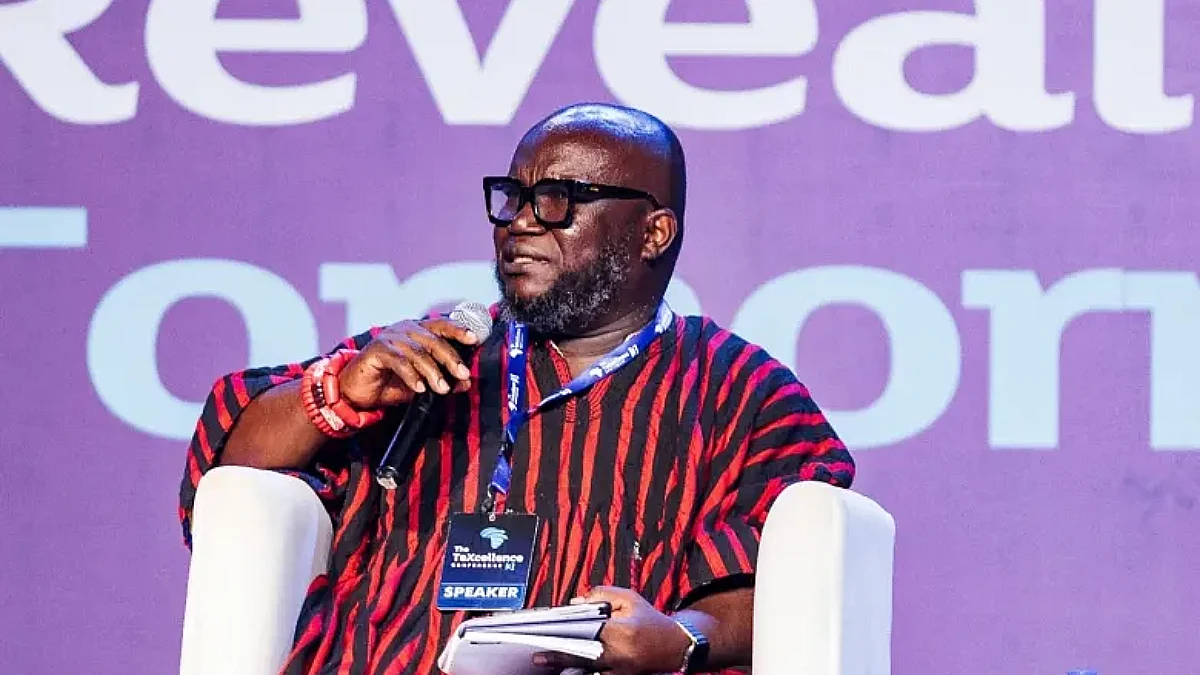

- Investor Confidence and Local Participation Must Advance Together — Ing Dr Ashigbey
Ghana’s mining industry has moved to reassure investors that the country’s renewed push for greater local participation in the sector should not be interpreted as a shift toward nationalisation or hostility to foreign capital.
Speaking at the Ghana Chamber of Mines Breakfast Meeting with the Minister for Lands and Natural Resources at the Accra Marriott Hotel on Monday, Chief Executive Officer of the Ghana Chamber of Mines, Dr Kenneth Ashigbey, said government’s stated policy direction was about securing greater national value from mineral resources while preserving Ghana’s long-standing openness to investment.
His remarks come at a sensitive moment for the extractive sector, as debate intensifies over resource nationalism, indigenous participation, state interest in strategic assets and the future role of multinational operators in Ghana’s mining economy.
“It is reassuring to hear the minister talk about the fact that the government’s policy is not about nationalisation,” Dr Ashigbey said.
He noted that Ghana still requires foreign investors to provide capital, technology transfer, operational expertise and long-term industrial partnerships needed to sustain mining investment.
According to him, the Chamber supports efforts to increase Ghanaian ownership and participation in mining, but believes this should happen through structured collaboration between local firms and multinational operators rather than through policy signals that could undermine investor confidence.
“We believe the indigenous Ghanaian investors can co-exist in partnership with foreign and multinational investors,” he stated.
Dr Ashigbey argued that Ghana’s mining policy must be anchored on balance. On one hand, the country must deliberately nurture Ghanaian companies capable of participating meaningfully in exploration, mine services, contract mining, supply chains and eventually mine ownership. On the other hand, it must avoid creating uncertainty for international investors whose capital, technology and market access remain critical to the sector’s expansion.
He warned that hostility toward foreign investors could ultimately work against Ghana’s own long-term ambitions, particularly if Ghanaian mining companies being nurtured today eventually seek to expand beyond the domestic market.
The Chamber’s position reflects a broader concern within industry that poorly framed resource nationalism could weaken investor confidence at a time when competition for mining capital is intensifying across Africa and globally.
Several resource-rich African countries are reviewing mining contracts, increasing state participation or tightening local ownership requirements amid higher demand for gold and critical minerals. While such measures may increase domestic benefits, industry executives warn that aggressive or unpredictable policy shifts could deter long-term investment.
Dr Ashigbey said Ghana’s approach must be different. The country, he suggested, should position itself as a jurisdiction where local participation and investor confidence are not treated as opposing goals, but as mutually reinforcing pillars of a stronger mining ecosystem.
The Chamber also welcomed recent international investor engagements by the Minister for Lands and Natural Resources and the Chief Executive Officer of the Minerals Commission in the United States.
It described the outreach as a positive signal to global capital markets that Ghana remains committed to private sector-led growth in mining, even as it works to increase local content and Ghanaian participation.
For the Chamber, that reassurance is critical. Mining investment is capital-intensive and long-term. Exploration, development, processing infrastructure and mine expansion require years of financing, technical planning and regulatory certainty. Investors, therefore, tend to respond not only to policy announcements, but to the tone and predictability of government action.
Dr Ashigbey said the Chamber was ready to work with government on reforms covering contract mining, local content expansion, supplier development and broader formalisation of the industry.
He pointed to indigenous firms such as ZEN Petroleum and GENSER Energy as examples of how Ghanaian companies can grow into strong local champions within a private sector-driven framework supported by partnerships and market discipline.
The Chamber believes similar models can be deepened in mining services, energy supply, logistics, engineering, processing inputs and eventually mine operations.
Dr Ashigbey also drew comparisons with mature mining jurisdictions such as Canada and Australia, where domestic operators coexist with multinational mining companies in competitive ecosystems that benefit from strong regulation, deep capital markets and predictable policy environments.
For Ghana, the lesson is that local participation does not have to mean exclusion of foreign capital. Rather, it can mean building Ghanaian capacity through deliberate policy, joint ventures, procurement opportunities, technology transfer and patient capital.
The mining sector remains one of Ghana’s most important sources of export revenue, fiscal receipts, employment and foreign exchange. But the industry also faces growing scrutiny over how much value the country retains from its mineral wealth.
That debate has sharpened in recent months as the government signals stronger interest in local ownership, value addition and strategic control over mineral resources.
For the Chamber, the answer lies in a carefully managed partnership model: one that gives Ghanaian companies more room to grow, while preserving the investor confidence needed to finance mines, sustain production and expand Ghana’s position as a major mining destination.
Dr Ashigbey’s message was therefore clear: Ghana can build local mining champions without frightening away global capital.
The challenge now is execution designing policies that increase Ghanaian participation, protect regulatory credibility and ensure that resource nationalism strengthens, rather than weakens, the country’s mining future.

