
- Karela United Challenge FIFA Transfer Ban Over Unpaid Obligation to Sana Camara
Karela United have begun proceedings to challenge a FIFA-imposed transfer ban linked to an outstanding financial obligation involving former player Sana Camara, placing the Ghana Premier League club under significant squad-registration pressure less than three weeks before the start of the 2026/27 season.
FIFA’s Disciplinary Committee has barred Karela United from registering new players at both national and international level following a dispute referenced as FPSD-23160. According to Citi Sports, world football’s governing body determined that the club had failed to satisfy its financial obligations despite an earlier ruling in the case.
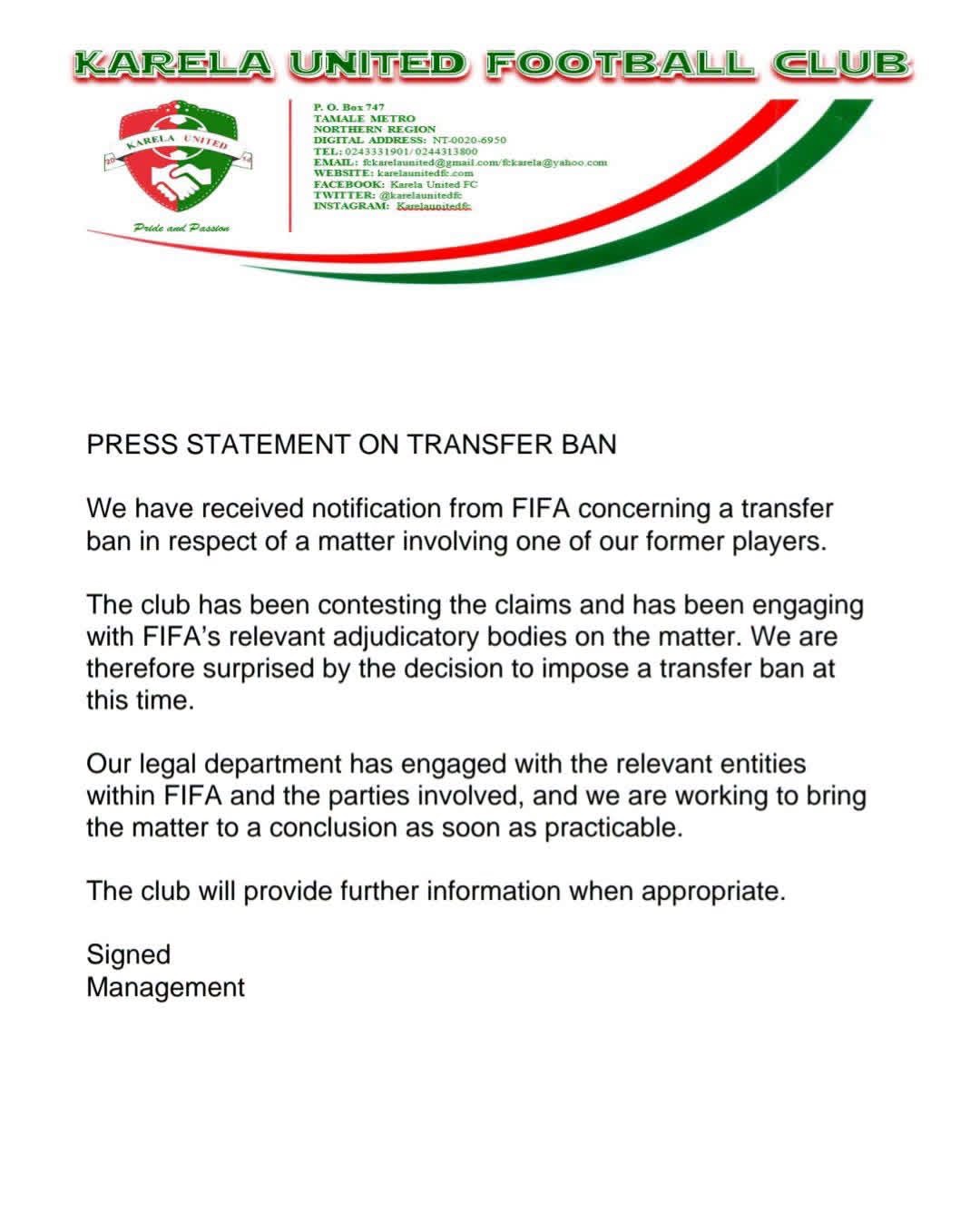
Karela United, however, say they are contesting the matter and expressed surprise at FIFA’s decision to impose the sanction while discussions surrounding the dispute were continuing. “We are surprised by FIFA’s decision to impose a transfer ban on us,” the club said in its response.
The club said its legal department had been engaging with FIFA and the relevant parties in an attempt to resolve the dispute and was working towards bringing the matter to a conclusion as quickly as possible. Karela’s challenge means attention will now focus on whether the club can satisfy FIFA’s requirements or otherwise secure relief before the domestic season begins.
The immediate sporting consequences are potentially significant because the sanction prevents Karela from registering new players while it remains in force. Any recruitment completed by the club would therefore have limited competitive value unless the affected players can be formally registered and cleared to participate in domestic or international competitions.
That creates an uncomfortable race against time ahead of Karela United’s scheduled opening fixture of the 2026/27 Ghana Premier League season against FC Samartex on September 6. The club must now manage preparations for that match while simultaneously dealing with the legal and financial requirements surrounding the FIFA case.
Transfer bans have an effect beyond simply preventing new acquisitions because they can disrupt squad planning undertaken months before a season begins. Coaching staff may have identified positions requiring reinforcement and management may already have negotiated with players, but those decisions become difficult to execute when registration rights are suspended.
For Karela, the timing could therefore prove as important as the underlying financial dispute. With the league opener approaching, prolonged uncertainty could force the technical team to rely more heavily on players who are already properly registered rather than reinforcements recruited for the new campaign.
The dispute also illustrates the growing importance of contractual and financial compliance in African club football. FIFA’s dispute-resolution framework allows players and other football stakeholders to pursue claims internationally, meaning domestic clubs can face sporting sanctions when financial obligations established through football-related proceedings remain unresolved.
Karela’s statement makes clear that the club does not regard the issue as uncontested. Its decision to challenge the sanction suggests it believes there are grounds for further engagement with FIFA and the parties involved, although Citi Sports’ report does not provide details of the amount outstanding or the specific legal arguments the club intends to advance.
That distinction is important because the existence of a challenge does not itself remove the registration restriction. Until the dispute is resolved and FIFA’s requirements are satisfied, the practical issue for Karela remains whether it can register players needed for the forthcoming campaign.
The case also poses a governance test for the club because unresolved player obligations can impose consequences directly on football operations. Financial decisions made away from the pitch can quickly become competitive disadvantages when they affect recruitment, squad depth and a coach’s ability to prepare for a new season.
Karela United will consequently be seeking a swift resolution before the September 6 meeting with FC Samartex. The club’s legal challenge may determine whether the dispute remains primarily a financial matter or develops into a significant sporting handicap at the start of the new Ghana Premier League season.