

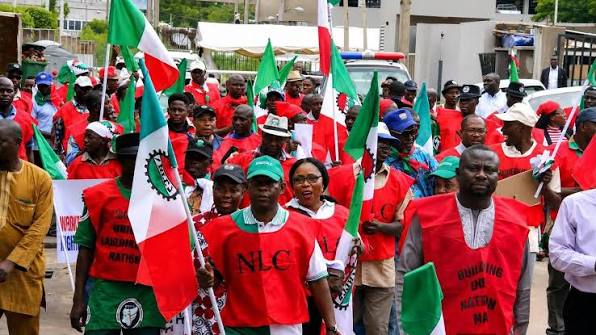

- Labour Pushes for US$365 Monthly Wage as Nigeria’s Cost-of-Living Crisis Deepens
Nigeria is heading towards another potentially difficult wage negotiation less than two years after President Bola Tinubu approved a major increase in the national minimum wage, as labour unions argue that inflation and the weaker naira have already eroded much of the benefit workers received.
The Nigeria Labour Congress is preparing to push for a new minimum wage of at least ₦500,000 a month, equivalent to about US$365, compared with the current statutory floor of ₦70,000, or roughly US$51. Such an increase would represent a rise of more than 600%, setting the stage for a potentially contentious debate over what workers need to survive and what government and employers can realistically afford.
NLC President Joe Ajaero, represented by Deputy President Audu Titus Amba at the Rights of Workers Summit in Birnin Kebbi, said the current minimum wage can no longer meet basic household needs. “Anything less than ₦500,000 cannot cater for workers. The current minimum wage is due for review, and we will soon begin negotiations with the government,” he said.
The demand illustrates the speed at which Nigeria’s cost-of-living crisis has overtaken earlier attempts to protect workers. Tinubu signed the ₦70,000 minimum wage into law in July 2024, replacing the previous ₦30,000 monthly floor introduced in 2019, while reducing the statutory review cycle from five years to three.
The 2024 increase was intended partly to cushion households from major economic reforms, particularly the removal of petrol subsidies and changes to the foreign-exchange regime. Yet the subsequent depreciation of the naira, together with persistently high food, transport and housing costs, has weakened the real value of the increase.
The currency effect is particularly striking. When Nigeria introduced the ₦30,000 minimum wage in 2019, it was worth about US$98, almost twice the dollar value of today’s ₦70,000 wage despite the nominal increase in naira terms.
That helps explain why organised labour is framing the debate increasingly around purchasing power rather than simply the nominal size of the salary. A worker may earn more naira than several years ago, but if food, rent, transport and other essentials rise faster than wages, the improvement exists largely on paper.
Nigeria’s minimum wage also looks particularly weak when compared with several other African economies. A general worker in Nairobi, Mombasa and Kisumu earns a statutory wage of about KSh18,531 including housing allowance, equivalent to roughly US$145 a month, while South Africa’s national minimum of R30.23 an hour translates to about R5,239, or around US$320, for a 40-hour working week.
Mauritius raised its minimum wage to around Rs17,745 a month, equivalent to about US$375, while Egypt increased the minimum income for state employees to EGP8,000, or about US$160, in July 2026. In dollar terms, the comparisons leave Nigeria’s wage floor significantly below several continental peers.
The comparison is politically uncomfortable because Nigeria remains Africa’s most populous country and one of its largest economies. Yet a larger economy does not automatically translate into stronger household incomes, particularly where currency weakness and inflation offset nominal wage increases.
The renewed labour push also comes against a mixed economic backdrop. The International Monetary Fund expects Nigeria’s economy to grow by 4.10% in 2026, after estimated growth of 4% in 2025, but it has continued to warn that elevated food, fuel and transport costs are weighing heavily on households.
Official data put headline inflation at 15.91%, while food inflation stands at 17.52%. Those numbers help explain why workers can experience economic growth at the national level without necessarily feeling materially better off in their own households.
The IMF has estimated that 63.00% of Nigerians live below the national poverty line, while about 27 million people faced food insecurity in late 2025. The contrast between macroeconomic stabilisation and household hardship is likely to become central to the wage negotiations.
Trade Union Congress President Festus Osifo, represented at the summit by Secretary General Nuhu Toro, similarly argued that higher food prices, transport fares, rents and inflation had severely weakened workers’ purchasing power. Kebbi State Governor Nasir Idris also backed calls for improved remuneration and said he would raise the issue through the Nigeria Governors’ Forum.
The difficulty for government is that a wage increase of the scale being demanded could carry significant fiscal consequences. Federal and state governments would face substantially higher payroll obligations, while private businesses could confront sharply increased labour costs at a time when many are already dealing with expensive energy, financing and imported inputs.
Labour, however, is likely to argue that affordability cannot be assessed only from the employer’s perspective. If statutory wages are too low to cover basic living costs, then workers effectively absorb the adjustment through falling living standards, debt, reduced consumption and increased economic insecurity.
That makes the coming debate more complex than a simple negotiation over one number. The real issue is whether Nigeria can rebuild wages fast enough to match economic realities without creating new fiscal or employment pressures.
A ₦500,000 minimum wage would dramatically raise worker incomes if implemented, but the sustainability of such a jump would depend on productivity, public finances, inflation and the capacity of businesses to absorb higher costs. If wage increases are ultimately passed through into prices, part of the purchasing-power gain could again be lost.
For Nigeria, the deeper challenge is therefore not merely raising the statutory minimum. It is restoring the relationship between wages, prices and productivity so that each new pay increase does not quickly become obsolete.
The current ₦70,000 wage was designed as a response to a difficult economic transition. Less than two years later, organised labour is already saying that transition has made the figure inadequate.
That is the strongest indication yet of how deeply Nigeria’s economic reforms have reshaped household finances. The coming minimum-wage negotiations will determine not only what workers earn, but whether the country can translate improving headline growth into incomes that ordinary Nigerians can actually live on.

