

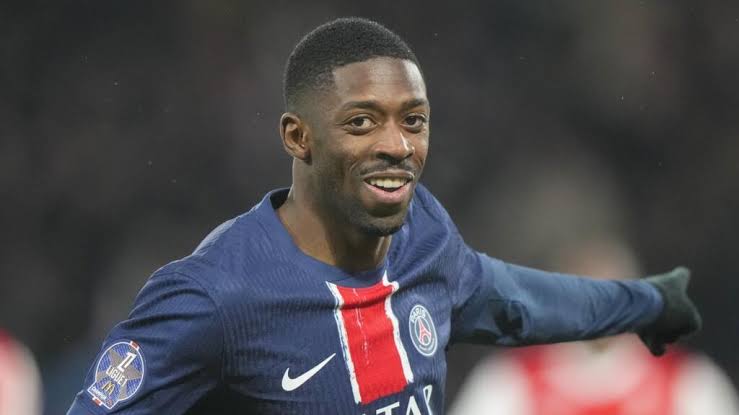

- Luis Enrique Backs PSG Player For 2026 Ballon d’Or After Another Champions League Triumph
Paris Saint-Germain head coach Luis Enrique has thrown his weight behind his players in the race for the 2026 Ballon d’Or, arguing that football’s most prestigious individual award should remain with the French champions after another season of major success.
The PSG manager stopped short of naming one outright favourite, but insisted that the strength of the club’s achievements made one of his players deserving of the prize. Ousmane Dembele is among the leading candidates as he attempts to win the award for a second consecutive year following his 2025 triumph.
“I’m not interested in who wins the Ballon d’Or. What I can say is that in my opinion, who deserves to win the Ballon d’Or; it should go to a PSG player,” Luis Enrique said ahead of PSG’s Ligue 1 encounter with AS Monaco.
The 2026 Ballon d’Or ceremony is scheduled for October 26 in London, with Dembele, England and Bayern Munich striker Harry Kane and Real Madrid forward Kylian Mbappe regarded in the source material as leading contenders for the prize.
Dembele’s case rests heavily on another outstanding campaign with PSG, where he played a significant role as the Paris club secured another UEFA Champions League title. His performances have kept him firmly in contention to retain the award he won in 2025.
Luis Enrique, however, suggested PSG’s case extends beyond Dembele alone. He pointed to the broader achievements of his squad, including Fabian Ruiz, whose international success with Spain adds another dimension to the club’s representation in the race.
“We have players who won the UEFA Champions League, then there’s Fabian who won the World Cup too. There’s Ousmane Dembele…but that’s my opinion, I can be wrong,” he said.
The comments reflect a wider debate around how the Ballon d’Or should weigh individual performance against collective success. Players who excel statistically can build strong cases, but major trophies — particularly the Champions League and World Cup — have historically carried significant influence in voting.
For PSG, that dynamic strengthens the argument for its leading players. The club’s ability to combine domestic dominance with another Champions League success gives its stars the type of team achievements that often define Ballon d’Or campaigns.
Dembele’s challenge will be to demonstrate that his individual influence was significant enough to distinguish him from other elite candidates. Winning the award in successive years would underline his transformation into one of world football’s defining players.
Kane and Mbappe, however, offer formidable competition. Both remain among the game’s most prolific attacking players, ensuring that the final decision is unlikely to rest purely on which club collected the most trophies.
Luis Enrique’s comments also reveal the extent to which PSG has evolved from a team historically associated with superstar individuals into one seeking recognition for collective excellence. His preference for a PSG winner is therefore as much an endorsement of the team’s season as it is support for any individual player.
The coach’s reluctance to identify a single candidate is notable. Rather than concentrating the club’s case entirely around Dembele, he has framed PSG’s success as evidence that several members of his squad merit consideration.
That approach could become both an advantage and a complication. Multiple strong candidates enhance PSG’s reputation, but they can also divide votes if selectors struggle to identify one clear standout from the same team.
For Dembele, the opportunity to retain the Ballon d’Or would be particularly significant. Back-to-back victories would place him among a select group of players to dominate the award across consecutive seasons and reinforce the importance of his role in PSG’s recent success.
Ruiz presents a different argument, with Luis Enrique highlighting the midfielder’s contribution to both club and country. If international success carries substantial weight in the voting, it could strengthen his case even if attacking players continue to attract greater attention.
The broader competition is therefore likely to turn on how voters balance individual statistics, decisive performances in major matches and collective honours. That equation becomes particularly difficult in a season where several leading contenders can point to significant achievements.
PSG’s continued success in Europe nevertheless gives Luis Enrique reason to believe one of his players should prevail. The Champions League remains one of the most influential stages in determining football’s major individual awards, particularly when a player becomes central to a title-winning campaign.
The manager’s position is therefore straightforward: he may not be interested in predicting the eventual winner, but he believes PSG has done enough collectively to ensure the award remains within his dressing room.
Whether voters agree will depend on how they assess Dembele’s attempt to retain the prize, Ruiz’s combined club and international success and the individual cases of rivals such as Kane and Mbappe.
For now, PSG enters the final stretch of the Ballon d’Or debate with something few clubs possess multiple credible candidates backed by major trophies.
Luis Enrique has made clear where his vote would go. For the PSG coach, the question is not whether one of his players deserves the 2026 Ballon d’Or, but which one should receive it.

