

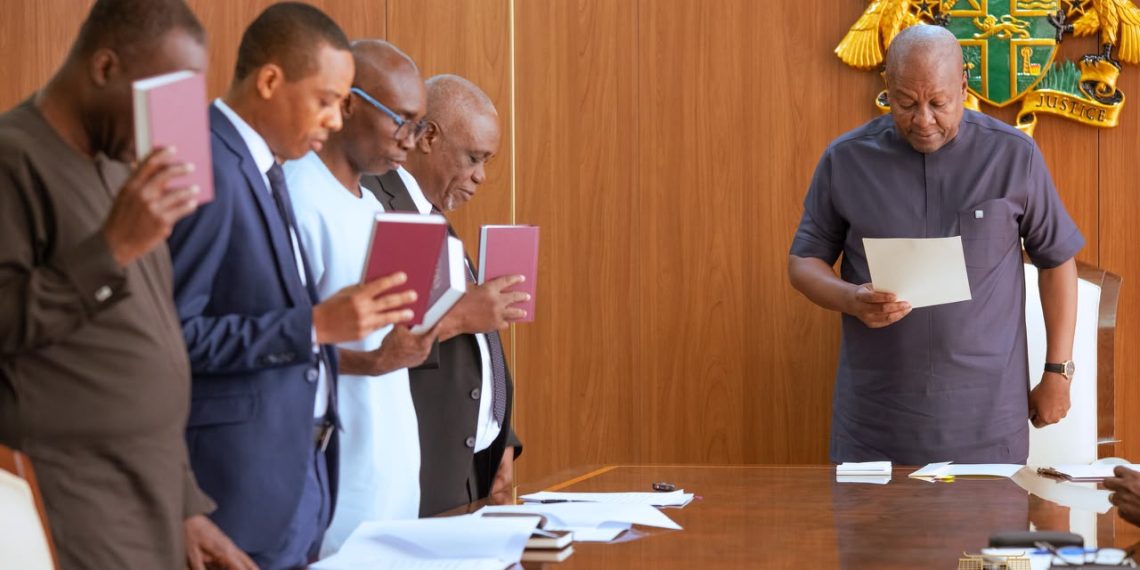

- Mahama Inaugurates Five-Member Independent Fiscal Council to Tighten Fiscal Oversight
President John Dramani Mahama has inaugurated Ghana’s five-member Independent Fiscal Council, charging it with providing credible and objective oversight of government fiscal policy as the country seeks to strengthen budget discipline and restore confidence in public financial management.
The Council has been given a four-year mandate under the Public Financial Management (Amendment) Act, 2025, Act 1136. Its establishment places an independent institutional check at the centre of Ghana’s efforts to improve fiscal credibility, debt sustainability and accountability.
Speaking at the inauguration at the Presidency on Tuesday, September 8, President Mahama said the Council would play a critical role in scrutinising government decisions and assessing whether fiscal policy complies with established rules.
“Your responsibility is to scrutinise the Government’s fiscal decisions, assess compliance with established rules, and provide sound recommendations in the national interest,” he said. The mandate gives the Council a potentially important role in testing whether government spending, borrowing and revenue decisions remain consistent with the country’s fiscal framework.
The Council is chaired by Dr Emmanuel Oteng Kumah, an international economic consultant and former Board Chairman of Standard Chartered Bank Ghana. Other members are Dr Henry Akpenamawu Kofi Wampah, former Governor of the Bank of Ghana; Professor Patrick Opoku Asuming of the University of Ghana Business School; Leslie Dwight Mensah, representing think tanks; and J. Kweku Bedu-Addo, a former public policy expert at the Ministry of Finance.
The composition brings together central banking, academia, financial-sector experience and public policy expertise.
President Mahama said the Council’s work had become particularly important because citizens, investors and other stakeholders expected greater prudence and transparency in the management of public resources.
He linked stronger fiscal oversight to wider objectives including investor confidence, inclusive economic growth, job creation and improved public services. The implication is that fiscal credibility is not merely an accounting issue but an important part of Ghana’s broader economic recovery strategy.
The Council’s legal mandate is intended to strengthen fiscal discipline and help ensure long-term debt sustainability. That places it in a sensitive position because meaningful oversight requires the ability to assess government projections, expenditure decisions, borrowing plans and compliance with fiscal rules without political interference.
Its value will therefore depend less on its formal existence than on whether its analysis is sufficiently independent, timely and influential to affect policy decisions.
President Mahama pledged to respect the independence of the Council and provide the institutional support required for it to perform its functions. “Fiscal responsibility must not be regarded merely as a statutory requirement.
It is a moral obligation to present and future generations,” he said. That framing elevates fiscal discipline from compliance with legislation to a broader responsibility to prevent today’s spending decisions from imposing unsustainable costs on future taxpayers.
The President also urged members to approach their work with professional independence and courage. “Your work must be guided by evidence and the national interest, without fear, favour, or political consideration,” he said. For the Council, that standard will be important when its conclusions conflict with government assumptions or when fiscal pressures create incentives to relax spending controls.
On behalf of the Council, Dr Wampah assured the President that members would discharge their responsibilities in accordance with the institution’s mandate. He said the Council would not be derelict in carrying out the duties assigned to it.
That assurance will be tested by the extent to which the body is willing to subject budget assumptions, fiscal risks and debt dynamics to rigorous public scrutiny.
The creation of the Council comes at a time when Ghana is seeking to rebuild credibility around public finance after years of fiscal stress and debt restructuring. An effective independent fiscal institution can help improve transparency by testing official forecasts and highlighting risks before they become embedded in the budget.
It can also provide investors and citizens with an additional reference point when assessing whether government fiscal policy remains consistent with medium-term sustainability.
Its credibility, however, will depend on access to information and the quality of its public reporting. Independent analysis is most useful when the Council can examine fiscal projections, contingent liabilities, debt trajectories and spending commitments using sufficiently detailed and timely data.
Without that access, it risks becoming a formal advisory body unable to meaningfully challenge optimistic assumptions or identify emerging fiscal pressures.
The Council will also need to establish a clear distinction between offering independent technical assessment and assuming responsibility for fiscal policy itself. Government remains accountable for taxation, expenditure and borrowing decisions, while the Council’s role is to scrutinise those decisions and assess their consistency with legal and sustainability benchmarks. Maintaining that separation will be important if the institution is to preserve both its independence and its analytical credibility.
For President Mahama’s administration, the inauguration therefore creates both an accountability mechanism and a test of political commitment. The President has promised that the Council will operate “without fear, favour, or political consideration,” but the real measure will be whether government continues to support that independence when the Council’s findings are uncomfortable. If it does, the institution could become an important anchor for stronger fiscal discipline and greater confidence in Ghana’s public financial management.

