


- Mali Militant Spillover Raises Security Risks for Guinea’s Gold Industry — ACLED
Guinea’s fast-growing mining sector faces an increasing security threat from the expansion of al-Qaeda-linked militants in neighbouring Mali, with artisanal gold areas, transport routes and commercial networks emerging as likely channels for cross-border infiltration.
A new assessment by the Armed Conflict Location & Event Data Project said Guinea had remained largely insulated from the militant violence affecting the central Sahel, but the advance of Jama’at Nusrat al-Islam wal-Muslimin, or JNIM, across southern and western Mali was bringing militant activity closer to Guinea’s main eastern gold-producing regions.
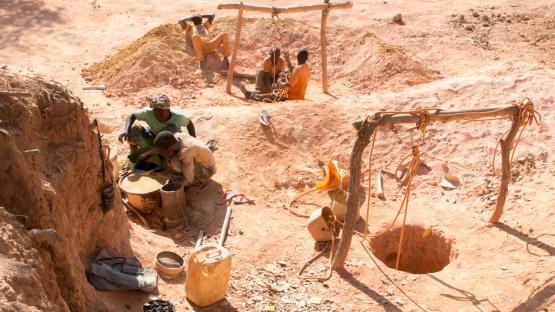
The immediate threat is not necessarily a direct assault on an industrial mine. ACLED said the more plausible risk was a gradual penetration of border communities, artisanal mining zones, trading networks and transport corridors around Siguiri and Mandiana.
This approach would allow militants to raise revenue, gather intelligence, recruit supporters and establish local relationships before openly confronting the Guinean state.
“The main risk is not the direct targeting of mining sites but the progressive infiltration of border communities, artisanal mining areas, transport corridors, and local commercial networks,” the report said.
If allowed to develop, ACLED warned, these networks could reproduce the conditions that helped JNIM expand elsewhere in the Sahel.
Concerns about militant involvement in Guinea’s mining regions are not entirely new.
In November 2023, Guinea’s Kaloum court prosecutor said suspected foreign militants had been identified in Kankan, Mandiana and forested areas near the country’s southeastern border.
The authorities initially described Guinea mainly as a transit route, with militants entering mining areas to generate income rather than establish permanent territorial control.
But ACLED said that pattern was consistent with the early phase of JNIM’s expansion elsewhere in West Africa. Militants frequently begin by moving across borders, joining commercial activity, establishing local support networks and recruiting before progressing towards more visible violence.
JNIM has strengthened its position in southern and western Mali since 2023. During 2025 and 2026, the group intensified attacks on mining operations near the Mali-Guinea border, abducting foreign personnel, destroying equipment and infrastructure and attacking military positions assigned to protect mining sites.
That expansion has brought the group closer to Siguiri and Mandiana, two of Guinea’s most important industrial and artisanal gold-producing prefectures.
For mining companies, proximity alone does not mean that an attack is imminent. It does, however, increase the cost and complexity of protecting employees, contractors, supply routes and production infrastructure.
ACLED said evidence of sustained JNIM operations inside Guinea remained limited. However, several developments pointed towards an evolving threat, including suspected reconnaissance, recruitment, cross-border movement and the establishment of local support networks.
Unidentified armed groups attacked miners, mining communities and border localities in eastern Guinea during 2024 and 2025.
In January 2025, armed men attacked civilians at the Kouremale customs post, the principal crossing between Mali and Guinea, before clashing with the Guinean military and traditional Dozo hunters.
None of those incidents has been conclusively attributed to JNIM. But subsequent arrests have deepened official concern.
Residents of Limbana in Mandiana reportedly detained a man suspected of conducting reconnaissance for JNIM in March 2025. Guinean authorities arrested 11 people in Siguiri, Mandiana and Kankan the following month.
The Office of the Prosecutor General later linked the arrests to suspected JNIM networks and announced investigations into alleged financing, recruitment, online radicalisation and local support structures.
These allegations remain subject to judicial proceedings. Nevertheless, they show that Guinean authorities are investigating the kinds of low-profile networks that can precede more overt militant operations.
The most important conclusion for investors is that militants do not need to seize or directly attack a mine to undermine its operations.
Local support networks can monitor employee movements, identify weak points along transport routes and supply intelligence for kidnappings or extortion.
Mining companies depend on fuel deliveries, equipment imports, contractor movements and the transportation of workers and minerals. A security threat affecting any of these links can raise costs, delay production and make remote operations more difficult to insure and finance.
Artisanal mining creates an additional vulnerability because transactions frequently operate through informal channels. Gold is portable, valuable and relatively easy to move across borders, making mining areas attractive sources of revenue for armed groups.
ACLED identified possible warning signals including the taxation or extortion of miners and traders, militant involvement in regulating access to mining sites, recruitment in local communities and attempts to build relationships with transporters and suppliers.
Militants may also seek legitimacy by resolving local disputes or presenting themselves as alternative providers of security where state institutions are weak.
Guinea’s expanding mining industry could strengthen the state’s ability to contain the threat by increasing revenues available for border security, infrastructure and local development.
But the same boom could create more targets.
New mines, foreign personnel and expanding logistics networks increase the opportunities for surveillance, kidnapping, extortion and attacks on transport corridors.
ACLED expects pressure on Guinea’s eastern border to increase over the next 12 to 24 months, although it considers a sustained militant campaign inside the country unlikely during the next six months.
The most probable trajectory is a gradual transition from transit and revenue generation towards recruitment, reconnaissance and the construction of local networks.
Guinea and Mali currently co-ordinate border-security efforts but generally conduct operations separately on their respective sides. That arrangement may leave gaps that militants can exploit.
The emerging risk demands more than additional security personnel around large mines. Guinea will need stronger intelligence gathering, regular border patrols, closer co-operation with Mali and better oversight of artisanal gold trading.
Mining companies must also reconsider security beyond their concession boundaries. Contractors, transport routes, employees’ movements and relationships with surrounding communities now form part of the operating risk.
For Guinea, the central challenge is to prevent its mining boom from financing or attracting the very networks capable of destabilising it.
The threat remains at an early stage. That is precisely why the opportunity to contain it still exists.

