

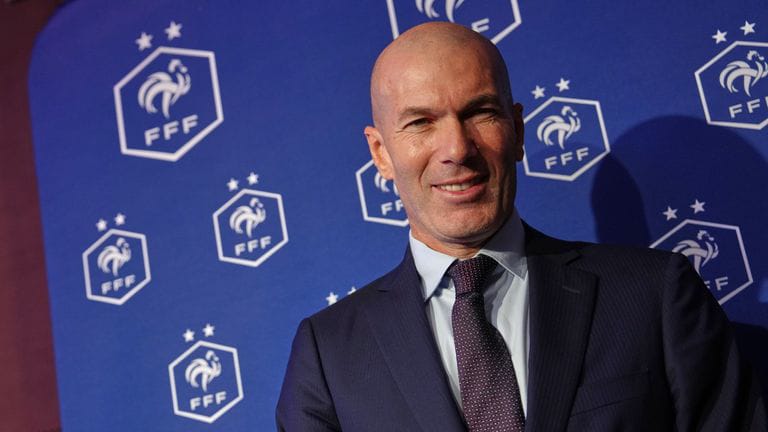

- Mbappé Calls Zidane’s France Arrival ‘Something Out of a Movie’ As New Era Begins
Kylian Mbappé has described the appointment of Zinedine Zidane as France head coach as “something out of a movie”, as Les Bleus begin a new era following the departure of Didier Deschamps after 14 years in charge.
Zidane was appointed in July and is preparing for his first competitive fixtures with France in the UEFA Nations League, beginning against Turkey on September 25.
For Mbappé, who remains national-team captain, the change brings together two of the most significant figures in modern French football.
“Now he’s my national team coach. It’s like something out of a movie, but he’s top-level,” Mbappé said ahead of France’s upcoming Nations League programme. “It’s a new phase with a new coach.”
His comments underline the symbolic weight of Zidane’s appointment, particularly for a generation of French players who grew up watching the former midfielder lead the country to the 1998 World Cup title.
Zidane succeeds Deschamps after a tenure that transformed France into one of international football’s most consistent tournament teams.
Deschamps led the country to victory at the 2018 World Cup, a runners-up finish in 2022 and fourth place at the 2026 tournament before stepping down.
His departure therefore represents more than a conventional coaching change, leaving France to replace a manager who had defined the national team for well over a decade.
“It’s going to be a new experience for everyone, since we’ve only ever had Deschamps,” Mbappé said. “It will be a change for us, but I think everything will turn out very well.”
The forward’s confidence reflects both Zidane’s standing within French football and his managerial record at Real Madrid, where he won three consecutive Champions League titles during his first spell in charge.
The appointment also closes a five-year gap in Zidane’s coaching career following his departure from Real Madrid in 2021.
His return comes with expectations considerably different from club football, where daily training and transfer-market control allow managers greater influence over squad construction.
International management instead requires shorter preparation windows, less tactical repetition and a heavier premium on squad selection, man-management and tournament execution.
Zidane’s first squad suggested he intends to combine continuity with selective renewal. Mbappé has retained the captaincy and remains central to the attack, while several new faces have been introduced as the coach begins shaping the group towards Euro 2028 and the 2030 World Cup.
Liverpool defender Jérémy Jacquet was among the debutants called up, alongside Guillaume Restes, Andy Diouf, Lucas Da Cunha and Esteban Lepaul.
That balance will be important because Zidane is inheriting a squad with both elite-level experience and pressure to convert near-misses into more trophies. France have remained among the strongest national teams in the world for most of the past decade, meaning the new coach is not being asked to rebuild from a position of crisis.
The challenge is instead to preserve the competitive standards established under Deschamps while introducing enough tactical and personnel change to prevent stagnation.
Mbappé’s relationship with Zidane adds another layer to the transition. The France captain has previously spoken about meeting Zidane as a teenager and being shown around Real Madrid’s training facilities, long before he became one of the world’s leading forwards.
The fact that the player once inspired by Zidane will now work under him at international level explains why Mbappé framed the appointment in such personal terms.
Zidane has also moved quickly to confirm that Mbappé will remain captain, avoiding an unnecessary leadership debate at the beginning of his tenure.
The decision preserves continuity within the dressing room and allows the coach to focus on broader tactical and selection questions rather than reopening an established hierarchy.
Mbappé, who has scored 66 goals for France, will therefore remain the central attacking and leadership figure in the new cycle.
France’s opening fixtures will offer an early indication of how much Zidane intends to change.
Their Nations League schedule includes Turkey, Belgium and Italy, providing a demanding set of opponents against which to test both the coach’s tactical preferences and the cohesion of a squad adjusting to a new voice.
Results will inevitably shape the early narrative around his appointment, even if the larger project is aimed at the next European Championship and World Cup.
For Zidane, the role represents perhaps the most emotionally significant assignment of his managerial career. He remains inseparable from France’s football history as the central figure in the 1998 World Cup triumph and one of the defining players of the national team’s modern era.
Returning now as head coach places him in the unusual position of trying to shape a new generation while carrying the expectations created by his own playing legacy.
For Mbappé and his teammates, the transition is equally significant because almost their entire senior international experience has been defined by Deschamps.
Zidane’s arrival therefore marks both continuity and rupture: continuity in France’s ambition to compete for every major trophy, but rupture in methods, relationships and authority after 14 years under one coach.
As Mbappé put it, the situation may feel cinematic, but the real test begins now — turning one of French football’s most anticipated appointments into another period of sustained success.

