


- Producer Inflation Rises to 4.8% as Mining and Factory Costs Regain Momentum
Ghana’s producer price picture became complicated in September: inflation remained moderate by recent historical standards, but the direction of travel turned less comfortable.
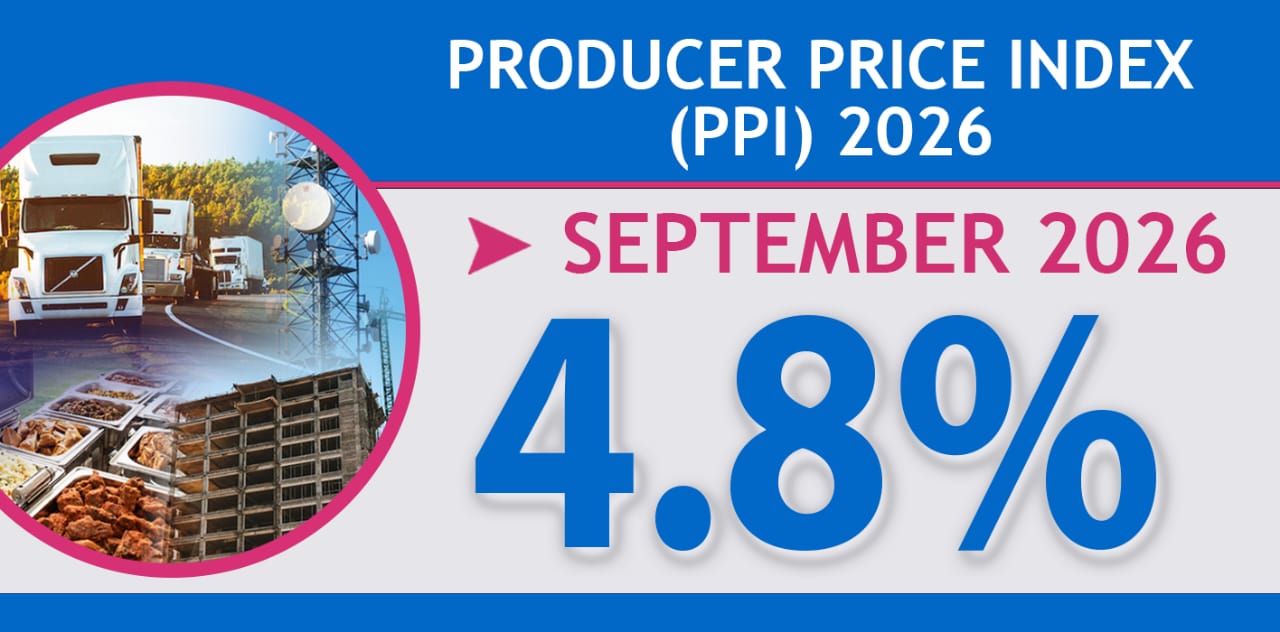
The Ghana Statistical Service said producer inflation increased to 4.8 percent year on year in September 2026, from 4.4 percent in August. Prices charged by domestic producers also rose 1.3 percent between August and September, although that monthly increase was considerably slower than August’s 2.5 percent.
The two movements tell different but complementary stories. The easing in monthly inflation suggests that the immediate acceleration in production costs has lost some force. Yet the higher annual rate indicates that prices at factory gates, mines, construction sites and service businesses are rising faster than they were a month earlier when compared with last year.
Businesses can initially absorb higher costs through reduced margins, efficiency gains or inventories. But sustained increases eventually create pressure to raise consumer prices, renegotiate contracts or postpone investment.
Industry excluding construction recorded annual inflation of 7.2 percent, up from 6.3 percent in August, and monthly inflation of 1.8 percent. Construction inflation edged higher from 4.5 percent to 4.7 percent, while services inflation eased from 1.8 percent to 1.4 percent.
This divergence reveals where the pressure lies. Ghana’s service economy remained broadly stable, but the production economy experienced stronger cost increases. Mining and manufacturing, which together carry 78.7 percent of the overall index, accounted for four percentage points of the 4.8 percent headline rate.
Mining and quarrying alone has a 43.7 percent weight and contributed 2.4 percentage points. Its annual inflation increased from 4.9 percent to 5.5 percent, while prices rose 2 percent during September. The extraction of crude oil and natural gas recorded inflation of 18.3 percent, making it the major source of pressure within mining.
The mining figures also show why averages need careful interpretation. Metal ores recorded deflation of 2.3 percent, while other mining and quarrying declined 2.8 percent. Mining support services posted inflation of 5.3 percent. One industry can therefore simultaneously contain falling prices and powerful inflationary forces, depending on the commodity and activity being measured.
Manufacturing provides the more direct link to households and domestic businesses. Its annual inflation rate rose one percentage point to 4.6 percent, while monthly prices increased 1.1 percent. Food manufacturing inflation stood at 6.6 percent, suggesting that cost pressures within supply chains have not disappeared even where headline consumer inflation may appear contained.
Leather products recorded the highest manufacturing inflation at 15.8 percent, followed by fabricated metal products at 14.3 percent. Furniture rose 9.2 percent, machinery and equipment 9 percent, and basic metals 7 percent. In contrast, non-metallic mineral products recorded deflation of 1.1 percent.
The breadth is important. Only eight of 23 manufacturing groups exceeded the sector average, meaning inflation was concentrated rather than universal. That may limit broad pass-through, but it can still impose severe pressures on firms dependent on metals, machinery, food inputs or specialised materials.
Utilities remained another concern despite easing annual rates. Electricity and gas inflation slowed from 12.3 percent to 9.8 percent, while water supply and waste management eased from 10.1 percent to 8.3 percent. These remain high because energy and water are economy-wide inputs. Even when their inflation rates decline, elevated price levels continue to shape operating costs.
Construction presented a mixed but manageable picture. Overall prices rose 4.7 percent year on year and 0.4 percent monthly. Building construction increased 7 percent, compared with 3.7 percent for civil engineering and 4.8 percent for specialised activities. Utility projects recorded 21.7 percent inflation, a potential warning for infrastructure budgets exposed to materials, imported equipment and financing costs.
Services offered the strongest element of stability, with annual inflation of 1.4 percent and monthly inflation of 0.3 percent. Information and communication rose only 0.4 percent annually, while telecommunications recorded no inflation. Accommodation and food services slowed markedly to 2.7 percent from 7.4 percent.
Yet transport requires attention. Transport and storage inflation eased annually to 5.8 percent, but monthly prices swung from a 1.3 percent decline in August to a 1.5 percent increase in September. Land transport inflation reached 30.1 percent, far above the service-sector average, while air transport stood at 9.3 percent.
That sharp land-transport reading could transmit costs widely because movement connects farms, factories, ports, shops and households. If persistent, it could weaken the benefit of stable communications and softer hospitality prices.
For the Bank of Ghana, the data strengthen the case for caution. Producer inflation remains contained overall, and monthly momentum has slowed, but industrial inflation is accelerating. Monetary policy must weigh these emerging pressures against the need to support credit, investment and employment.
For government, the challenge is more granular. Broad subsidies would be costly and poorly targeted. Policy should instead address logistics bottlenecks, reliable energy, competitive transport, efficient ports and access to working capital. Those interventions can lower production costs without stimulating excessive demand.
Businesses, meanwhile, face a margin-management test. The data favour firms able to diversify suppliers, conserve energy, improve inventory planning and raise productivity before passing costs to customers. Smaller enterprises may have less room to absorb shocks, making affordable finance and dependable infrastructure especially important.
September’s PPI is ultimately a warning about composition, not crisis. The headline rate remains moderate, and the monthly slowdown is encouraging. But pressure is concentrated in economically influential areas: crude oil, manufacturing inputs, utilities, buildings and land transport.
Ghana’s inflation progress will be secure only if stability moves beyond the headline and becomes embedded in the costs of producing, transporting and selling. September shows that the country has travelled far from its previous inflation shock. It also shows that the final mile towards durable price stability may be decided inside factories, mines and transport networks long before it becomes visible at the checkout counter.

