


- The Netherlands Seeks a Bigger Stage for Its Innovative Companies
The Netherlands has built one of Europe’s strongest high technology ecosystems, and is home to leading companies in semiconductors, photonics, digital technologies, life sciences and other advanced industries.
The prominence of high-tech sectors translates into an outsized share of exports relative to the economy’s size. Dutch exports also contribute more value added to other countries’ exports than the European average. The sector accounts for about 11 percent of value added and 6 percent of employment, an expansion of about 2 and 1 percentage points, respectively, over the past decade.
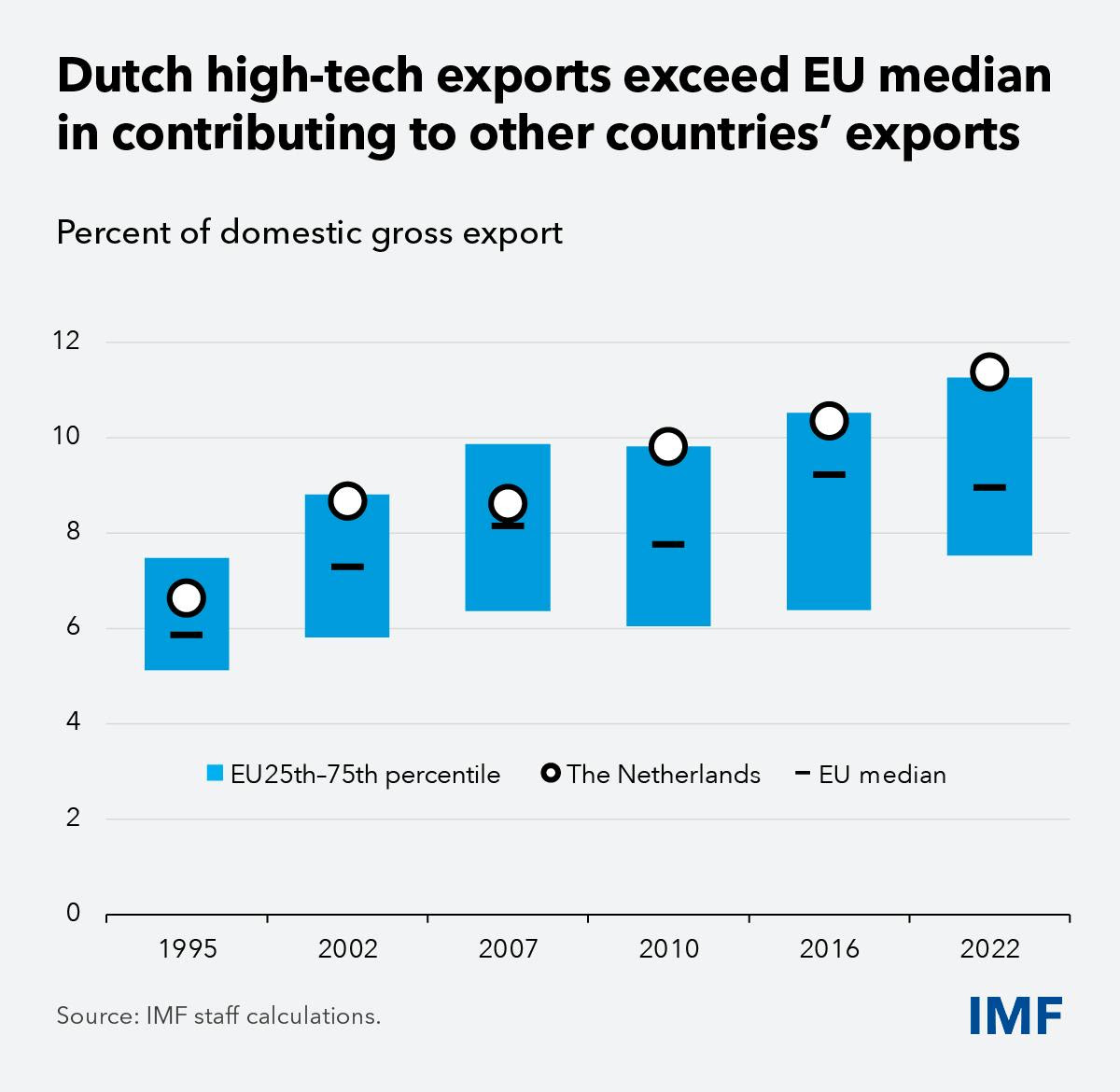
Chart showing Dutch high-tech exports exceeding EU median in contributing to other countries’ exports
Notwithstanding this success, converting innovative startups into global leaders remains constrained by limited scale, domestic bottlenecks, and rising global fragmentation. While The Netherlands excels at generating ideas and early-stage companies, scaling them depends on access to larger, integrated markets, conditions that remain incomplete within the European Union (EU), especially in heavily regulated industries like biotech, defense, and digital services. Fragmented regulatory regimes raise compliance costs and limit cross-border expansion.
Domestic bottlenecks compound the challenge: labor and skill shortages and electricity grid congestion keep energy costs elevated. Access to risk capital for later-stage companies (as the more mature startups are known) is difficult for those facing larger capital requirements over a longer period before they become profitable.
Integration creates vulnerabilities
Integration into global value chains drives Dutch competitiveness. But this integration also creates vulnerabilities in a more fragmented global economy. High-tech exports depend heavily on imported inputs, and a growing share of those are coming from outside the EU. Meanwhile, exports are concentrated in a few markets, especially Germany, the United States, and China.
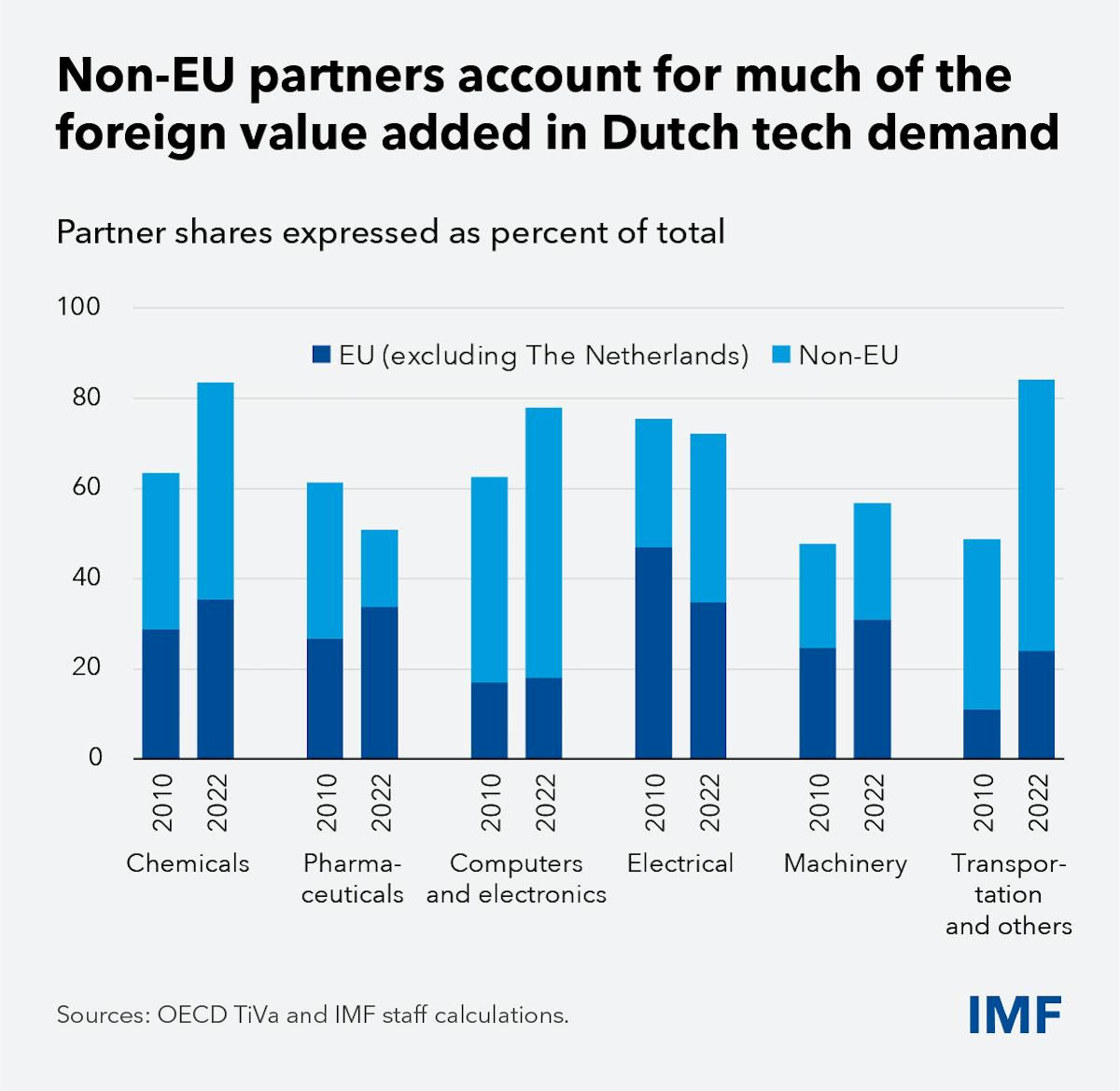
Chart showing non-EU partners accounting for much of the foreign value added in Dutch tech demand
This two-sided exposure—upstream through dependence on imports, and downstream through concentrated export markets—is increasingly becoming a source of uncertainty and vulnerability as geoeconomic tensions rise. Trade restrictions, export controls, and subsidy races may disrupt both supply chains and market access.
Execution, scale, and resilience
Our new research shows that addressing these challenges requires actions at the domestic and regional levels that are mutually reinforcing:
- Execute faster: Plans are in place to ease long-standing bottlenecks—particularly skill shortages, electricity-grid, and nitrogen-related permitting constraints. But steadfast implementation is essential, along with addressing financing gaps that hinder scaling of innovative companies, and enhancing coordination across government levels. Successful initiatives, such as Project Beethoven, to support the semiconductor industry, offer lessons on how to strengthen policy execution.
- Scale in Europe: Better execution at home must be matched by leveraging EU-level policies to create stronger conditions for high-tech companies to scale. While supply-side support, including public funding, is important, deeper integration of the EU Single Market is critical to increase market depth, lower barriers to cross-border value chains, and boost cross-border demand.
- Build resilience: Strengthening high-tech companies’ resilience helps to translate ideas into innovation. This requires greater emphasis on research and development diffusion, supply-chain diversification, and the energy transition at both national and EU levels, including identifying and managing critical dependencies while leveraging strategic interdependencies. Slow grid expansion, high energy costs, and fragmented EU energy markets point to the need for stronger coordination to enhance energy resilience.
The task for the Netherlands is to make its openness work better: removing domestic bottlenecks; using Europe to provide the scale and market that companies need; and managing dependencies before they become vulnerabilities. In this way, innovative Dutch companies will be able to continue to benefit from openness and global integration, but scale faster while generating stronger innovation, knowledge and productivity spillovers across the country and beyond.

