

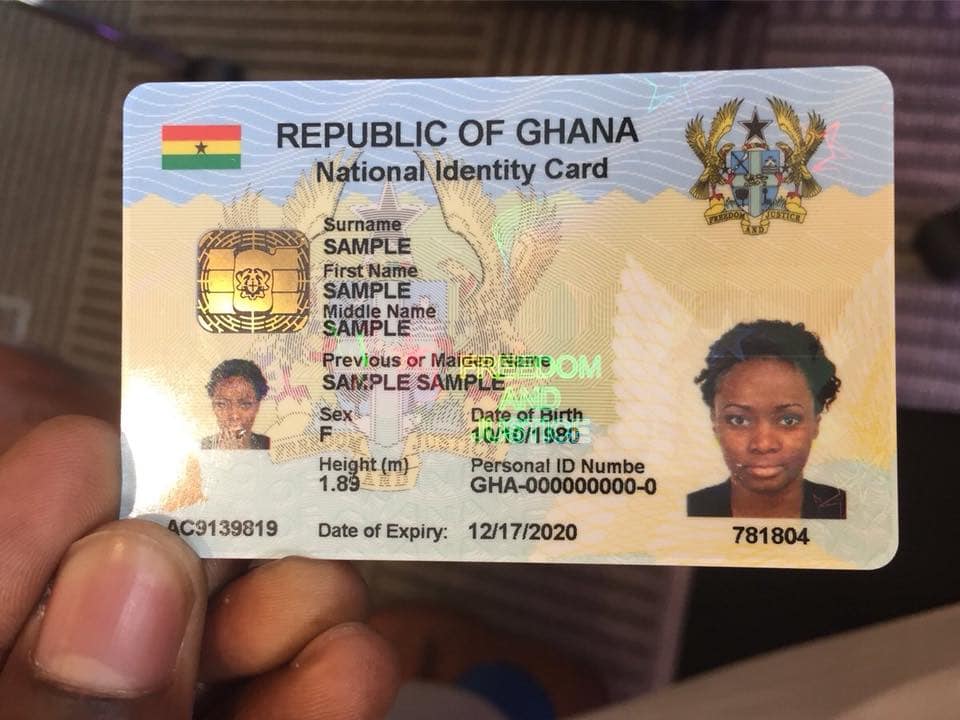

- NIA Defends Ghana Card Charges as Debate Shifts From Legality to Affordability
The National Identification Authority has moved to contain growing public concern over the cost of accessing Ghana Card services, insisting that its revised charges were approved by Parliament and were not unilaterally imposed by the state identification agency.
The clarification shifts the argument away from whether the NIA acted on its own and towards a more consequential policy question: how Ghana should finance a national identification system that has become increasingly central to banking, telecommunications, taxation and access to public services.
The NIA said the current charges were approved under the Fees and Charges (Miscellaneous Provisions) (Amendment) Regulations, 2025 (L.I. 2512) pursuant to the Fees and Charges (Miscellaneous Provisions) Act, 2022 (Act 1080).
The revised fee regime took effect on February 2, 2026, after going through the required statutory and parliamentary processes.
“The revised fees currently applicable to NIA services were approved by Parliament,” the Authority said.
That legal foundation is important because some of the criticism surrounding Ghana Card charges has suggested that the NIA recently introduced or increased fees on its own initiative.
The more difficult issue is whether the pricing structure strikes the right balance between cost recovery and universal access to a service that has increasingly become part of the basic infrastructure of economic participation.
The Ghana Card is no longer simply an identity document.
It has become an authentication mechanism across significant parts of Ghana’s formal economy. Banks use it for customer identification. Telecommunications companies rely on it for subscriber registration. State institutions increasingly integrate it into tax, social and administrative systems.
That makes the cost of obtaining, replacing or updating the card economically important. The NIA says its 276 regular district offices remain operational nationwide, providing the lower-cost channel within the system.
At those offices, first-time registration remains free for people below 25, while applicants aged 25 and above pay a GH¢30 processing fee.
Replacement of a Ghana Card costs GH¢200, while renewal attracts a GH¢150 charge. Nationality updates cost GH¢200.
A record update that does not require a replacement card remains free, while an update requiring issuance of a new card costs GH¢200. Card transfer attracts a GH¢75 fee, excluding courier charges.
The structure appears designed around two objectives that do not always sit comfortably together. The first is to preserve broad access to a national identification system. The second is to generate revenue sufficient to help meet the cost of operating that system.
It requires biometric enrolment equipment, secure databases, software, communications infrastructure, cards, staff, cybersecurity and continuous maintenance.
Those costs do not disappear once the first round of registrations has been completed.
At the same time, the more indispensable the Ghana Card becomes, the stronger the argument that access to it should remain affordable. That tension becomes more visible when the Authority’s regular services are compared with its Premium and newly introduced Prestige offerings.
The NIA’s first 24-hour Prestige Centre at Labone in Accra began operating on August 1 and runs seven days a week.
The Authority says the centre is intended for users willing to pay more for speed, convenience and flexible access.
“The introduction of the Prestige Centre therefore does not make the use of a Prestige Centre compulsory,” the NIA said.
At the Prestige Centre, first-time registration and renewal each cost GH¢610, while card replacement costs GH¢720.
A record update without replacement costs GH¢400, while an update requiring a replacement card attracts GH¢655.
Premium Centres sit between regular district offices and Prestige services.
First-time registration and renewal cost GH¢410, while replacement costs GH¢520.
The result is effectively a three-tier pricing system.
Citizens can use ordinary district offices at lower regulated charges, pay more for Premium access, or pay considerably more for Prestige services offering greater speed and convenience.
Differentiated pricing can allow a state institution to recover more of its costs from people willing to pay for additional convenience while preserving a lower-cost option for the wider population.
The model only works, however, if the lower-cost option remains genuinely accessible. That is the point on which the NIA’s pricing strategy will ultimately be judged. If ordinary district offices remain properly staffed, functional and reasonably efficient, Premium and Prestige services can legitimately be described as optional. If ordinary centres become characterised by excessive delays, limited capacity or difficulty securing service, the distinction becomes much less convincing.
An expensive premium option may be formally voluntary while becoming practically necessary for citizens who urgently need identification to open an account, complete a transaction or access another service. That is why the NIA’s assurance that all 276 district offices remain operational matters.
The Authority must demonstrate that the lower-priced channel is not merely available in theory but usable in practice. There is also a broader issue around first-time registration.
Ghana continues to offer free first-time registration to people below 25, protecting younger citizens from an initial access charge. Those aged 25 and above, however, must pay GH¢30. The distinction may reflect an attempt to balance social access against the administrative cost of late or adult registration.
But it raises a legitimate policy question: should access to a foundational national identity document attract any fee at all? That question becomes more important as the Ghana Card shifts from being useful to being effectively indispensable.
When a document is required to participate fully in the banking system, acquire certain telecommunications services, interact with the state and increasingly authenticate economic identity, barriers to obtaining it become barriers to participation itself.
It is responsible for delivering a public service that has quasi-utility characteristics: almost everyone needs it, the state increasingly requires it, and private-sector institutions are integrating it into daily transactions.
Yet unlike electricity, water or telecommunications, the underlying product is identity. That makes affordability more politically and socially sensitive.
The NIA said it recognises the public’s legitimate interest in scrutinising fees for public services and has encouraged questions about the regime. It has also urged media organisations and commentators to verify claims before publication, warning that inaccurate information about national identification could create unnecessary public concern.
But public scrutiny will continue because the Ghana Card has become too important for its pricing structure to remain a narrow administrative matter. The debate is now about more than whether Parliament approved a fee schedule.
It is about whether the state can recover the cost of maintaining sophisticated digital identity infrastructure without creating a two-speed system in which convenience and speed increasingly depend on the ability to pay.
There is nothing inherently wrong with charging more for premium service. The problem would arise if premium service becomes the only reliable service.
That distinction will determine whether the current model is seen as sensible segmentation or as an access problem. It must maintain the integrity, security and financial sustainability of a national identification system whose operating costs are substantial.
At the same time, it must ensure that citizens who cannot afford GH¢410, GH¢610 or GH¢720 are not placed at a material disadvantage in accessing a document that has become central to economic life.
That is why the strongest defence of the current pricing structure will not ultimately be the fact that Parliament approved it. It will be evidence that lower-cost district services remain widely available, functional and sufficiently efficient that citizens genuinely have a choice.
Because as the Ghana Card becomes more deeply embedded in the architecture of the economy, the question is no longer simply how much identification services cost. It is how much Ghana should allow people’s ability to pay to determine the speed and ease with which they can access the infrastructure of citizenship itself.

