
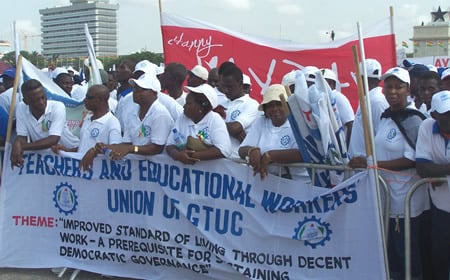

- Payday to Payday: New Study Exposes Pressure on Ghanaian Workers
The majority of Ghanaian salaried workers are unable to save from their monthly earnings, as rising living costs and weak income growth continue to squeeze household finances despite recent signs of macroeconomic stabilisation.
A new study by Dr Smart Sarpong of Kumasi Technical University found that only 32.2 per cent of salaried workers are able to save from their monthly income, leaving nearly seven in ten workers spending all, or more than, what they earn each month.
The findings point to a growing “salary-to-salary” economy, where workers depend almost entirely on their next pay cheque to survive, with little capacity to build savings, absorb emergencies or invest in long-term financial security. The research, which surveyed more than 4,000 households across multiple regions, examined income levels, expenditure patterns and public perceptions of the cost of living in Ghana.
It found that about 95 per cent of salaried employees earn below GH¢5,000 a month, with a substantial proportion earning less than GH¢2,000. The data raises fresh concerns about the gap between wages and the real cost of maintaining a household, particularly in urban centres where rent, food, transport and utilities have increased sharply in recent years.
The report also revealed significant disparities between public and private sector incomes, with private sector employees more exposed to low wages and financial instability.
For many workers, the challenge is no longer only the level of inflation, but the cumulative effect of years of price increases on already modest incomes. Although headline inflation has moderated in recent months, the cost of basic necessities remains high relative to wages.
Economists say this explains why many households say they are not yet feeling the benefits of macroeconomic recovery. Lower inflation does not necessarily mean prices are falling. It only means prices are rising at a slower pace. For workers whose salaries have not adjusted meaningfully, the pressure on disposable income remains severe.
The study’s findings come at a time when policymakers are increasingly being challenged to move Ghana’s recovery beyond headline indicators such as GDP growth, inflation reduction and exchange rate stability.
While recent macroeconomic data suggest the economy is stabilising, the condition of salaried workers shows that recovery is yet to translate fully into stronger household balance sheets.
Weak savings among salaried workers could also have wider implications for the economy. Household savings are an important source of domestic capital formation, financial sector deposits and long-term investment. When workers are unable to save, the financial system loses a critical pool of stable funds, while households become more vulnerable to debt, emergencies and income shocks.
The inability to save also affects retirement security, education planning, home ownership and small business formation. In many households, salaried income supports not only the worker but also dependants, extended family members and informal social obligations.
Analysts warn that this pattern could undermine the quality of Ghana’s economic recovery if wage growth remains weak and credit conditions do not improve.
The report further highlighted declining public confidence in living conditions, with respondents expressing concern over the affordability of essential goods and services. Transport fares, food prices, accommodation, electricity, water and school-related expenses remain among the main pressure points for households.
The findings also point to a deeper structural challenge in Ghana’s labour market. A large number of salaried workers are employed in sectors where wages are low, productivity is weak and income progression is limited. This means formal employment does not automatically guarantee financial stability.
With the government, the study adds urgency to the policy shift from macroeconomic stabilisation to jobs, wages and household welfare.
Economists argue that Ghana’s next phase of recovery must focus not only on restoring fiscal discipline and controlling inflation, but also on expanding productive employment, improving access to affordable credit, supporting wage growth and lowering the cost of essential services.
Without such measures, the recovery risks becoming visible in official data but absent from the lives of ordinary workers.
The study ultimately presents a sobering picture of the Ghanaian salaried class: employed, but financially stretched; earning, but unable to save; and increasingly vulnerable to shocks despite working full-time.
For a country seeking to rebuild confidence after a difficult economic adjustment period, the message is clear. Stability alone will not be enough. The test of recovery will be whether workers can live on their wages, save from their income and plan beyond the next payday.

