

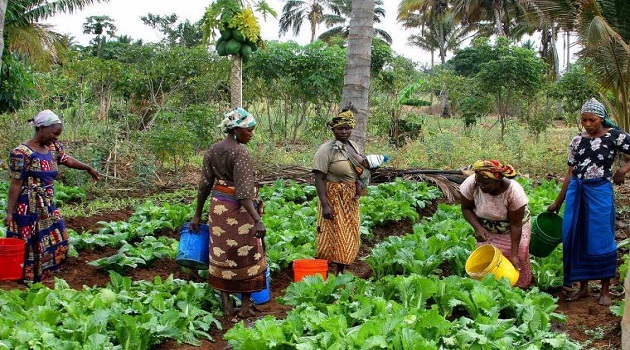

- Peasant Farmers Association Challenges GH¢155.90 million Cut in Agriculture Allocation Amid Food Security Concerns
The Peasant Farmers Association of Ghana (PFAG) has criticised the government’s 2027 Budget for what it describes as a significant mismatch between its ambitious agricultural transformation programme and the financial resources allocated to the sector, warning that inadequate investment could undermine food security, farmers’ incomes and Ghana’s efforts to reduce dependence on agricultural imports.
In a statement issued on Thursday, November 26, 2026, the Association disclosed that identifiable allocations to agriculture-related ministries and programmes account for just 3.64% of total government expenditure, significantly below Ghana’s 10.00% commitment under the Comprehensive Africa Agriculture Development Programme (CAADP), reaffirmed through the Kampala Declaration.
The assessment raises questions about the government’s capacity to implement its proposed US$3 billion commercial agriculture investment programme between 2027 and 2030 while addressing immediate difficulties confronting thousands of smallholder farmers.
The Association also estimates that the government’s Feed Ghana Programme and related agricultural interventions face an annual financing gap of approximately GH¢83.18 billion, based on its assessment of the resources required to deliver the programme effectively.
PFAG argues that although agriculture has been identified as a principal driver of the government’s New Economy, New Ghana: Jobs and Prosperity Programme, the proposed budgetary allocations do not reflect the investment necessary to transform production, expand irrigation and strengthen access to markets.
The concerns emerge as the government seeks to increase domestic food production, develop agricultural value chains and reduce reliance on imported commodities through investments in rice, poultry, sugar, oil palm and other products.
However, the Association maintains that the strategy risks being weakened by insufficient financing and delays in implementing existing programmes.
Its strongest criticism concerns the allocation to the Ministry of Food and Agriculture (MoFA), which it says has declined from GH¢3.038 billion in 2026 to GH¢2.882 billion in 2027.
The reduction amounts to approximately GH¢155.90 million, equivalent to 5.10%, according to the Association’s figures.
The 2027 allocation is consistent with the government’s published Budget, which rounds the Ministry’s government-funded expenditure provision to GH¢2.90 billion.
The decline is particularly significant because it occurs at a time when the government is proposing to expand agricultural production substantially.
Under the four-year commercial agriculture programme, the government intends to mobilise US$3 billion for investments covering rice, sugar, poultry, maize, soybean feed, aquaculture, oil palm, vegetables and cocoa value addition.
The targets include developing an additional 100,000 hectares of rice production, establishing 100,000 hectares of oil palm plantations and constructing the Pwalugu Multipurpose Dam.
These commitments could strengthen agricultural productivity and reduce imports if effectively implemented.
However, PFAG questions whether the proposed investment framework has been matched with sufficient annual funding to meet immediate production needs.
The Association estimates that Feed Ghana requires approximately GH¢85.60 billion annually, compared with GH¢2.43 billion identified for the programme and complementary agricultural interventions.
On that basis, the allocation covers only approximately 2.83% of the Association’s estimated requirement.
The implied financing gap is approximately GH¢83.18 billion.
The scale of this figure is considerable and requires an important qualification: GH¢85.60 billion is PFAG’s estimated annual financing requirement, not an amount independently established by the 2027 Budget. The statement does not provide the detailed costing assumptions underlying that estimate or establish how much would need to come from government rather than private investment.
Nevertheless, the figures highlight the Association’s concern that announcing agricultural programmes without clearly identifying financing arrangements could create expectations that are difficult to fulfil.
The financing challenge extends beyond production inputs to the markets through which farmers sell their produce.
PFAG has identified an ongoing agricultural marketing crisis, with farmers struggling to sell harvested grains as weak demand and inadequate purchasing arrangements depress farm-gate prices.
The Association disclosed that the National Food Buffer Stock Company (NAFCO) requested GH¢770 million to purchase excess grain stocks but received an allocation of GH¢200 million.
The provision represents approximately 25.97% of the requested amount, leaving a difference of GH¢570 million.
Although the government has also allocated GH¢500 million for silo infrastructure and proposed measures requiring public institutions to purchase locally produced staple foods, PFAG argues that these interventions may not resolve the immediate difficulties confronting farmers.
The distinction is economically important.
Expanding production without developing reliable markets can increase supplies during harvest periods, potentially depressing prices and weakening farmers’ incomes.
Where farmers cannot recover production costs, their capacity to invest in subsequent planting seasons may deteriorate.
This creates a risk that programmes intended to strengthen food security could become less effective if marketing and storage systems fail to develop alongside production.
PFAG consequently wants an emergency purchasing arrangement capable of absorbing existing grain stocks while longer-term procurement and storage interventions are implemented.
It considers the government’s proposed restriction on commercial rice imports by 2030 a potentially important policy instrument but argues that farmers require immediate market support rather than depending exclusively on future import-substitution measures.
Irrigation infrastructure represents another major source of concern.
The Association welcomed the proposed Pwalugu Multipurpose Dam, which is expected to support irrigation on more than 25,000 hectares.
However, it criticised the absence of adequate financing commitments for other irrigation schemes, particularly Kpong, Weta and Vea, as well as the Tanoso inland valleys.
According to PFAG, rehabilitation and development activities associated with these facilities have stalled following the cancellation of funding.
The Association estimates that more than 3,000 farmers who depend on the affected schemes have experienced disruptions, with no clearly identified arrangements to restore the projects or provide alternative livelihood support.
These claims require confirmation from the responsible implementing agencies, particularly regarding the current status of each project and the specific funding decisions involved.
However, the broader economic concern is significant.
Irrigation infrastructure can reduce farmers’ dependence on rainfall, support multiple cropping seasons and improve the reliability of agricultural production.
Without adequate water-management systems, targets for increased rice, vegetable and other crop production may remain exposed to climatic uncertainty.
The Association also criticised the absence of a dedicated Agricultural Development and Emergency Preparedness Fund.
It argues that the 2027 Budget does not adequately address the risks posed by droughts, floods, pest outbreaks and other climate-related disruptions.
The warning is particularly relevant as concerns grow over a possible El Niño event and its implications for agricultural production.
PFAG wants the government to establish a financing mechanism capable of providing timely support when climate shocks threaten farmers’ livelihoods.
Another concern involves the Farmer Service Centres programme.
The government has allocated GH¢800 million for machinery under the programme’s second phase, a commitment intended to improve farmers’ access to mechanisation and other services.
However, PFAG argues that implementation remains behind schedule.
The Association says only ten centres are currently under active construction, despite an earlier government target of establishing at least 50 by the end of 2026.
The gap raises questions about whether the programme’s execution capacity is keeping pace with its stated objectives.
For smallholder farmers, access to affordable mechanisation can influence planting schedules, production efficiency and the cost of cultivation.
Delays in establishing service centres could therefore reduce the immediate benefits of public expenditure intended to improve productivity.
The Association’s intervention reinforces concerns raised earlier by the Chamber of Agribusiness Ghana over the financing and institutional arrangements supporting the government’s agricultural transformation agenda.
Both organisations have questioned whether public allocations adequately reflect Ghana’s continental agricultural financing commitments.
However, their estimates differ.
PFAG calculates identifiable agricultural expenditure at 3.64% of total government spending, while the Chamber’s broader assessment placed the agrifood share at no more than 4.80%.
These figures should not be treated as directly interchangeable without reconciling the expenditure categories and financing sources included in each calculation.
The difference nevertheless illustrates a wider transparency challenge: the need for a clearly disaggregated account of agricultural spending across ministries, programmes and the broader New Economy investment framework.
For policymakers, such information would allow Parliament and the public to assess whether government commitments are supported by identifiable resources.
It would also help distinguish annual government expenditure from planned private investment and multi-year project financing.
The central question raised by PFAG is whether Ghana can deliver meaningful agricultural transformation while farmers continue to face unresolved difficulties involving financing, irrigation, mechanisation and access to markets.
The Association argues that programme announcements must be accompanied by predictable funding releases and measurable improvements in farmers’ productivity and incomes.
It has called for a progressive increase in agricultural expenditure towards the CAADP benchmark, the establishment of an agricultural emergency fund, stronger produce-purchasing mechanisms and the restoration of financing for stalled irrigation schemes.
It also wants resources directed towards addressing farmer-herder conflicts, which can disrupt production and threaten rural livelihoods.
PFAG estimates that agriculture supports approximately 38.30% of Ghana’s employed population, underscoring the sector’s importance to household incomes, employment and national food security.
The Association’s Executive Director, Bismark Owusu Nortey, and National President, Annor Douglas, are identified among the officials responsible for the statement.
Its central demand is that government move beyond policy commitments and demonstrate how agricultural investments will translate into practical benefits for farmers.
For the government, the 2027 Budget presents an opportunity to strengthen agricultural production and deepen domestic value addition.
For farmers, however, the immediate priorities remain affordable inputs, reliable irrigation, accessible mechanisation and markets capable of absorbing their harvests at sustainable prices.
The debate over agricultural financing will therefore be determined not only by the headline value of planned investments but also by how quickly resources reach farms, infrastructure projects become operational and farmers obtain dependable returns.
Ghana’s agricultural transformation ambitions are substantial. The more consequential test is whether the government can align financing, implementation and market development closely enough to improve the livelihoods of the farmers expected to deliver that transformation.

