



- Policies to Curb Tax Avoidance Are Changing How Countries Court Global Business
The globalization of production and the ever-accelerating integration of digital technologies have made highly mobile intangible assets—such as data, patents, software, and trademarks—increasingly important in production and for a firm’s value and structure.
These assets make it easier for multinational corporations to separate where they report profits from where they do business, shifting them to places where they pay lower taxes. At the same time, governments compete to attract those profits, as well as investment, by cutting tax rates and offering generous incentives.
But the landscape is shifting. As anti-avoidance measures become more widespread, multinationals appear more likely to report profits where they invest, as we show in an analytical chapter of the latest World Economic Outlook. Tax competition may therefore become less about attracting profits and more about luring the economic activity that generates them.
Competition, spillovers, trade-offs
Tax competition has not disappeared, but its character appears to be changing. While a 1 percentage point reduction in other countries’ headline tax rates is associated with a 0.4 percentage point reduction at home on average, this competitive response is strongest among economies at similar stages of development.
Since the mid-2010s, competition over headline tax rates appears to have moderated. This coincides with stronger anti-avoidance rules supported by major international reforms to limit the scope for tax base erosion and profit shifting.
Our findings suggest that reported profits have become less sensitive to differences in tax rates, while real investment has become more sensitive. This is consistent with a closer alignment of reported profits and the locations where real investment takes place. These patterns are evident among multinationals that are either less intensive in their use of intangible capital or headquartered in countries that have strengthened their anti-avoidance rules.

A chart showing rules to prevent tax avoidance can better align profits with investment
More broadly, our empirical results highlight how domestic corporate income tax policy choices can have implications beyond borders, creating important trade-offs that vary over time. Specifically, corporate income tax cuts in major economies are followed by reduced economic output in the rest of the world. That’s because the negative effects of capital reallocation exceed the positive spillovers from import demand. Evidence also suggests that when a country’s corporate income tax rate increases by 1 percentage point relative to other countries, foreign direct investment inflows decline cumulatively by about 0.5 percent of GDP over three years.
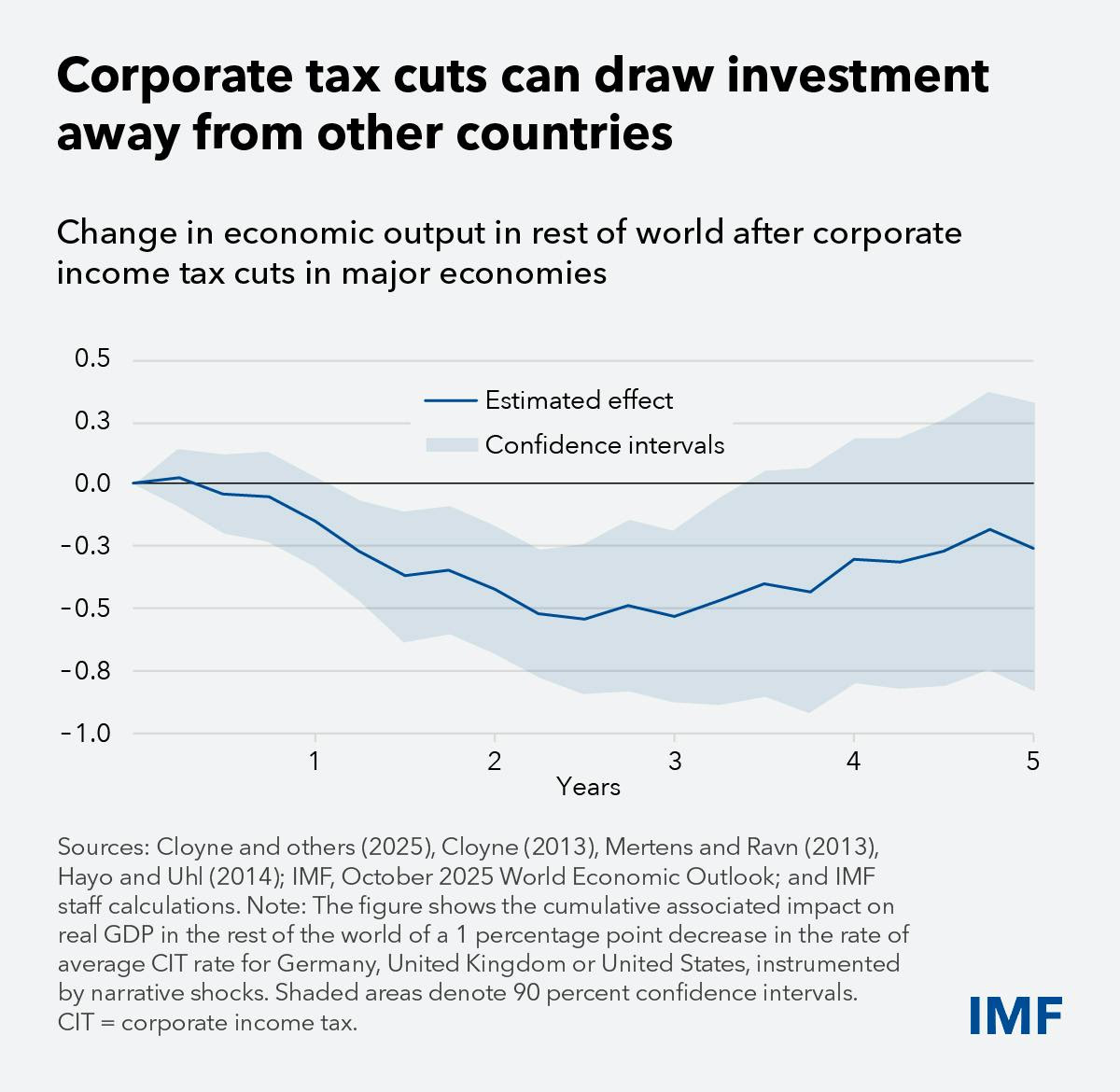
Chart showing corporate tax cuts can draw investment away from other countries
Cutting domestic corporate income tax rates in response to foreign tax cuts can attract investment and profits from abroad and support domestic demand. Simulations using the IMF’s Global Integrated Monetary and Fiscal model show how the spillover effects also depend on how the tax cut is financed. In the short term, if governments increase their borrowing to finance tax cuts, all economies face higher real interest rates and smaller investment expansions. If other countries reciprocate, the first country to move sees its own gains shrink. Tax competition, in other words, redistributes the gains from a tax cut.
In the long term, revenue and output depend on how governments budget. When they offset lost revenue with less spending or higher taxes elsewhere, potential domestic gains must be weighed against possible reductions in revenue for public investment. That’s important for countries with substantial infrastructure and social spending needs. However, our simulations show that spillovers can be positive due to cross-border knowledge transfers, offsetting the effects of capital reallocation. This is based on a framework developed for this chapter—a spatial general equilibrium model, with highly specialized means of tracking multinational production and intangible capita
Reducing trade-offs
Not all responses to corporate income tax cuts abroad entail the same trade-offs. Tax competition can attract profits and investment and boost innovation, but the overall gains are often offset by diminished government budgets and negative short-term spillovers if the tax cuts are financed through debt.
Meanwhile, anti-avoidance measures limit profit shifting and allow countries to preserve fiscal space, which can generate particularly large gains for emerging market and developing economies. These gains largely reflect their greater reliance on corporate income tax revenues to finance infrastructure, education, health, and other investments that support longer-term economic growth.
Looking ahead, as technological change continues to ease the movement of capital across borders, corporate income tax systems are likely to place greater emphasis on attracting investment as the link between profits and economic activity continues to strengthen.
This blog, which reflects contributions by Davide Malacrino, is based on Chapter 3 of the October 2026 World Economic Outlook, “Intangible Yet Real: Spillovers From Corporate Income Taxation.”

