


Policy Uncertainty, Not Capacity, Holding Back Local Currency Printing — Margins CEO Says
Margins ID Group, Africa’s most certified identity and security printing company, has the technical capacity and international certification required to print banknotes, but the absence of a clear government policy continues to prevent the company from printing the Ghana cedi locally.
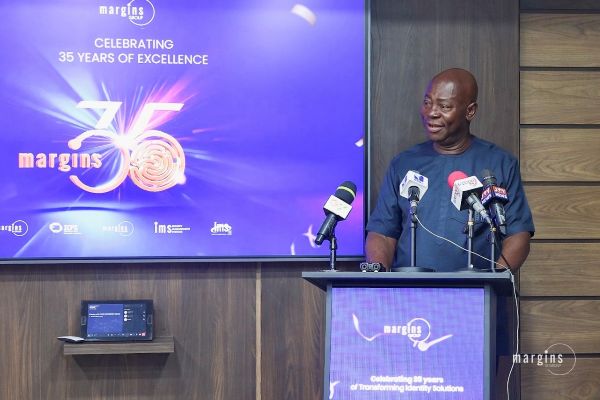
This was disclosed by the Group Founder and Chief Executive Officer, Mr. Moses K. Baiden Jr., at a forum with senior journalists, where he traced the company’s 35-year journey from a modest US$100 start-up into a multi-million-dollar, world-class African leader in identity solutions, security printing, border control and access management systems.
According to Mr. Baiden, Margins Group has, over the years, secured at least 15 high-level global certifications, six held by the group and nine by its security cards printing subsidiary, Intelligent Cards Production Systems (ICPS). These include seven International Organization for Standardization (ISO) certifications, alongside approvals from Visa, Mastercard, PCI, ICMA, Crest Pathway, DPC and Ghana’s Cyber Security Authority.
He explained that these certifications have become a critical trust benchmark in an industry where even minor lapses can carry severe consequences, positioning Margins competitively against peers in Europe, Asia and the United States.
One of ICPS’s most significant credentials is the Intergraf certification, obtained in 2019, which qualifies the company to print banknotes under the globally recognised ISO 14298 security printing standard. Mr. Baiden noted that despite holding this certification for several years, ICPS has yet to be given the opportunity to print even a single banknote in Ghana.
Intergraf certification, he explained, is underpinned by rigorous audits that track every material, process and individual within a printing facility, ensuring complete accountability and eliminating risks of counterfeiting. “The requirements are extremely stringent, but they have now become part of our culture and routine at ICPS,” he said.
The disclosure comes against the backdrop of rising costs associated with offshore currency printing. In 2024 alone, the Bank of Ghana reportedly spent about GH¢987 million printing banknotes abroad, representing a 47 per cent increase over the GH¢689 million spent in 2023. Industry observers argue that printing banknotes locally could significantly reduce these costs, including foreign exchange and transportation expenses.
Mr. Baiden stressed, however, that for Margins to invest in additional equipment required for currency printing, there must be clear policy predictability and assurance that local capacity will be prioritised. “Investment goes where it is wanted and where it can grow. We must be certain that government policy will favour local capability over external suppliers,” he said.
He added that while Ghana has several local content and industrial support policies on paper, implementation has been inconsistent, limiting their impact on domestic investors. Establishing a rule-driven, merit-based policy environment, he argued, would unlock significant private sector investment.
Touching on digital payments, Mr. Baiden also welcomed plans by the National Identification Authority to integrate payment functionality into the Ghana Card, noting that the card already has an embedded e-wallet feature. He said activating the feature would require clear legal and policy frameworks, adding that Margins has the technical expertise to support its rollout.
According to him, a functional Ghana Card e-wallet would help transform the National Identification Authority into a revenue-generating institution, while strengthening secure digital payments and identity verification across the economy.

