

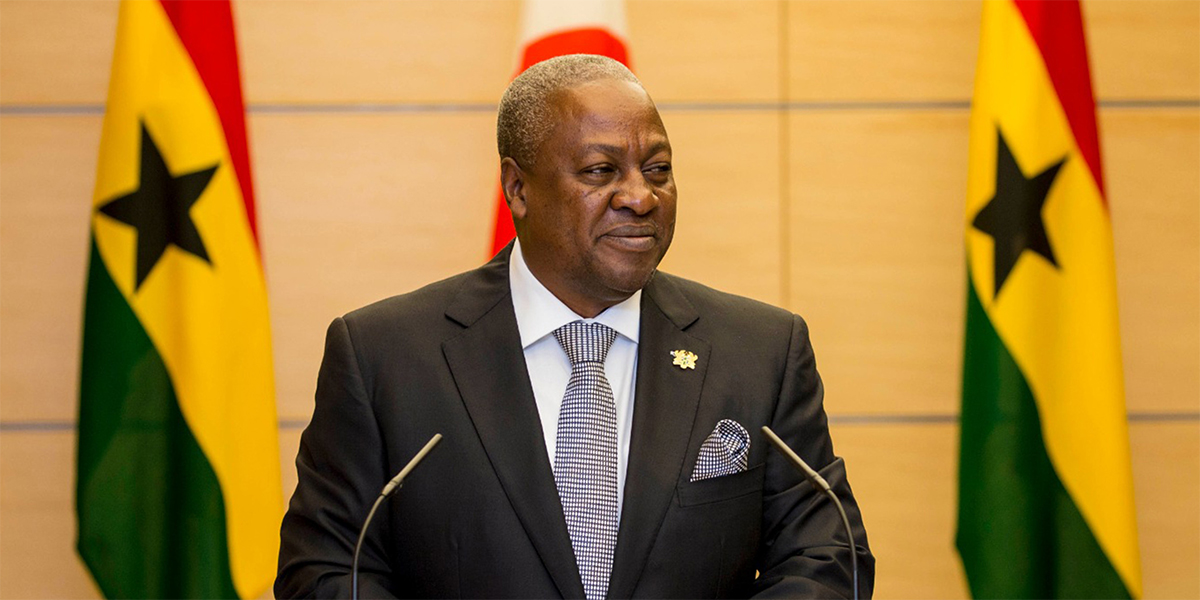

- President Mahama Proposes Ghana–Gabon Economic Corridor to Drive Investment and Industrial Growth
President John Dramani Mahama has proposed a commercially focused Ghana–Gabon partnership aimed at expanding trade, attracting investment and building industrial value chains linking West and Central Africa. The initiative represents an attempt to move more than six decades of bilateral relations beyond diplomatic engagement towards measurable economic cooperation capable of generating businesses, infrastructure and jobs.
Speaking during bilateral talks with Gabonese President Brice Clotaire Oligui Nguema at the Jubilee House on Tuesday, President Mahama said the visit offered both countries an opportunity to redefine their relationship around mutual economic interests.
“I believe that your decision to undertake this visit to Ghana reflects our personal friendship as leaders of our two countries, but it also reflects the desire that our two governments have to consolidate the long-standing bonds of friendship between our two nations into a more purposeful, ambitious and mutually beneficial partnership,” he said.
The proposed reset is centred on stronger private-sector collaboration, investment flows and industrial cooperation under the African Continental Free Trade Area. With Ghana hosting the AfCFTA Secretariat, President Mahama argued that the country had a responsibility to promote deeper intra-African trade and demonstrate how bilateral relationships could be converted into productive regional partnerships.
“As the host country for the African Continental Free Trade Area Secretariat, Ghana is committed to advancing intra-African trade, industrialisation and economic integration,” he said.
The President identified manufacturing, agribusiness, transport and logistics, infrastructure, financial services and value addition as priority areas for cooperation. These sectors are strategically important because they could connect Ghanaian and Gabonese businesses across production, distribution and financing rather than limiting the relationship to the exchange of raw commodities.
A Ghana–Gabon economic corridor would not necessarily involve a single physical route. It could instead function as a network of commercial, logistical and industrial linkages connecting ports, manufacturers, commodity producers, financial institutions and investors across the two countries.
Ghana could serve as a gateway to West African markets, while Gabon provides access to Central African commercial networks and natural-resource value chains. Such an arrangement could allow companies in both countries to reach larger markets, share production capacity and reduce their dependence on suppliers and buyers outside Africa.
President Mahama said trade and investment must remain central to the new relationship.
“We should encourage stronger partnerships between our private sectors, facilitate investment flows and create an enabling environment for businesses in both countries to collaborate,” he said.
The emphasis on the private sector reflects a wider recognition that diplomatic agreements alone rarely generate sustained economic value. For the partnership to deliver results, businesses must be able to identify viable opportunities, access finance, move goods efficiently and operate under predictable regulatory conditions.
Both governments would need to address visa procedures, customs documentation, taxation, standards, investment protection, transport connectivity and the recognition of business licences and professional qualifications.
The lack of direct and efficient transport links between many African economies remains one of the largest barriers to intra-continental trade. Goods often move more easily from African ports to Europe or Asia than between neighbouring regional blocs.
A commercially meaningful Ghana–Gabon partnership would therefore need to examine shipping routes, air cargo, warehousing and port cooperation. The ports of Tema and Owendo could potentially become important nodes in a broader trade network connecting Ghanaian and Gabonese businesses. Improved logistics would support trade in processed foods, pharmaceuticals, construction materials, consumer goods, machinery and other manufactured products.
Both countries possess agricultural and natural-resource advantages but face similar challenges involving processing, storage, productivity and access to markets. Joint ventures could focus on agro-processing, cold-chain infrastructure, packaging and the production of inputs required by farmers and food manufacturers.
Rather than exporting agricultural commodities in raw form, both countries could cooperate to produce finished goods for regional markets. Ghana has sought to position itself as a manufacturing and distribution base within the AfCFTA market, while Gabon has pursued economic diversification beyond its traditional dependence on oil and extractive industries.
Partnerships between companies in the two countries could therefore support industrial projects involving timber processing, food production, pharmaceuticals, petrochemicals and building materials. African economies have historically exported raw materials while importing finished goods at significantly higher prices. That pattern has limited industrial employment and left countries vulnerable to external commodity cycles.
President Mahama’s proposal suggests that Ghana and Gabon should use their natural resources as inputs for domestic and regional manufacturing rather than viewing them primarily as export commodities. Cross-border trade requires payment systems, insurance, trade finance and currency-risk management. Banks and financial technology companies in Ghana and Gabon could develop products designed specifically for firms operating between West and Central Africa.
Digital payment systems could reduce the cost and delay associated with cross-border transactions, particularly for small and medium-sized enterprises. The AfCFTA framework creates a platform for this type of cooperation, but its benefits will depend on implementation. Tariff reductions alone will not be sufficient where businesses continue to face transport constraints, non-tariff barriers and limited access to information. Companies must know what products are in demand, which standards apply and how to identify credible commercial partners. Business councils, trade missions and investment forums could therefore help translate the political relationship into actual transactions.
For Ghana, stronger ties with Gabon could expand the market for locally produced goods and services. It could also attract Gabonese capital into infrastructure, manufacturing and financial services while strengthening Ghana’s ambition to operate as a regional trade and investment hub.
For Gabon, the relationship could provide access to Ghana’s expanding consumer market and wider opportunities across the Economic Community of West African States. It may also create partnerships with Ghanaian companies experienced in banking, digital payments, construction, professional services and agribusiness.
The broader political significance lies in the attempt to connect two regional economic spaces. West and Central Africa have often pursued integration through separate institutions, with limited commercial interaction across their boundaries. A stronger Ghana–Gabon partnership could demonstrate how bilateral cooperation can bridge those divisions.
Countries are increasingly under pressure to show that official visits and bilateral commissions produce investment, technology transfer and employment rather than statements of friendship alone.
The success of the proposed partnership will consequently be judged by outcomes. Investors will look for signed agreements, clearly defined projects and practical reforms that lower the cost of doing business. Citizens will expect new jobs, expanded markets and improvements in infrastructure and productivity. The Ghana–Gabon relationship has the political foundation for deeper cooperation. The challenge is to convert that goodwill into commercially viable ventures.
President Mahama’s proposal provides a strategic direction: connect West and Central Africa through trade, industrialisation and private investment. Whether it becomes a genuine economic corridor will depend on how quickly both governments move from diplomatic ambition to implementation.

