

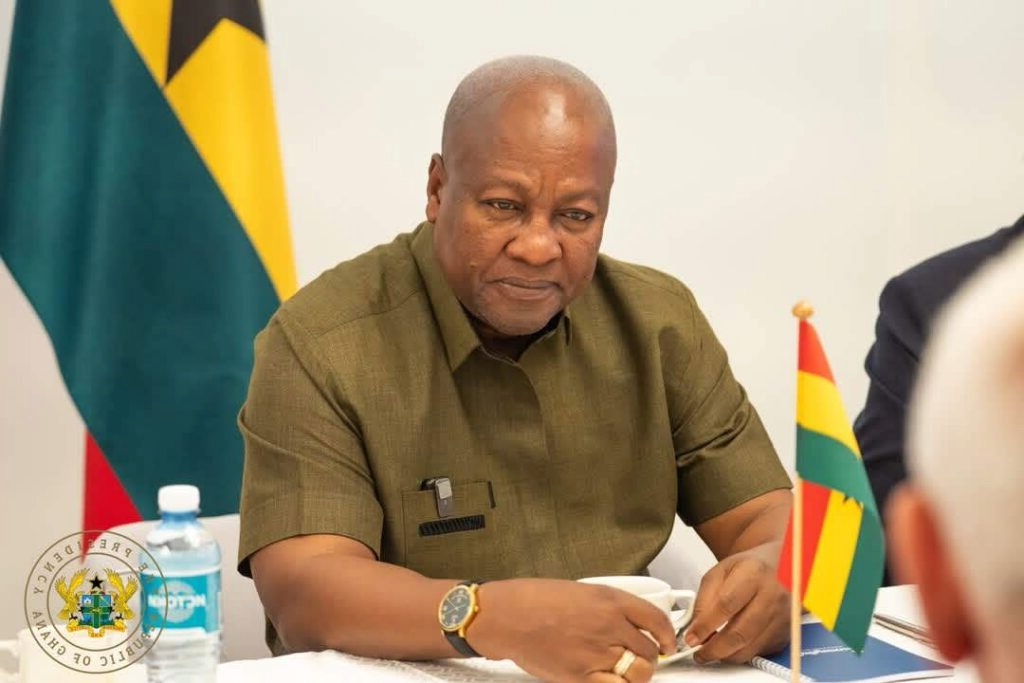

- President Mahama Seals Belarus Machinery Deal as Ghana Targets Food Production Boost
President John Dramani Mahama has secured a major agricultural machinery agreement with Belarus for the supply of 1,840 farm equipment units, as Ghana steps up efforts to modernise food production and reduce dependence on manual farming methods.
The agreement was reached during President Mahama’s official visit to Belarus, where discussions focused on expanding bilateral cooperation in agriculture, industrialisation and technology transfer.
Under the arrangement, Ghana is expected to receive a range of tractors, harvesters, irrigation systems and other mechanised farming equipment to support crop production across the country.
Government officials say the equipment will be deployed to farming communities and state-backed agricultural programmes as part of efforts to improve productivity, expand mechanised farming and reduce the rising cost of food production.
The deal comes at a time when Ghana is placing renewed emphasis on agriculture as a key pillar of economic recovery, food security, job creation and rural transformation.
Agriculture remains one of the most important sectors of the Ghanaian economy, employing a significant share of the workforce. However, the sector continues to face long-standing challenges, including low mechanisation levels, limited irrigation, high post-harvest losses, weak access to modern inputs and low productivity among smallholder farmers.
The Belarus machinery deal is therefore being positioned as part of a broader strategy to shift Ghana’s agriculture from largely labour-intensive production toward a more modern, efficient and commercially viable system.
The equipment is expected to support key staple crop value chains including rice, maize and vegetables, where improved mechanisation could help raise output, reduce production costs and improve food availability.
For rice and maize farmers in particular, access to tractors, harvesters and irrigation systems could help reduce delays during land preparation and harvesting, two of the biggest constraints facing many farming communities.
The inclusion of irrigation equipment is also significant.
Ghana’s agriculture remains heavily dependent on rainfall, exposing farmers to climate shocks, erratic weather patterns and seasonal production gaps. Expanding irrigation capacity would support year-round farming and reduce vulnerability to drought and changing rainfall patterns.
Analysts say the agreement signals a renewed push by the Mahama administration to use strategic international partnerships to revive agricultural expansion and strengthen domestic food production.
Across Africa, governments are increasingly prioritising food self-sufficiency as global supply-chain disruptions, climate pressures and rising import costs expose the risks of overdependence on imported food.
For Ghana, those concerns are particularly urgent.
Food prices have remained a major driver of household cost pressures in recent years, while import dependence in rice, poultry, vegetable oil and other staples continues to place pressure on foreign exchange demand.
A successful mechanisation programme could therefore support both food security and macroeconomic stability by helping Ghana produce more of what it consumes.
The Belarus engagement also highlights Ghana’s attempt to diversify its economic and technical partnerships beyond traditional Western sources.
By deepening cooperation with Eastern European partners, government is seeking access to machinery, industrial expertise and technology transfer that can support priority sectors such as agriculture, manufacturing and agro-processing.
The real test, however, will be implementation.
Ghana has received and distributed agricultural machinery under previous programmes, but several initiatives have been weakened by poor maintenance systems, weak management of equipment pools, limited spare parts, politicised distribution and inadequate farmer access.
For the Belarus deal to produce lasting impact, government will need a clear deployment strategy, transparent allocation system, maintenance framework, operator training programme and financing model that allows farmers to access the equipment at affordable rates.
Without those systems, the equipment could become another symbolic intervention rather than a productivity-changing investment.
The deal must also be linked to broader agricultural reforms.
Mechanisation alone will not transform farming unless it is supported by improved seeds, fertiliser access, irrigation infrastructure, storage, processing, reliable markets, rural roads and affordable credit.
If properly integrated into Ghana’s wider agricultural transformation agenda, however, the Belarus machinery package could support a major productivity push.
It could help farmers cultivate larger areas, reduce labour bottlenecks, improve harvesting efficiency, cut post-harvest losses and make commercial farming more attractive to young people.
For rural communities, the potential benefits go beyond crop yields.
Mechanisation can support agro-service businesses, create jobs for machine operators and technicians, stimulate local maintenance workshops and strengthen value chains around farming, transport and processing.
For government, the message is clear: Ghana’s food security agenda will not succeed on policy statements alone. It must be backed by machinery, infrastructure, financing and market access.
The Belarus agreement gives Ghana another opportunity to close the mechanisation gap that has held back agricultural productivity for decades.
The challenge now is to ensure that the 1,840 pieces of equipment do not merely arrive in Ghana, but reach the farmers, cooperatives and production zones where they can make the biggest difference.
If managed well, the deal could become an important step in modernising Ghana’s agriculture.
If poorly managed, it risks becoming another reminder that equipment imports without strong systems rarely transform farming.

