


- Professional Facility Management Could Cut Ghana’s Asset Costs and Protect Investment — IFMA
Ghana risks increasing the lifetime cost of its buildings and public infrastructure unless it strengthens professional facility-management standards and shifts from reactive repairs towards preventive, technology-driven asset management, according to the International Facility Management Association.
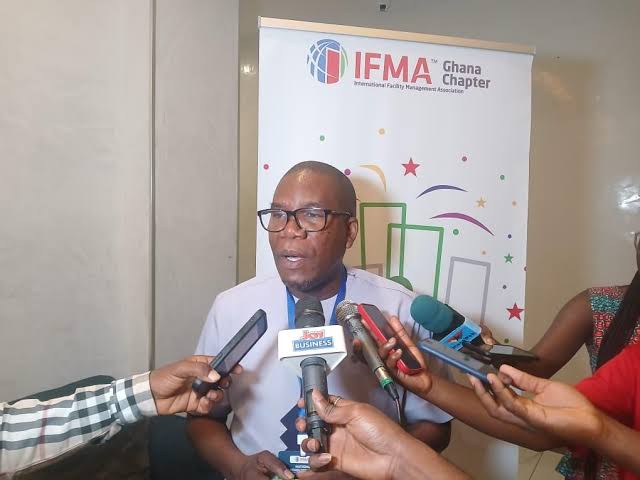
Michael Geary, Chief Executive Officer of IFMA, has urged facility managers in Ghana to align their operations with internationally recognised standards as the country’s stock of offices, shopping centres, hotels, hospitals, educational institutions, factories and public facilities continues to expand.
The intervention places attention on an often neglected part of infrastructure economics: what happens after an asset is commissioned.
For an economy where long-term capital remains relatively expensive, the failure to maintain buildings and equipment efficiently can impose significant costs on both businesses and government. Assets that deteriorate earlier than expected require more frequent repairs, rehabilitation or replacement, effectively reducing the return on the original investment.
Poor maintenance can therefore become a form of capital destruction. Facility management has traditionally been viewed narrowly as a support function involving cleaning, security and routine repairs. But modern buildings are increasingly complex systems in which energy consumption, equipment reliability, water use, workplace safety and environmental performance directly influence operating costs.
That makes professional facility management increasingly relevant to productivity.
Preventive maintenance can identify faults before they become expensive failures, while structured asset-management programmes can extend the lifespan of mechanical and electrical systems. Energy-management tools can also reduce consumption at a time when electricity costs remain an important operating expense for Ghanaian businesses.
For companies, those savings can translate into improved margins and fewer disruptions to operations.
Ghana has invested substantial public resources over decades in hospitals, schools, administrative buildings and other infrastructure. But the economic value of those assets depends not only on the cost of construction but on how long they remain fully functional.
Where maintenance is deferred, the state may eventually be forced to rehabilitate or replace facilities years earlier than originally expected.
In a period of tight public finances, extending the useful life of existing assets could prove one of the more cost-effective ways of protecting capital expenditure. Every additional year that a properly maintained hospital, school or public building remains operational reduces pressure for replacement spending and allows scarce resources to be deployed elsewhere.
International facility-management standards could also become important to Ghana’s attractiveness to multinational businesses and institutional real-estate investors.
Large companies increasingly require properties to meet defined standards for occupational safety, business continuity, environmental performance, energy efficiency and workplace quality.
Buildings unable to demonstrate those standards may struggle to attract premium tenants or investors seeking predictable operating performance.
Facility management therefore becomes part of the investment proposition surrounding commercial property rather than simply a cost incurred after construction.
The rise of environmental, social and governance considerations is strengthening that trend.
Companies face growing pressure to demonstrate how they manage energy, emissions, water and waste. Facility managers sit at the operational centre of those requirements because the performance of buildings can materially affect a company’s environmental footprint.
A well-managed property can lower utility costs and improve sustainability performance. An inefficient one can increase operating expenditure and make corporate environmental targets harder to achieve.
Digital building-management systems can monitor energy use, water consumption, occupancy, temperature and equipment performance in real time. Sensors can identify abnormal behaviour before machinery fails, allowing organisations to move from reactive repairs towards predictive maintenance.
Artificial intelligence could deepen that transition by analysing building data and identifying patterns associated with equipment failure, excessive energy consumption or inefficient space utilisation.
The economic implications extend beyond maintenance departments.
Reduced equipment downtime can improve business continuity, while better energy efficiency can reduce operating costs. More sophisticated space management can lower property expenses, and predictive maintenance can reduce unexpected capital expenditure.
Modern facility management increasingly combines engineering, procurement, finance, sustainability, information technology, occupational health and safety, and property management. That creates a need for multidisciplinary skills and continuous professional development.
The push towards international standards therefore also creates an opportunity for Ghana’s universities, technical institutions and professional bodies.
Specialised facility-management training and certification could create new employment opportunities while developing the expertise required to operate increasingly sophisticated commercial and public infrastructure.
For property developers, the shift requires a change in how projects are conceived.
The economics of a building should increasingly be assessed over its entire lifecycle rather than principally through construction cost and initial rental or sale value. A property with lower operating costs, reliable systems and recognised management standards is likely to remain commercially competitive for longer.
That can influence occupancy rates, valuations and investment returns. The larger policy question is whether Ghana’s development model pays enough attention to preserving assets once they have been built.
Infrastructure debates frequently focus on financing and commissioning new projects. Far less attention is given to the condition of those assets five, 10 or 20 years later.
Yet an economy that repeatedly rehabilitates poorly maintained infrastructure is effectively paying more than once for the same development.
Adopting stronger international facility-management standards would not eliminate Ghana’s infrastructure financing constraints. But it could improve the return on capital already deployed.
For businesses, that means lower operating costs and greater reliability. For property owners, it means stronger protection of asset values. For government, it could reduce the fiscal burden created by premature deterioration.
In a capital-constrained economy, the economic case is increasingly straightforward: maintaining what Ghana already owns may be just as important as financing what it builds next.

