

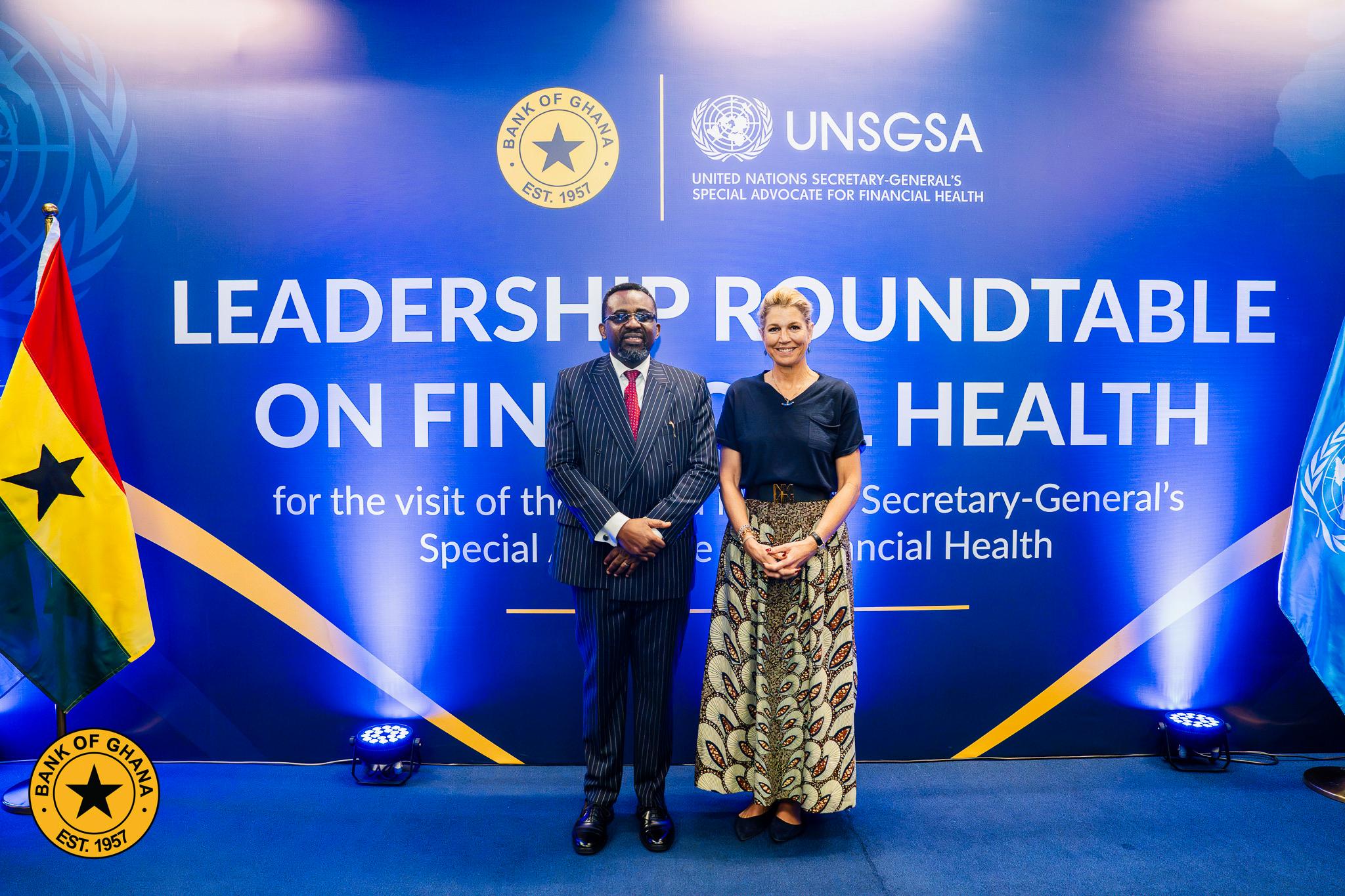

- Queen Máxima Urges BoG to Measure Whether Financial Services Improve Wellbeing
Queen Máxima of the Netherlands has urged the Bank of Ghana to assess whether the financial products offered by banks are improving customers’ financial health, challenging the sector to look beyond account ownership and digital access.
The Queen, who is the United Nations Secretary-General’s Special Advocate for Financial Health, made the call at a leadership roundtable hosted by the Bank of Ghana in Accra on Wednesday.
She commended Ghana’s progress in expanding financial access but said the next step was to measure the effect that banking products have on customers.
Her intervention shifts the focus from how many people can reach a financial service to whether that service helps them manage daily expenses, withstand unexpected costs and plan for the future.
The distinction is central to Ghana’s financial inclusion debate: an account or mobile money wallet may open a door, but it does not show whether its owner can save, access suitable credit or recover from a financial shock.
Ghana has made significant gains in access. The World Bank’s Global Findex Database 2025, based on surveys conducted in 2024, indicates that 81% of adults in Ghana held a financial account.
But the latest cited national measure of financial health comes from the 2021 Ghana Demand Side Survey, which found that 22% of adults were financially healthy, 44% were coping and 34% were financially vulnerable. The figures come from different surveys and years, so they are not a like-for-like comparison; together, however, they show why account ownership alone cannot answer whether households are secure.
The UN defines financial health in practical terms: the ability to manage day-to-day finances, withstand unexpected shocks, invest in future goals and build financial confidence. That measure includes access, but also asks whether people can use financial services to improve their financial position.
Bank of Ghana Governor Dr Johnson Pandit Asiama told the gathering that Ghana’s financial sector had been transformed over the past decade through innovation, collaboration and investment in digital infrastructure.
“Financial services have become more accessible to millions of Ghanaians,” he said, pointing to interoperable payment systems, mobile money, fintech innovation and regulation that has supported growth and trust.
Yet the Governor also acknowledged that access must translate into better outcomes for households and businesses.
He identified savings, insurance, pensions, investment opportunities and financial literacy as factors shaping financial health, while emphasising productive and responsible credit.
“Credit, when appropriately designed and delivered, enables households to invest in their futures and gives businesses the capital required to grow, innovate and create jobs,” Asiama said.
That emphasis matters for micro, small and medium-sized enterprises, which the Governor described as a backbone of Ghanaian economic activity but said continue to face barriers to finance.
Technology and better data, he argued, could help lenders assess viable businesses, reduce information gaps and make credit available on fair and sustainable terms.
The challenge for regulators and providers is to distinguish useful borrowing from credit that leaves customers under greater strain. A loan may increase access to finance, but its effect depends on whether the borrower can repay it, whether the terms are appropriate and whether the credit supports productive activity.
Measuring those outcomes would help the sector identify where products are working and where they are creating risks.
The 2021 survey suggests that resilience is a particular concern. While 22% of adults were classified as financially healthy, 34% were financially vulnerable.
The survey found that 48% had a low score for building and maintaining reserves, while 61.7% had a low score for managing risks. Those findings are now five years old, making updated and comparable data important if regulators and financial institutions are to track whether newer digital products are changing household outcomes.
Queen Máxima’s call for the Bank of Ghana to assess customers’ financial health points to a practical accountability question: should financial providers be judged only by the number of accounts opened, transactions made or loans issued, or also by whether customers are better able to save, manage obligations and handle shocks? The answer will shape what the sector measures and what products it chooses to develop.
A more complete assessment would need to look across several services. Savings and investment products can help households build reserves, while insurance can soften the financial impact of illness, job loss or other emergencies.
Pensions can support long-term security. Credit can fund business growth or investment, but can also deepen vulnerability when it is poorly matched to a customer’s circumstances.
The roundtable brought together senior leaders from the financial sector, regulators, government and development institutions to discuss these issues.
Dr Asiama called for practical solutions to expand productive credit for MSMEs, women and smallholder farmers, strengthen savings and insurance, and improve long-term financial resilience.
For Ghana’s financial sector, the next stage of inclusion will require more than extending digital infrastructure. It will require evidence that the services available to customers are affordable, useful and suited to their needs.
Without that evidence, rapid growth in account ownership can obscure whether people are building savings, managing debt sustainably or protecting themselves against shocks.
The Governor said the roundtable would have achieved its purpose if participants left with “a clear set of priorities”.
Queen Máxima’s call to assess customer outcomes gives that agenda a concrete starting point: establish how financial health is measured, update the national evidence and use it to test whether financial products are improving people’s lives.
The result could give regulators and providers a clearer basis for deciding which innovations to scale and where the gaps remain.

