

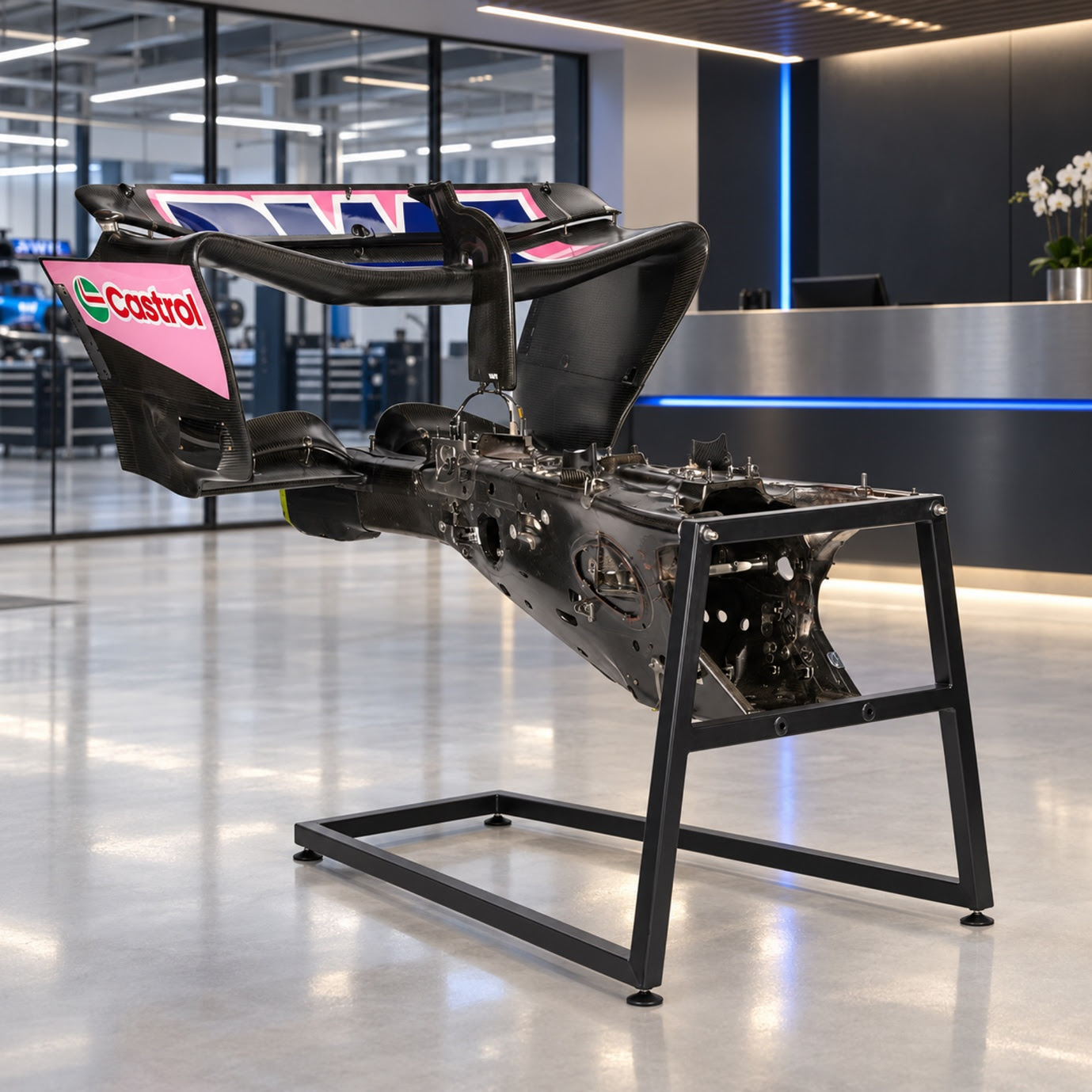

- Race-Used Alpine Rear Wing Headlines Latest F1 Authentics Auction
Formula One’s memorabilia market is moving beyond signed helmets and race suits into technical collectables: complete engineering assemblies preserving the identity of cars once used in competition today.
F1 Authentics is preparing to auction a race-used gearbox carrier from BWT Alpine Formula One Team’s 2024 campaign, paired with a race-spec rear wing whose drag reduction system flap remains operational. The assembly, mounted on a purpose-built display stand, will headline the platform’s latest online auction opening at the end of this week.
The attraction lies not only in the scale or appearance of the piece. The gearbox carrier retains its original FIA seal, giving prospective buyers a tangible connection to the component’s racing history and strengthening the provenance on which high-value memorabilia depends.
Operated by UK-based Memento Exclusives, F1 Authentics is Formula One’s official memorabilia platform. Its business model combines licensing relationships within the championship with specialist manufacturing expertise that turns retired components into display pieces for collectors, offices and corporate spaces.
The Alpine assembly illustrates how that model is evolving. Rather than presenting a single carbon-fibre panel as a static object, Memento Exclusives has combined two distinct parts of a modern racing car. The gearbox carrier reveals aspects of the car’s mechanical architecture, while the rear wing demonstrates the aerodynamic technology used to control airflow and straight-line speed.
The operational DRS flap is particularly significant. In competition, the system changes the wing’s configuration to reduce aerodynamic drag and assist overtaking under prescribed conditions. On the display piece, it gives collectors an interactive feature while preserving one of the most recognisable technologies associated with contemporary Formula One.
This combination of authenticity, engineering and functionality points to a broader transformation in sports memorabilia. Collectors are increasingly being offered objects that are valuable not merely because they were associated with a team or driver, but because they embody the technology, materials and manufacturing processes of the sport itself.
Formula One components have a natural scarcity. Teams produce specialised parts for specific cars, circuits and periods of competition. Once the relevant design is replaced, the hardware cannot simply be reproduced with the same history. Official documentation and identifiable features, such as the FIA seal retained on the Alpine gearbox carrier, become essential to demonstrating that scarcity is genuine.
Provenance is therefore the foundation of value. The premium memorabilia market is vulnerable to replicas, uncertain ownership histories and exaggerated claims about how items were used. F1 Authentics’ position as an officially licensed platform gives it an important advantage by connecting the object’s commercial presentation directly to relationships within Formula One.
The choice of Alpine’s 2024 campaign adds sporting context. The team finished sixth in the Constructors’ Championship after a strong conclusion to the season. Its defining result came at the rain-affected São Paulo Grand Prix, where Esteban Ocon and Pierre Gasly secured an historic double podium.
The auction release does not claim that the gearbox carrier or wing was used during that particular race. Its relevance instead comes from belonging to the wider season in which Alpine recovered sufficiently to produce one of its most memorable modern results. Maintaining that distinction is important because responsible memorabilia marketing must separate confirmed provenance from the broader story surrounding an item.
Such transformation creates a delicate design challenge. Excessive modification can weaken the historical integrity that makes a component desirable, while insufficient adaptation may leave it difficult to display outside a workshop or garage. The custom stand and retained seal suggest the Alpine assembly has been designed to balance presentation with preservation.
For buyers, however, the investment case remains less straightforward. Memorabilia values depend on provenance, rarity, condition, cultural relevance and the depth of future demand. A technologically impressive component does not automatically appreciate, particularly if it lacks a direct association with a championship-winning car, celebrated driver or defining race.
The Alpine assembly may therefore derive much of its value from uniqueness and presentation rather than from a guaranteed financial return. Its likely audience includes collectors seeking a centrepiece unavailable through conventional retail channels and companies wanting an object that communicates engineering, performance or innovation.
Memento Exclusives’ longer-term Formula One relationship provides continuity to that market. The partnership began in 2019 and now runs through 2030, while the company also maintains licensed agreements with teams across the grid, including Alpine. The pieces are built at its headquarters in the United Kingdom’s Motorsport Valley near Northampton.
The platform’s previous auctions indicate how storytelling and exclusivity can translate into substantial bidding. A Disney and Formula One “Fuel the Magic” helmet signed by 20 drivers sold for £151,000 in support of Make-A-Wish International.
That sale is not directly comparable with the Alpine assembly. The helmet combined signatures from the entire grid, two globally recognised brands and a charitable purpose capable of attracting bidders motivated by both collecting and philanthropy. Nevertheless, it demonstrated the platform’s ability to handle prominent lots and secure confidence around authenticity.
It also reflects the increasing commercial sophistication of Formula One’s fan economy. Supporters are no longer offered only apparel, miniature models and conventional souvenirs. At the premium end, they can acquire fragments of the machinery that shaped the spectacle, professionally presented and supported by official licensing.
For the sport, this creates another bridge between closed technical environments and the public. Formula One cars are normally experienced at speed, from grandstands or through screens. A gearbox carrier and adjustable rear wing allow collectors to examine materials and structures that television coverage rarely reveals.
The auction’s success will ultimately depend on whether bidders see the assembly as decoration, historical artefact or investable collectable. Its strongest proposition may be that it can occupy all three categories without fitting neatly into any one.
What was once equipment built for competitive performance is being recast as cultural and commercial property. By preserving the FIA seal, working DRS mechanism and Alpine identity, F1 Authentics is selling more than retired hardware. It is selling controlled access to Formula One’s engineering story and testing how much collectors will pay to bring that story home.

