



- Real estate professionals must act as gatekeepers against dirty money — REAC
Ghana’s expanding real estate sector remains vulnerable to money laundering and illicit financial flows despite its growing contribution to investment, employment and wealth creation, the Real Estate Agency Council has warned.
Acting Chief Executive Officer of the Council, Emmanuel Jeffery, said the same features that make Ghana’s property market attractive to legitimate investors also expose it to abuse by persons seeking to conceal or legitimise proceeds from unlawful activities.
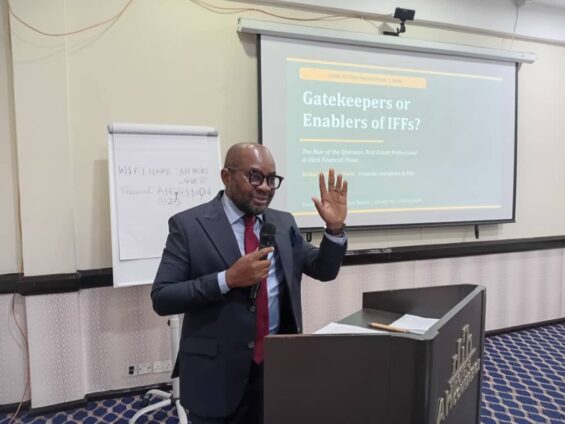
Speaking in Accra at a policy dialogue on illicit financial flows in the real estate sector, Mr Jeffery said property transactions are increasingly being used globally as channels through which illicit funds are introduced into formal economies.
The dialogue, held under the theme, “Gatekeepers or Enablers of Illicit Financial Flows? The Role of the Ghanaian Real Estate Professional,” was organised by Global Financial Integrity in partnership with REAC.
It brought together the Financial Intelligence Centre, professional bodies, training institutions, brokers, estate agents, developers and other actors within Ghana’s property industry.
“The real estate sector occupies a strategic position within Ghana’s economy. Beyond providing housing and facilitating investment, it contributes significantly to economic growth, employment creation and wealth generation,” Mr Jeffery said.
“However, the sector’s attractiveness to legitimate investors also makes it vulnerable to abuse by persons seeking to conceal or legitimise proceeds derived from unlawful activities.”
He said the warning should be taken seriously because real estate transactions can provide a convenient route for laundering funds, especially where cash payments, opaque ownership structures, weak due diligence and informal brokerage practices persist.

The property sector has become one of the most visible signs of wealth creation in Ghana, particularly in Accra and other major urban centres. But the rapid expansion of high-value residential and commercial developments has also raised questions about beneficial ownership, source of funds, regulatory compliance and the role of professionals in identifying suspicious transactions.
Mr Jeffery said real estate professionals must now see themselves as a critical line of defence against financial crime.
“Real estate professionals are increasingly expected to serve as the first line of defence against money laundering and other financial crimes,” he stated.
Ghana has strengthened its anti-money laundering framework in recent years through the Anti-Money Laundering Act, 2020, Act 1044, and the Real Estate Agency Act, 2020, Act 1047.
The Real Estate Agency Council was established under Act 1047 to promote professionalism, transparency and accountability in the sector.
According to Mr Jeffery, the Council has intensified work on licensing, inspections, stakeholder engagement, compliance monitoring and public education to ensure that practitioners understand and discharge their legal responsibilities.
“Through licensing, inspections, stakeholder engagement and compliance monitoring, the Council is working to ensure that real estate practitioners understand and discharge their responsibilities under the law,” he said.
The warning comes as Ghana undergoes its third-round mutual evaluation under the Inter-Governmental Action Group against Money Laundering in West Africa and the standards of the Financial Action Task Force.
Mr Jeffery said the current assessment goes beyond the existence of laws and institutions and focuses more heavily on whether compliance systems are working effectively in practice.
“This means that regulators, financial institutions and designated non-financial businesses and professions, including real estate professionals, must demonstrate that compliance measures are being implemented effectively,” he said.
The real estate sector falls within designated non-financial businesses and professions, meaning practitioners have obligations linked to customer due diligence, record keeping, suspicious transaction reporting and compliance controls.
Mr Jeffery said REAC has introduced several measures to strengthen Ghana’s preparedness, including the licensing of brokers, agents and firms, the creation of a national database of practitioners, compliance inspections and anti-money laundering awareness programmes.
These interventions, he noted, are aimed at protecting the integrity of the sector and reinforcing public confidence in Ghana’s property market.
The concern is particularly important because property markets can absorb large amounts of capital and often involve complex transactions, intermediaries and ownership structures. Without strong oversight, real estate can become attractive to politically exposed persons, organised criminal networks, tax evaders and other actors seeking to disguise the origin of funds.
For Ghana, the risk is not only reputational. Weak controls in real estate could expose the financial system to illicit flows, undermine tax collection, distort property prices and make housing less affordable for ordinary citizens.
If illicit money enters the property market unchecked, it can inflate prices, encourage speculative development and create unfair competition for legitimate investors and homebuyers.
The issue also intersects with land administration, construction permits, professional regulation and financial reporting. Effective anti-money laundering supervision in real estate therefore requires coordination among REAC, the Financial Intelligence Centre, banks, lawyers, accountants, developers, brokers, land sector agencies and law enforcement institutions.
Mr Jeffery said the policy dialogue was timely and challenged industry players to reflect honestly on their role in protecting the sector from abuse.
“The question before us is simple yet profound: Are we gatekeepers protecting the integrity of the real estate sector, or are we unknowingly creating opportunities for illicit financial activities?” he asked.
“The answer will depend on our commitment to due diligence, transparency, ethical conduct and compliance with the laws that govern our profession.”
His remarks point to a broader shift in regulatory expectations. Real estate professionals are no longer expected only to connect buyers and sellers or facilitate property transactions. They are increasingly expected to understand the source of funds, identify red flags, verify clients, keep proper records and report suspicious activity.
This will require a change in industry culture, particularly in a market where informal transactions, undocumented agency activity and cash-based payments have long been common.
The Council’s licensing and national database initiatives could help formalise the sector by making it easier to identify legitimate practitioners and sanction those who operate outside the law.
However, compliance will also require training, enforcement and collaboration with financial institutions, especially where property purchases are linked to bank transfers, mortgage finance or corporate structures.
Mr Jeffery expressed confidence that the dialogue would deepen collaboration among regulators, practitioners, policymakers and development partners as Ghana intensifies efforts to combat illicit financial flows.
He also commended Global Financial Integrity and the Financial Intelligence Centre for supporting Ghana’s anti-money laundering, counter-terrorist financing and counter-proliferation financing agenda.
The warning from REAC is clear: Ghana’s property market can continue to support economic growth, investment and job creation, but only if transparency and accountability keep pace with expansion.
As the sector grows, the responsibility on real estate professionals will also grow. The market must decide whether it wants to be a trusted pillar of Ghana’s economy or a weak point in the country’s fight against illicit finance.
For REAC, the answer lies in stronger due diligence, effective regulation, ethical conduct and a firm commitment by practitioners to act not as passive intermediaries, but as gatekeepers protecting the integrity of Ghana’s real estate sector.

