


- Rising Global Imbalances Underscore Need to Confront Domestic Distortions
Global current account balances increased further in 2025, driven primarily by China, where the current account surplus recorded the largest widening in at least two and a half decades. This was offset by some narrowing in the United States and the euro area.
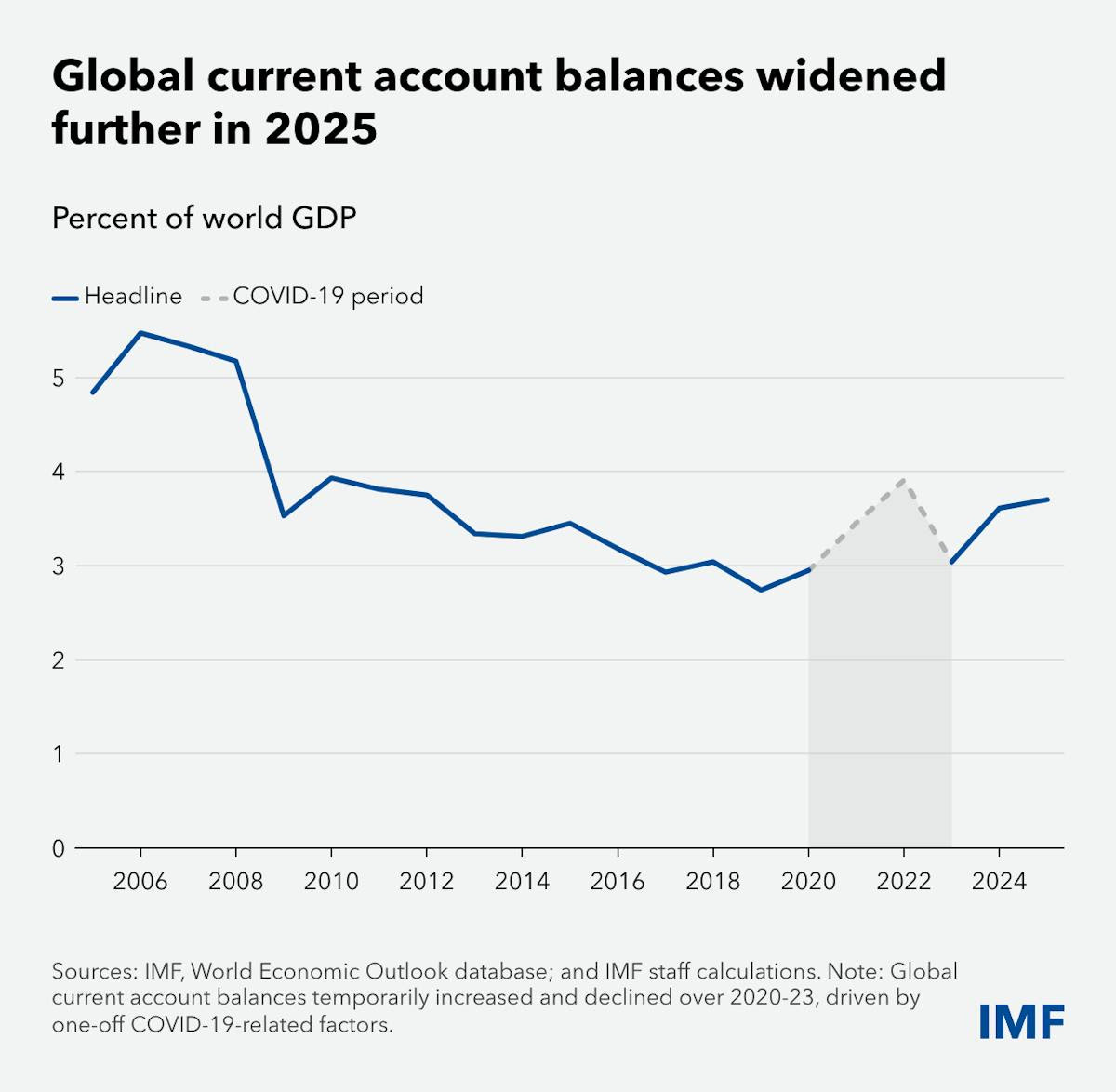
Global current account balances widened further in 2025
As our latest External Sector Report shows, China’s current account surplus increased by about $300 billion last year, the largest widening in absolute terms since at least 2000, to about 0.6 percent of world GDP. While the US current account deficit narrowed by $69 billion, its balance remained by far the world’s largest, at about 0.9 percent of global GDP, exceeding the combined surpluses of China and the euro area.
The rise in global current account balances comes amid elevated trade tensions and a significant shift in US trade policy. Historically, trade barriers in effect in the past have had no clear impact on aggregate current accounts. The assessment of the impact of recent measures is complicated by other factors, including the AI boom. But it is clear that trade barriers have led to a marked reconfiguration of trade patterns, with a sharp fall in US imports from China accompanied by a rise in US imports from the rest of the world.
Excess imbalances
Not all current account surpluses or deficits are a cause for concern. Indeed, countries borrow and lend—the flip side of imports and exports of goods and services—across borders for many good reasons. Concern arises, however, when current account balances become excessively large and persistent.
Alongside the rise in headline current account balances, our report also finds that what we consider to be “excess” balances have also widened. The largest contributions to excess balances also came from China and the US, according to our four-step process for assessing when countries’ external balances become excessive.
Weakening investment—first in real estate and more recently in manufacturing and infrastructure—has been a major driver of the widening of China’s surplus since 2023. However, structurally high private saving, driven by precautionary saving motives due to weak social safety nets, remains a contributor to its surplus.
In the US, large current account deficits reflect sustained low saving, with the fiscal balance deep in deficit.
Mounting vulnerabilities
While persistent excess imbalances may not create immediate problems, they can signal inefficient resource allocation, contribute to financial vulnerabilities, and increase the risk of disorderly adjustment in the future, especially in economies with large net external liabilities. Additionally, large and persistent excess current account balances can signal uneven growth patterns, generate adverse cross-border spillovers, and increase trade tensions and economic fragmentation.
History shows that large imbalances can unwind abruptly through capital flow reversals, asset price corrections, and weaker growth, imposing significant costs both domestically and globally.
The best solution to today’s elevated imbalances and their associated risks is simultaneous action across the world’s major economies. Mutually reinforcing policies by the US, China and the euro area could reduce global imbalances and boost economic growth. Stronger domestic demand and investment in surplus economies would offset the drag on growth from fiscal consolidation and higher saving in deficit economies.
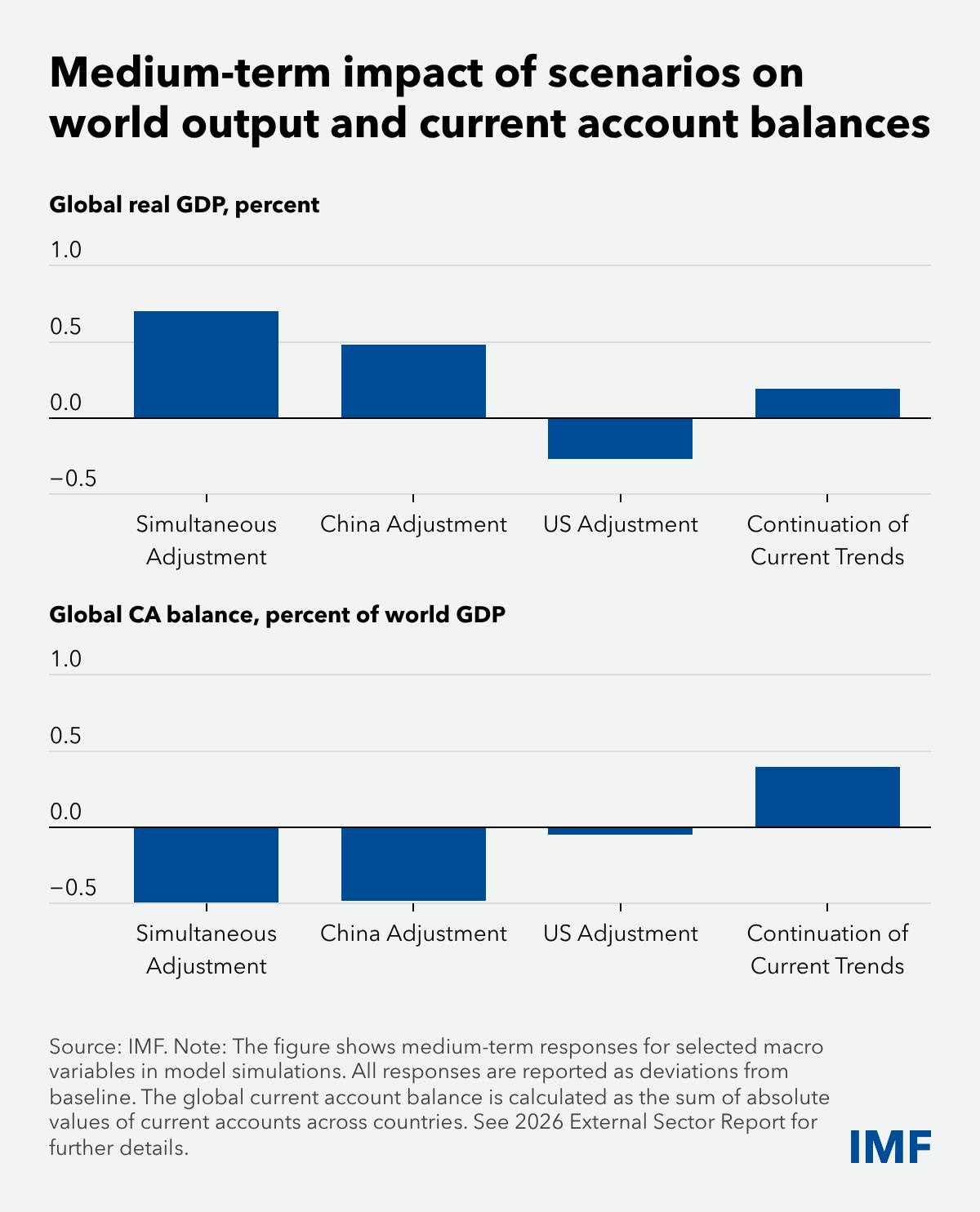
Medium-term impact of scenarios on world output and current account balances
But even if coordination proves difficult, it is in a country’s own interest to take action to reduce its domestic imbalances, even when done unilaterally. In the absence of simultaneous actions, rebalancing efforts by one country can still meaningfully reduce excess global balances, and its policy action would worsen domestic imbalances elsewhere, heightening the case for other countries to take appropriate actions. At the same time, unilateral adjustments could pose risks for the financial markets with negative impacts on growth and inflation.
If current trends continue, and the world’s major economies don’t change course, global imbalances could widen further. Even if growth holds up in the near term, vulnerabilities could continue to build beneath the surface, increasing the risk of a far more disruptive adjustment in the future.

