

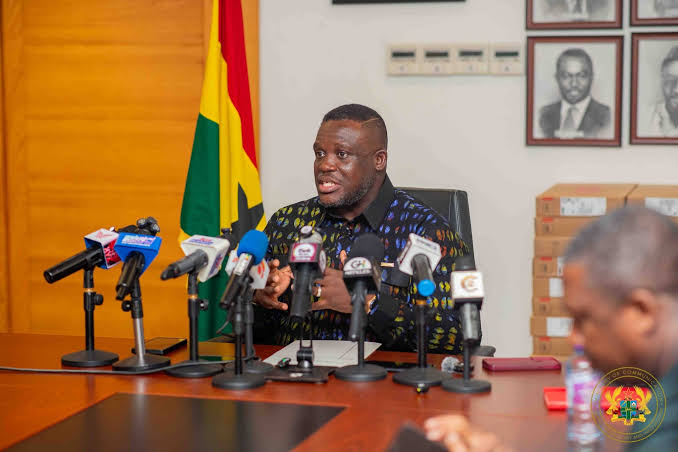

- Rural Connectivity Must Not be Left Behind in Ghana’s 5G drive — Sam George
Ghana’s drive to accelerate fifth-generation mobile technology could deepen the economic divide between urban and rural communities unless advanced telecommunications investment reaches areas still dependent on weak legacy networks, Communications Minister Samuel Nartey George has warned.
The government is seeking to upgrade rural telecommunications sites from third-generation connectivity to a minimum of 4G, creating infrastructure that can support 5G services.
The policy recognises that national digital progress cannot be measured only by faster networks in Accra, Kumasi and other major commercial centres. It must also be judged by whether farmers, students, health facilities and small businesses in underserved communities can use reliable and affordable broadband.
Speaking during an inspection of Rural Telephony Project sites in the Sekyere Afram Plains District of the Ashanti Region on October 13, Mr George directed the Ghana Investment Fund for Electronic Communications to accelerate network expansion to three additional communities.
The inspection covered Nyameama No. 1, Nyameama No. 2, Dawia and Abenua, where the Minister assessed infrastructure development, operational readiness and the implementation difficulties affecting rural coverage.
The government also plans to audit inherited rural telephony facilities to determine their completion status and establish whether previously commissioned infrastructure is providing dependable services.
“The world has moved to 5G, getting to 6G, so at the very least we must give 4G to our networks,” Mr George said during an earlier inspection.
“We must invest in telecom and decide that we are going to convert all our Rural Telephony sites to do a minimum of 4G, ready for 5G as well.”
The intervention addresses an uncomfortable contradiction within Ghana’s digital ambitions. The country may launch advanced services and advertise higher network speeds nationally while large sections of its population remain unable to access stable broadband.
That would produce a two-speed digital economy. Urban consumers and businesses would gain access to faster applications, cloud services and data-intensive technologies, while rural communities could remain constrained by slow connections, dropped calls and limited network capacity.
Connectivity has moved beyond convenience. It increasingly determines who can access financial services, education, healthcare, government platforms, commercial markets and employment opportunities.
For rural businesses, stronger broadband could reduce transaction costs and connect traders directly to customers. Small enterprises could advertise online, receive digital payments and manage supplies without travelling long distances to urban centres.
Agricultural communities could obtain commodity prices, weather forecasts, extension advice and market information in real time. Better information could strengthen farmers’ bargaining power, improve production decisions and reduce losses caused by delayed access to weather or transport information.
Schools could use online educational materials, while rural health facilities could support telemedicine, transmit patient information and consult specialists located elsewhere. These gains, however, require networks that remain available and deliver usable speeds rather than coverage that exists only on official maps.
The proposed audit is therefore important. Ghana’s infrastructure debate has often focused on how many projects were commissioned, rather than whether those projects remain operational and deliver the service promised.
An effective audit should examine network uptime, data speeds, equipment condition, electricity supply, maintenance responsibilities and actual usage. It should identify incomplete sites, inactive installations and communities where nominal coverage fails to provide meaningful connectivity.
The economics of rural telecommunications remain difficult. Building towers, supplying power, installing transmission equipment and maintaining sites require substantial capital. Yet operators may earn lower returns because populations are dispersed, household incomes are limited and demand for expensive data packages is weaker.
This creates a market failure. Private operators have limited incentives to invest at the required scale where commercial returns are uncertain, even though the wider social and economic benefits of connectivity may be significant.
GIFEC’s role is to close that gap by directing public resources towards underserved communities and working with operators to make investment viable. The challenge is ensuring that public support produces sustainable networks rather than installations that deteriorate after commissioning.
Government is also collaborating with MTN Ghana to deploy 800 additional telecommunications sites nationwide. The programme forms part of MTN’s commitment to invest more than US$1.1 billion over three years in network capacity, service quality and 5G deployment.
The scale of that investment could improve coverage, but the location and technical capability of the new sites will determine whether it reduces inequality. Concentrating the strongest infrastructure in already profitable markets would improve average national performance while leaving the underlying rural gap unchanged.
Infrastructure alone will not guarantee inclusion. A household may live within reach of a 4G signal but remain disconnected because smartphones, data packages or electricity are unaffordable.
Government and operators must therefore treat affordability as part of network policy. Lower-cost devices, transparent data pricing, community access facilities and targeted digital-literacy programmes may be required to convert coverage into regular use.
Network resilience is another concern. Government figures indicate that Ghana recorded 8,578 fibre-optic cable cuts by August 2026. Repairing damaged infrastructure increases operators’ costs, interrupts services and diverts capital that could have financed expansion.
Addressing the problem will require stronger coordination among telecommunications companies, road contractors, utility providers and local authorities. Infrastructure maps, permit requirements and meaningful penalties for negligent damage could reduce repeated disruption.
Power supply and maintenance must receive equal attention. Rural sites may face electricity interruptions, difficult access and delayed equipment repairs. Upgrading technology without a dependable maintenance and energy plan could replace obsolete infrastructure with newer but equally unreliable systems.
The wider policy objective should be meaningful connectivity: sufficient speed, reliability, affordability and digital skills to allow people to participate productively online.
Ghana’s 5G programme can support innovation and competitiveness, but it should not become an urban showcase detached from the realities of underserved districts. Rural 4G upgrades are not a secondary welfare intervention; they are economic infrastructure needed to expand the country’s productive base.
The success of Ghana’s digital transformation will ultimately depend on who benefits. If advanced networks improve life only for existing urban users, technology may reinforce geographic inequality. If investment connects rural businesses, farms, schools and health facilities, it can broaden opportunity and make digitalisation an instrument of national development.

